
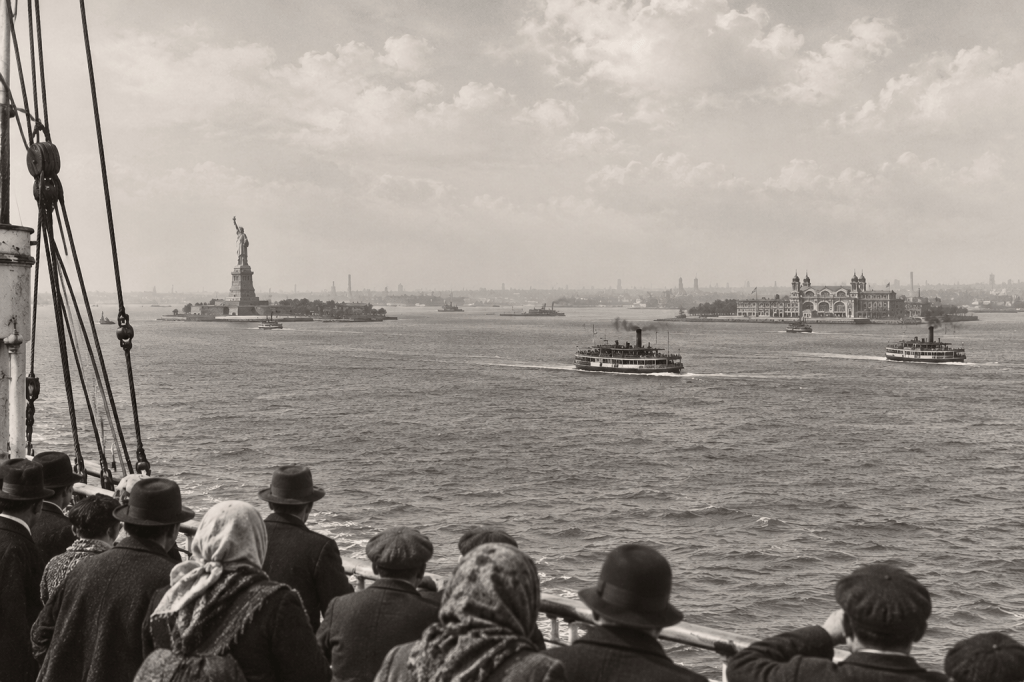
Featured Image note: This AI-generated illustration imagines a view from a passenger ship approaching New York Harbor around 1908. It is not an archival photograph.
✨
After recently wishing Route 66 a happy upcoming 100th birthday, here’s another birthday or anniversary to celebrate, “et pas des moindres“!
Two weeks ago, on October 28, we marked the 140th anniversary of the inauguration of the Statue of Liberty in New York Harbor in 1886. A gift from France to the United States, Lady Liberty has a special place in the story connecting our two countries.
And what a symbol she is…
The Statue of Liberty, or “Liberty Enlightening the World” (in French: La Liberté éclairant le monde) was built in France between 1875 and 1884, shipped to the United States in 1885, and reassembled in New York in 1886. It was offered as a symbol of friendship by the people of France to Americans.
For being 140 years old, this Lady looks quite amazing! When my current physical body reaches the ripe age of 140 years old, I’m pretty sure it won’t be in an upright position!
💡 Did You Know?
If your ancestor was a child living in the United States in 1885, he or she might have contributed $1 toward the pedestal of the Statue of Liberty!
In 1885, the construction of the Statue of Liberty’s pedestal came to a halt because the funds had run out. Newspaper publisher Joseph Pulitzer stepped in, using his newspaper, The New York World, to appeal to the American public for donations, no matter how small.
His campaign was a remarkable success! In just six months, more than $100,000 was raised, with approximately 125,000 people contributing. Many donations were just $1 or less, and children were among the contributors. Pulitzer even published the names of donors in his newspaper, giving ordinary people a chance to be part of this extraordinary project.
A few fascinating details about Lady Liberty
Before she made her home in New York Harbor, parts of the Statue of Liberty were displayed at two world’s fairs!
In 1876, her hand holding the torch was exhibited at the Centennial Exposition in Philadelphia, celebrating the 100th anniversary of American independence. Two years later, in 1878, her head and shoulders were displayed at the Exposition Universelle in Paris.
💡 Did You Know?
The Statue of Liberty has an internal iron framework designed by Gustave Eiffel, the engineer who would later become world-famous for the Eiffel Tower in Paris. So, in a way, there’s a little bit of Eiffel Tower engineering inside Lady Liberty herself!
What the Statue of Liberty represents to me
I used to see the Statue of Liberty with the history behind her story. But now, after years of researching genealogy, I see her very differently.
The first thing that comes to my mind is that she has watched countless ships carrying generations of immigrants over those 140 years. Every time I see the Statue of Liberty or even think about her, I immagine the emotions of those arriving at Ellis Island after such a long and perilous voyage, seeing this magnificent statue, a symbol of freedom.
(Note: Ellis Island opened as an immigration station on January 1, 1892, a little over five years after the Statue of Liberty was dedicated.)
I imagine that conditions aboard ships in the late 19th century had improved since the days of the Mayflower (1620), the Fortune (1621), and the Anne (1623), or even the eleven ships of the Winthrop Fleet in 1630. But crossing the Atlantic was still a long journey, especially for families who couldn’t afford a cabin.
Arriving in New York Harbor after such a long trip and seeing this beautiful Statue must have been quite a sight for sore eyes!
People left their homelands for many reasons: poverty, famine, war, political turmoil, or religious persecution. Whatever their reasons, many left so much behind—their families and friends, their homes, and the life they had always known. They crossed the ocean hoping for a better future, but facing a great deal of uncertainty.
Land Grants
For some immigrants, the hope of owning land and building a better future for their families was one of the reasons they crossed the Atlantic. In certain periods, governments in what is now the United States offered land to encourage settlement, although obtaining it often required money, hard work, and years of residence. Much of the land distributed under American settlement policies was Indigenous land. Sadly, these policies contributed to the dispossession of Native American peoples.
As ships approached New York Harbor, many immigrants would have seen the Statue of Liberty before reaching Ellis Island. The harbor has changed over the years, but the two islands remain powerful reminders of the hopes and uncertainties that accompanied so many journeys to America.
Immigrants arriving in New York I encountered during my research
I “met” Dorothy Brown during one of my genealogy rabbit holes (you know, one of those when you start your morning with researching a family in one country and end up at the end of the day in a completely different country and time frame!). Dorothy was born in 1903 in Cornwall, England. She emigrated to the U.S. with her family in 1908, arriving via Ellis Island in New York.
I absolutely loved reading her memoir, written when she was 85 years old. Among other things, she talks about her memories of arriving at Ellis Island in 1908, Halley’s Comet in 1910, having been aboard the same ship as survivors of the Titanic in 1912, her brief encounter with actor Tom Mix, the Spanish flu, and the 1918 armistice. In short: a life full of fascinating details and historical events, written with a good dose of British humor!
If you want to read more about this lady, here is my post about her (you’ll also see the link to her memoir): Dorothy Brown’s Memoir: “Mission Accomplished”
Think about how much the journey across the Atlantic had changed over the centuries!
- In 1620, when the Mayflower crossed (England to Cape Cod), the voyage took 66 days. Other ships carrying settlers to the New World in the 1620s also spent several weeks or even months at sea.
- By 1908, when Dorothy made her journey, steamships had reduced the crossing from Liverpool to New York to approximately 8 days.
- By 1977, the journey had become even more extraordinary: the Concorde could fly from Paris to New York in just 3 hours and 39 minutes.
A crossing that had once taken months could now be completed in less time than a long afternoon!
Quick Facts about the Statue of Liberty
- Location: Liberty Island, New York City, U.S.
- Originator of the idea: Édouard Lefebvre de Laboulaye
- Architect and sculptor: Auguste Bartholdi
- Engineer of the statue’s internal framework: Gustave Eiffel (yes – the very same man who built the Eiffel Tower in Paris which opened in 1889)
- Architect of the pedestal: Richard Morris Hunt
- Construction: 1875–1884 in France; reassembled in New York in 1886
- Height, from the statue’s base to the torch: 46.05 m (151 ft 1 in)
- Height from ground level to the tip of the torch: 92.99 m (305 ft 1 in)
- Official dedication: October 28, 1886 — President Grover Cleveland
- National Monument designation: October 15, 1924 — President Calvin Coolidge
- UNESCO World Heritage Site since 1984
Want to learn more?
If you’d like to discover more about the fascinating story behind the Statue of Liberty, I highly recommend Raising Lady Liberty, a 55-minute PBS documentary exploring how France and the United States came together to create this iconic monument.
Please note: The documentary is available for streaming only through November 19, 2026.
✨
🌿 Genealogy on my Geneanet tree
Here are the links to several pages on my Geneanet tree related to individuals, events or places mentioned in this post: (FYI: on Geneanet, the little “green circle” on an individual’s image indicates that the person is part of my direct lineage).
Note: Some individuals or events might appear “alone” on my tree, but be sure to check the links to other pages.
- Statue of Liberty
- Eiffel Tower
- Édouard Lefebvre de Laboulaye (1811-1883)
- Auguste Bartholdi (1834-1904)
- Gustave Eiffel (1832-1923)
- President Grover Cleveland (1837-1908)
- President Calvin Coolidge (1872-1933)
- Dorothy Brown (1903-1997)
- Native American peoples
- Centennial Exposition of 1876 (Philadelphia, PA, USA)
- World Fair of 1878 in Paris (Exposition universelle de Paris)
- UNESCO since 1984
Some of the many early ships carrying emigrants to America
- Pilgrims of America
- Mayflower (1620)
- Fortune (1621)
- Anne (1623)
- Winthrop Fleet (1630, 11 ships)

