Dear Fellow Genealogist… A Word of Caution
Not everything you find in someone else’s tree is correct. Errare humanum est!
Other people’s research can be wonderful, but mistakes travel remarkably well! No tree is perfect, especially when you start researching very far back in time. All trees contain mistakes, and so does mine. They could be simple typos we make, minor errors such as just a day apart for a birth (even though an astrologist would rightfully disagree here and say “a day apart changes everything!”), or, more importantly, when there is a doubt about the mother of a child (sources might disagree on who is the mother). This is more common when you reach nobility research.
The important thing is to remember that a genealogy tree is never a finished product. New records become available, previously overlooked documents are discovered, and sometimes information we once considered reliable turns out to be incorrect. We all make mistakes, but we should also be willing to question our own conclusions and correct them when necessary.
Let Us Not Be Hasty! Beware the Domino Effect.
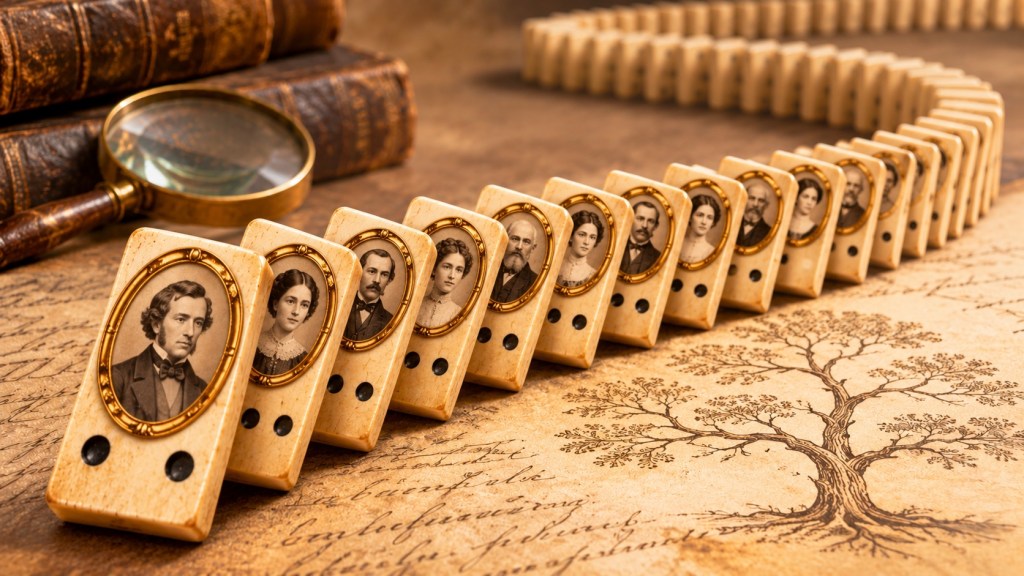
One incorrect ancestor can send entire generations of your family tree in the wrong direction.
If you accept an incorrect parent-child relationship, every generation you add above that individual may also be wrong. Before long, you could find yourself researching an entirely unrelated family, adding hundreds of people who have absolutely no connection to your own ancestors. And because each new generation appears to fit into the previous one, the original mistake can become increasingly difficult to spot.
A Hint Is Not a Proof
Just because someone has attached a name to an ancestor doesn’t mean they’ve actually documented the connection.
A name, a date, or even a collection of matching information is only a starting point for your own research. Always look for the original records or reliable sources that support the relationship. A baptismal record, a marriage record, a death record, a notarial document, or a census can provide valuable evidence. And remember: one record may not be enough to establish a connection. Sometimes, you need to compare several documents before reaching a sound conclusion.
Not Every Pierre Martin Is Your Pierre Martin
Same name, same village, same approximate birth year… and still the wrong person. Homonyms can be a genealogist’s worst nightmare!
This is particularly true in France, where certain first names and surnames appear repeatedly in the same villages and families. Two men named Pierre Martin could have been born within a few years of each other, lived in the same commune, and even married women with the same first name! (Remember my Stewarts of Scotland? What a genealogical nightmare!) It is easy to confuse them if you rely on names and dates alone. Look at occupations, parents, spouses, witnesses, addresses, and other details that can help distinguish one individual from another.
Your Family Tree Is Not an All-You-Can-Import Buffet!
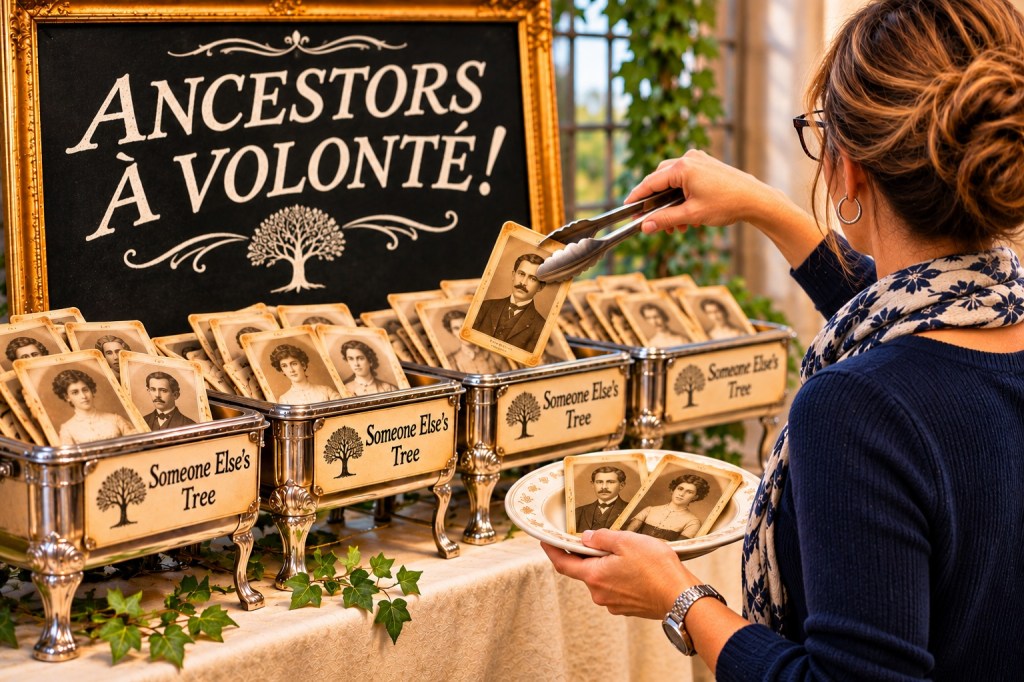
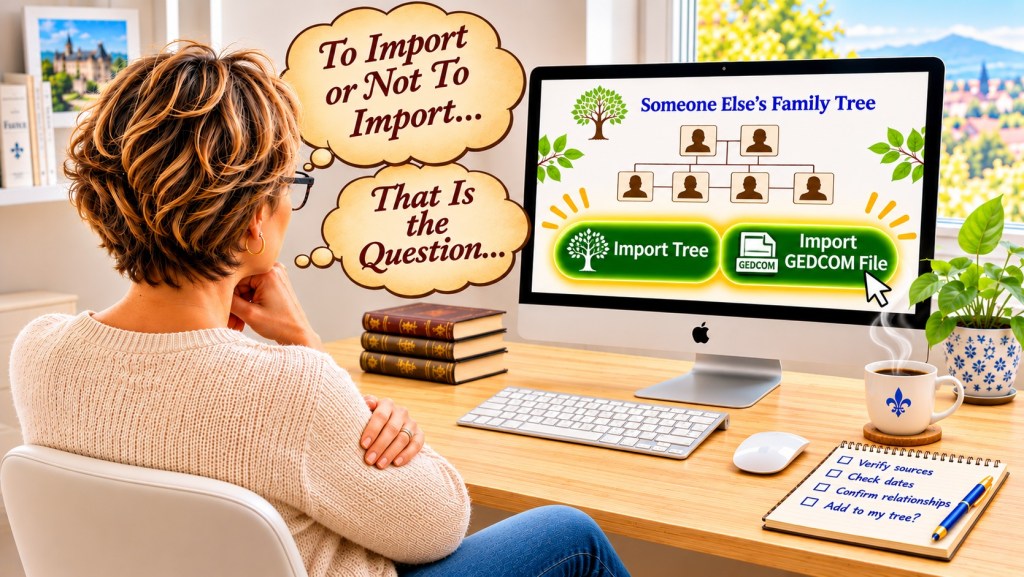
Doing the research ourselves is, of course, a much longer process than clicking the “import tree” button, import someone else’s GEDCOM file, or copying someone else’s tree. However, by taking our time to do our own research, we discover so much knowledge that we would have missed by importing generations upon generations of individuals with the click of a mouse.
To me, researching an ancestor is about much more than finding a name and adding a birth and death date. It is about understanding the life of that individual, discovering the places where they lived, the people they married, their occupations, and sometimes the historical events that shaped their lives. Each document can reveal another little piece of their story. And isn’t that what genealogy is all about?
Let’s say you import 20 generations from someone else’s tree. You will miss having learned about numerous towns and villages, in numerous départements of France, and even go outside of France. You might have discovered that an entire branch of your family was not from France but actually from England (Oh dear…), or Italy (Ciao, bella!).
You might also miss the opportunity to discover that an ancestor moved from one département to another, changed occupations, served in the military, or emigrated to another country. These are the little (or big!) discoveries that make genealogy so fascinating. A simple search for a birth record can lead you to a marriage, then to a census, then to a military record, and eventually to an entirely unexpected family story!
Do look at other genealogy platforms and other people’s trees, but personally, I choose to not import any “matched” tree, nor to request a GEDCOM file from someone else’s tree.
I had done that on the first website I had started my tree with many years ago, and realized later that that person had made some errors. Because there were only about 200 people on my tree at the time, I started over from scratch on Geneanet in 2016.
That experience taught me an important lesson: it is much easier to verify information as you go than to untangle an entire branch of potentially incorrect ancestors later. I learned from that mistake and changed my approach. Today, if I look at other people’s tree, I prefer to use their tree as research clues, not as ready-made ancestors. If I find an interesting connection, I investigate it myself and look for the supporting documentation before adding anyone.
So, fellow genealogists, by all means, do explore other people’s trees! They can be an excellent source of ideas, clues, and new directions for your research. Just remember to do your homework before clicking that tempting import button. Your ancestors deserve it!
Keep searching (and researching) for your ancestors!
✨

