
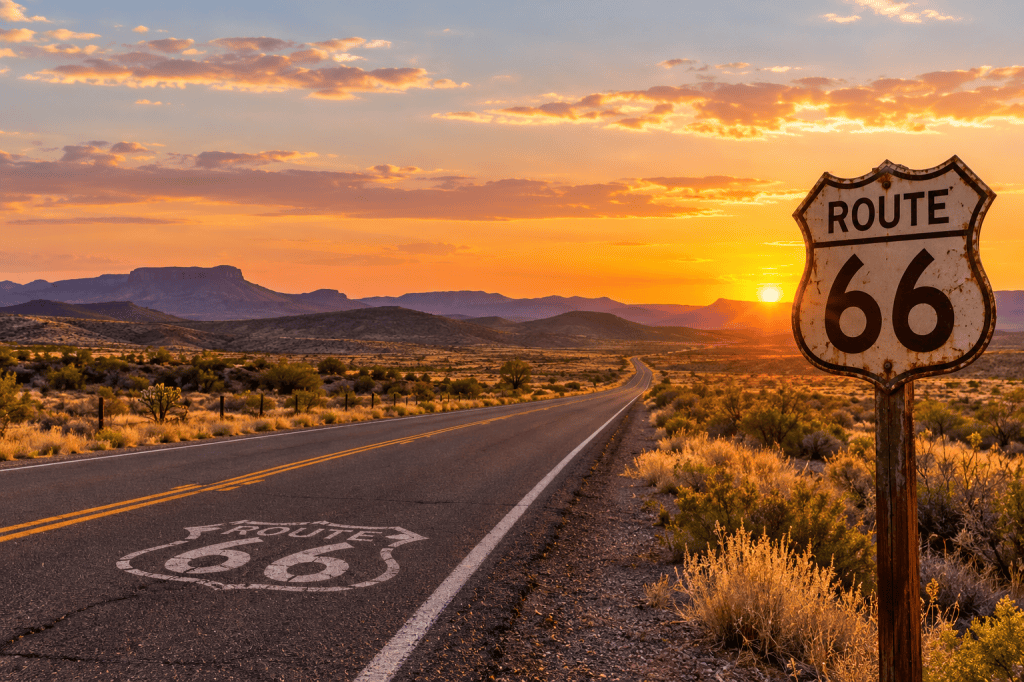
On November 11, 2026, Route 66, nicknamed “the Mother Road,” will celebrate its 100th birthday! For me, this iconic American highway brings back memories of my lifelong fascination with the American West.
✨
I was born and raised in France. As a teenager, I became fascinated by the American “Far West”. This probably had something to do with watching American Westerns on Tuesday nights (“La Dernière Séance”, presented by Eddy Mitchell), many of them filmed in Monument Valley by John Ford (see the section “My lifetime: 1967-…» in my post “The Good Things of History (1874-2026)”.
You can imagine how emotional it was for me, a few decades later, to visit Monument Valley for the first time after moving to Phoenix, Arizona! Driving through Monument Valley and seeing this magnificent scenery with my own eyes, I felt as if I were in a John Ford movie…
During that first trip, we also drove along the iconic Route 66, which I had heard so much about. In Arizona, the historic route stretches for 250 miles, from Lupton, near the New Mexico border, to Topock, near the California border.
Since then, I have driven along Route 66 several more times.
What makes a road interesting to a genealogist?
Beyond the landscapes and historic landmarks, roads tell stories of migration, work, family vacations, and the places where people’s lives unfolded.
Route 66 became part of the lives of countless American families. Old photographs, postcards, maps, and family stories can help us discover the journeys they made and the communities they knew. Even a famous highway can become a starting point for exploring our family history.
For genealogists, understanding the historical context can also help explain why a family moved from one state to another. During the Great Depression (1929-1939) and the Dust Bowl of the 1930s, for example, many families left their homes in search of work and a better future. When researching ancestors who lived during this period, checking the 1930 and 1940 U.S. census records can help us trace their movements and better understand their changing circumstances.
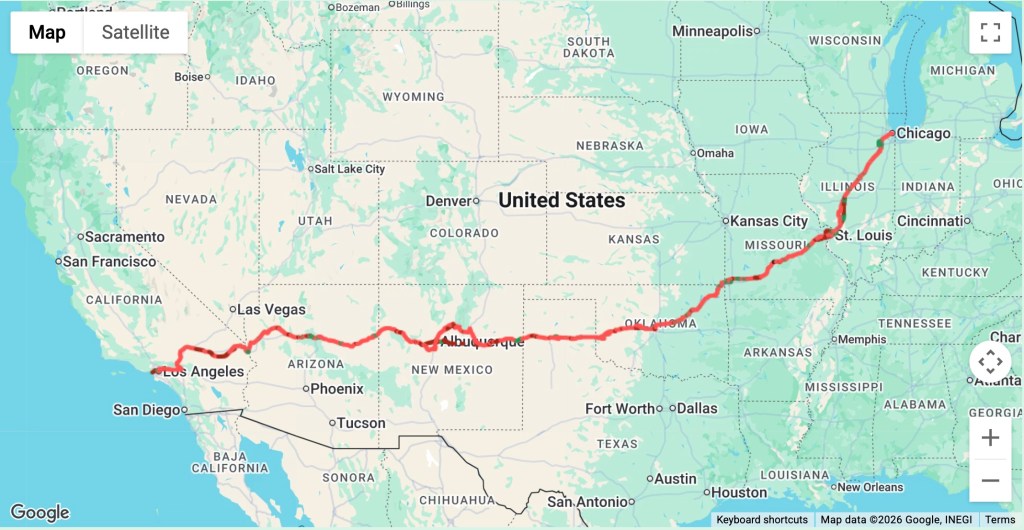
Route 66 and the Dust Bowl
During the 1930s, severe droughts and devastating dust storms struck the Great Plains, destroying crops and forcing many farming families to leave their homes. The Great Depression made it even harder for people to find work and support their families. Route 66 became one of the roads traveled by families heading west, many hoping to find jobs and a better life in California.
Their journeys became part of the history of the “Mother Road,” reminding us that behind every road are people, families, and stories of hardship, courage, and hope.
Route 66 and the Trail of Tears: a Road with a Deeper History
Route 66 also crosses paths with a much darker chapter of American history. In Missouri, parts of Route 66 follow a corridor that also formed a portion of the northern route of the Trail of Tears. In 1838-1839, thousands of Cherokee people were forcibly removed from their ancestral homelands in the southeastern United States to present-day Oklahoma. Many died during this devastating journey.
I am currently researching the family of someone who lived in Pulaski County, Missouri, during that period. If you have Brownfields and McElroys in your ancestry, you might be related!
They may well have witnessed the passage of Cherokee people along the Trail of Tears, bringing this difficult chapter of American history a little closer to home.
It is a sobering reminder that the land crossed by Route 66 has a much older history, marked by both human journeys and human suffering.
Route 66 through French eyes… and ears!
My fascination with the American West is certainly not unique among the French!
French rock star Johnny Hallyday had a lifelong passion for America and motorcycles and traveled along Route 66 on his United States road trips.
Another French singer, Eddy Mitchell, released “Sur la route 66” in 2003, bringing the legendary American highway into French popular music. The song appears on his album “Frenchy“, recorded partly at Ocean Way Recording in Hollywood, Los Angeles. The album reached No. 2 on the French album charts that year.
I love the thought of a French singer recording music inspired by America in California, not far from the western end of the legendary Route 66!
If you speak French, or simply enjoy discovering French music, you can watch this official live performance of “Sur la Route 66” by Eddy Mitchell.
Quick facts about Route 66
Route 66 in America
2,448 miles
The historic highway from Chicago, Illinois, to Santa Monica, California.8 states
Illinois, Missouri, Kansas, Oklahoma, Texas, New Mexico, Arizona, and California.November 11, 1926
The date Route 66 was officially designated as a U.S. Highway.1938
The National Park Service confirms that the highway was fully paved by 1938, twelve years after its designation.
Route 66 in Arizona
According to “Historic 66 AZ”, Arizona is home to the longest remaining uninterrupted stretch of Historic Route 66. Along the way, visitors can discover historic towns, diners, neon signs, classic motels, roadside attractions, museums and some of the most iconic landscapes along the Mother Road.
250 miles
Topock → LuptonNote that the 250 miles refers to the drivable Route 66 in Arizona today, not the full length of the original historical route, which was 385 miles.
Communities along the Route
Topock, Oatman, Kingman, Hackberry, Valentine, Truxton, Peach Springs, Seligman, Ash Fork, Williams, Flagstaff, Winona, Winslow, Joseph City, Holbrook, Lupton157.87 miles
The longest remaining uninterrupted stretch of Route 663 days recommended
Recommended time to fully experience the Arizona route
For me, Route 66 is part of the fascination I have always felt for the American West—a fascination that began in France, long before I ever imagined I would live in Arizona.
✨
Sources used to prepare this post
- Sharlot Hall Museum in Prescott, AZ
- National Park Service
- Research Route 66
- Visit Arizona
- U.S. Department of Transportation
- National Trust for Historic Preservation
- Trail of Tears National Historic Trail
- History
- Route 66 Road Trip
- Historic 66 – Historic 66 AZ
- Route 66 Map
- Wikipedia (English) and Wikipedia (French)

