
Let’s step through the doors of History and into the past.
Beyond this threshold lies a world shaped by centuries of history — ancient landscapes, medieval castles, old villages, and the places where generations of ancestors lived their lives. Every stone, every record, and every story offers a glimpse into the journey that connects us to those who came before us.
✨
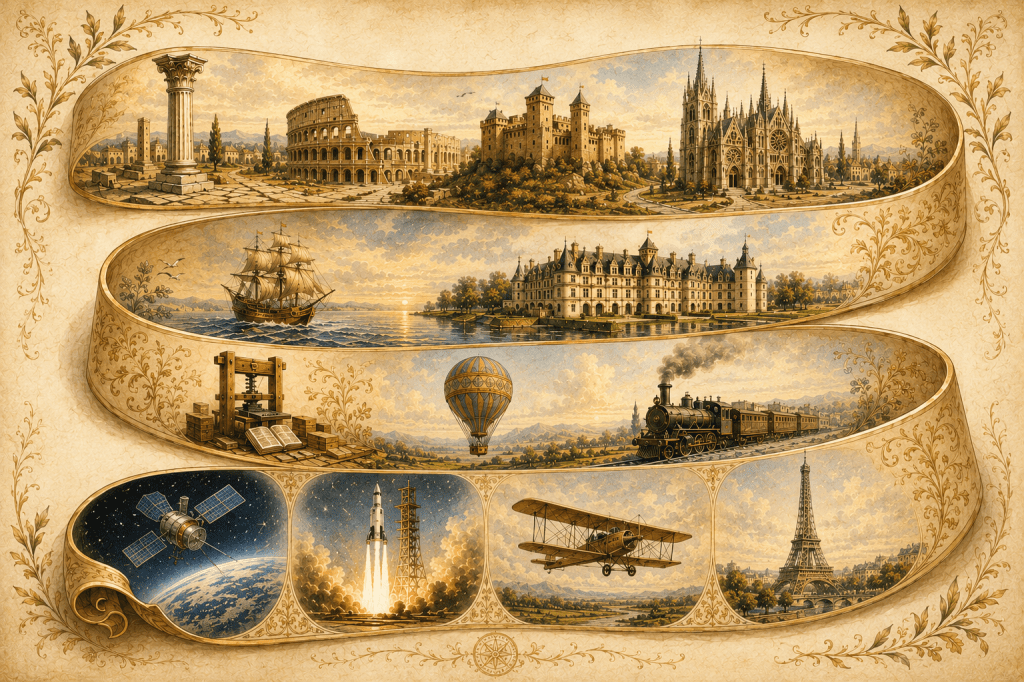
History is often presented as a list of dates. But to me, history is better understood as a journey — a ribbon that unfolds like an old manuscript, winds through the passage of time, and never breaks, suggesting that every era is connected to the next.
We often think of history as isolated events, but our ancestors lived through a continuous flow of time. And so do we.
The same ribbon carries Roman builders, medieval pilgrims, Renaissance printers, railway passengers, early aviators, and eventually us. It twists and turns through centuries, carrying kingdoms, discoveries, wars and peace treaties, inventions, and ordinary families alike.
Every one of us enters that ribbon at the very end, yet our roots stretch back through every curve that came before.
That idea inspired me to return to one of the oldest pages on my website — my Timeline of Historical Events. Last week, I completed a major update to it.
Until recently, the Timeline covered only the major events from the 15th century (1401–1500) to the present day. But as I gradually worked my way backward through history —century by century — I found myself doing much more than adding historical events.
As I linked people, places, and events in my Timeline to those already documented in my Geneanet family tree, I was surprised by how often I realized, “I’ve already been here.” Research I had completed years earlier quietly resurfaced, reminding me that every discovery becomes part of a much larger story.
I revisited ancestors whose branches I had stopped researching. (I have always followed my intuition in genealogy: when a particular line seems to resist every attempt to move forward, I set it aside and explore another one instead.)
Returning to those forgotten branches months — or sometimes years — later often reveals new connections that I might never have discovered otherwise.
As I continued moving backward through the centuries, I began to see my Timeline differently. It was no longer just a collection of historical milestones; it became a thread connecting the wider history of the world with the lives of the people already recorded in my family tree.
A date on a page was no longer just a date. A medieval castle, a royal dynasty, a migration, or a historical event could suddenly have a familiar name attached to it. The past became more personal, because my ancestors were no longer observers of history — they were part of it.
Of course, genealogy is never truly finished. Each discovery leads to another question, another document, another path to explore. But this journey through time reminded me of something important: every ancestor, whether famous or unknown, lived within moments of history that shaped their lives and the generations that followed.
Have you ever discovered unexpected connections between world history and your own ancestors?

