What can recurring dates in a genealogy tell us?
As I worked my way through thousands of French and worldwide birth, marriage, and death records—and through historical events of all kinds, from wars and peace treaties to the foundation of castles and churches, and the beginnings and ends of reigns—I began noticing something curious.
Certain dates seemed to appear again and again. Days and months (ignoring the year).
At first, I noticed this in connection with deaths. Over the years, in my own “getting up there” life, I have often noticed that a lot of people die on—or very close to—a significant date: their own birthday, their spouse’s birthday, their wedding anniversary, their grandparent’s birthday, or another date that seems meaningful to them. So I started paying attention to this in my genealogy research.
For a death, it is easy to imagine a person somehow hanging on long enough to “make it to their next birthday.” But what about a birth? There, the stars decide. :)
Then I began noticing other recurring dates—dates that were familiar to me because they belonged to my family members or friends. Birthdays, of course. And Saints’ days. (In France, we say « Bonne fête ! » to someone on their Saint’s day. Mine, for instance (Sainte Isabelle), is February 22. Remember to shoot me an email next year!)
I’ve never—ever—liked maths. To this day, simple maths calculations make me hyperventilate. That dislike of maths dates (ha-ha) back to elementary school, when we started learning fractions. Our teacher tried to make them “fun” by using the comparison with pizza slices, but even pizza couldn’t make me like fractions. (I do enjoy eating them, though).
I have, however, always enjoyed statistics. So, after a few years of genealogy research, I started keeping a list.
I kept track of things such as:
- individuals who died on their birthday;
- individuals who died within a week or two of their birthday;
- individuals whose birth, marriage, or death date matched a significant date belonging to someone I knew;
- twins in families.
And then there were the fun discoveries that made me stop and smile. For example, one woman in my research was born on my mother’s birthday and died on my father’s birthday. Or two brothers from one family marrying two sisters from another, on the same day.
As the years went by, I continued to wonder: in a genealogy containing tens of thousands of individuals—and, in my tree, historical figures and events as well—could certain dates actually occur surprisingly often in a family tree? Not just among birthdays. Not just among deaths. But across generations, across branches of a family, and even across completely different kinds of events.
Are recurring dates simply coincidences—or are they telling us something?
Perhaps this is why I find recurring dates so fascinating. They raise a question that goes beyond statistics: could some of these repetitions have a meaning that statistics cannot reveal?
This is where the idea of psychogenealogy comes in—the idea that events, patterns, and even dates may sometimes echo across generations. In my post Mindful Genealogy, I share a little about French psychologist and psychotherapist Anne Ancelin Schützenberger (1919-2018), who was world-renowned for coining the term and pioneering the clinical field of psychogenealogy.
I am not claiming that statistics can prove such connections. They can’t. But statistics can give us something very interesting: they can tell us where to look.
So this week, I decided to let the GEDCOM do the counting.
A note about the numbers:
At the time of this analysis, my Geneanet tree currently contains 64,973 “individuals“. However, that number includes more than people. Over the years, I have also created records for monuments, castles, churches, cemeteries, historical events, and other subjects—many of which are linked to the corresponding entries in my Timeline of Historical Events in France and in the World. Some records contain no date at all, while others contain only a year. A cemetery, for example, may have only its year of foundation, so it cannot contribute a specific day and month to this analysis.
The same applies to all my pages “History of… (country)“, many ancient Egyptian dynasties, Roman, Byzantine, Babylon, and other Empires, and other civilizations, as well as historical figures, events, and places for which historians can give only an approximate year rather than an exact date. These records are part of my tree, but they cannot be included in statistics based on a specific day and month. The numbers that follow represent only the portion of my tree for which a precise day and month are available, and should not be interpreted as a measure of how common a particular date is among all 64,973 records in my tree.
In the GEDCOM used for this analysis, only about 28,000 records contain at least one specific day and month; the others contain only a year, no date, or information that cannot be used for this type of analysis.
The analysis for this article was performed on a GEDCOM export of my tree. Because GEDCOM and GeneWeb—the system underlying Geneanet’s tree structure—handle individual and family records differently, the number of records contained in a GEDCOM export does not necessarily correspond exactly to the number of individuals displayed by Geneanet.
Therefore, the statistics below reflect all dated events contained in the exported GEDCOM, while the size of my tree is given according to the number of individuals currently displayed by Geneanet.
So… what does my family tree reveal?
🎂⚰️ People who died on their birthday
For every individual in the dataset who had both a recorded birth date and a recorded death date, I compared the two dates—again ignoring the year.
And I found:
| Distance from birthday | Individuals |
| Same day | 211 |
| 1 day | 90 |
| 2 days | 89 |
| 3 days | 63 |
| 4 days | 45 |
| 5 days | 65 |
| 6 days | 82 |
| 7 days | 68 |
| On or within ±7 days | 713 |
211 people died on the very day of their birthday. And if we widen the window to seven days before or after the birthday, the number rises to 713 people. That was the kind of pattern that first made me wonder whether recurring dates in a large genealogy might reveal something more than isolated coincidences.
If birthdays and deaths can show these kinds of repetitions, what happens when we look at every dated event in the tree?
Here are some of the dates that stood out most strongly when I looked at the worldwide data. These are not complete rankings, but rather the results that caught my attention first.
Reminder: “All dated events” in the tables below means exactly that—births, marriages, deaths, historical events, wars, battles, treaties, reigns, the foundation of castles and monuments, and anything else in my tree with a specific date.
🌎 Top recurring dates — Worldwide
| Category | Date | Occurrences |
| 🎂 Births | December 25 | 66 |
| 🎂 Births | March 4 | 66 |
| 💍 Marriages | February 10 | 49 |
| ⚰️ Deaths | October 25 | 148 |
| 📜 All dated events | October 25 | 278 |
| 📜 All dated events | March 4 | 273 |
| 📜 All dated events | January 20 | 258 |
| 📜 All dated events | January 1 | 220 |
🥇 October 25
🥈 March 4
🥉 January 20
🇫🇷 Top recurring dates — France
| Category | Date | Occurrences |
| 🎂 Births | September 3 | 27 |
| 🎂 Births | February 2 | 26 |
| 💍 Marriages | November 26 | 30 |
| 💍 Marriages | November 22 | 28 |
| 💍 Marriages | February 3 | 28 |
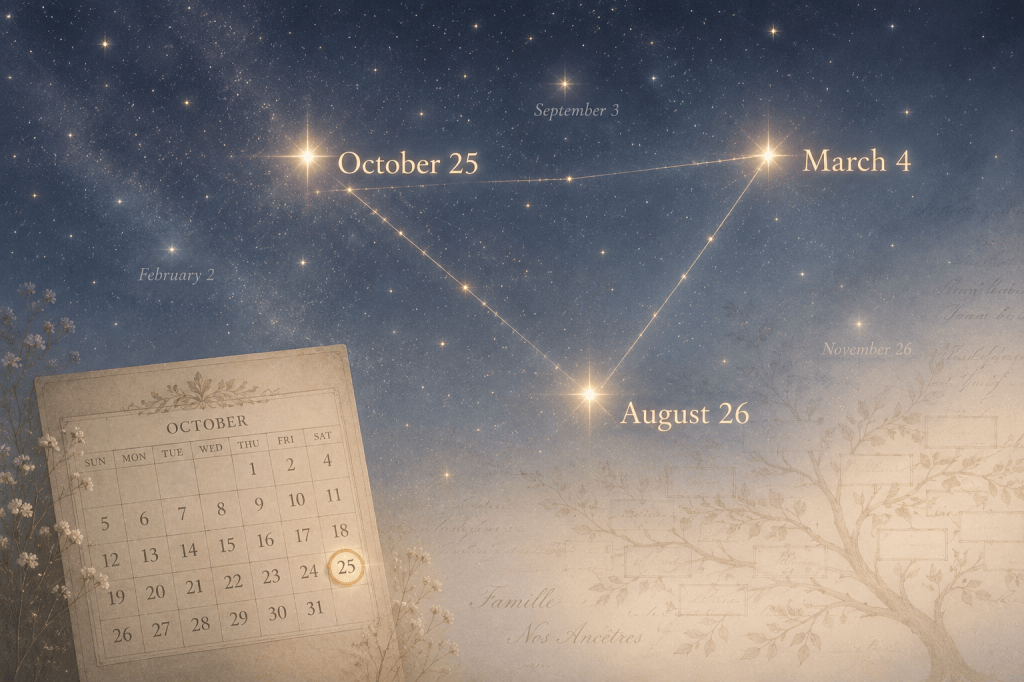
| ⚰️ Deaths | October 25 | 98 |
| ⚰️ Deaths | August 26 | 40 |
| 📜 All dated events | October 25 | 179 |
| 📜 All dated events | August 26 | 92 |
| 📜 All dated events | February 4 | 88 |
🥇 October 25
🥈 August 26
🥉 February 4
Well, hello, October 25!
🥇 Gold Medalist, clear winner of both “Worldwide” and “France” categories.
- In my “Worldwide” category, among deaths, October 25 appears 148 times—and when all dated events are combined, it appears 278 times. March 4 isn’t far behind, with 273 occurrences across all events. (We’ll get back to March 4 later.)
- In my “France” category, I noticed something even more striking: in the Nord-Pas-de-Calais alone, October 25 appears 122 times, including 82 deaths.
At this point, I’m wondering: why this date?
Then I looked at the years. And suddenly the mystery disappeared…
⚔️ The Agincourt effect!
Of those 148 October 25 deaths, 83 occurred in 1415. Why? Because October 25, 1415, was the date of the Battle of Agincourt (Bataille d’Azincourt).
My tree contains a substantial group of historical figures who died during that battle, including several members of the nobility. So the “enormous” number of October 25 deaths isn’t evidence that October 25 is somehow a particularly dangerous day. It is evidence that history leaves fingerprints on a genealogy database.
This is also a good reminder that a recurring date needs context. A number by itself can be misleading. Before deciding that a date is unusual—or meaningful—we need to look at who is behind the number and why those people are in the dataset.
And this is one of my favorite discoveries from the entire experiment. A recurring date can look like a statistical curiosity until you investigate the people behind the numbers. Suddenly, the number becomes a historical story.
The statistics tell me where to look. The history helps explain what I’m seeing. This is one of the reasons I love genealogy: sometimes the numbers lead you straight back to history.
Going back to March 4 and January 20 (Worldwide numbers)
🥈 Silver Medalist: March 4
🇺🇸 My GEDCOM contains a long sequence of U.S. presidential inaugurations on March 4, because March 4 was Inauguration Day for U.S. Presidents until 1933. I have recorded the beginning and ending of presidential “reigns” on that date. (I used “Règne de”—Reign of —on my tree so that, by clicking on “Règne de“, you can see the list of all the “reigns” I have recorded for kings and presidents in multiple countries).
🇫🇷 My GEDCOM also contains a few March 4 dates in France, such as:
- March 4, 1532: an entry for the Castle of Villandry, my mother’s favorite castle in France
- March 4, 1663: a couple of marriages at the Louvre Palace
🥉Bronze Medalist: January 20
🇺🇸 Here too, my GEDCOM contains a long sequence of U.S. presidential inaugurations. Beginning in 1937, January 20 became the official date for U.S. presidential inaugurations, starting with Franklin D. Roosevelt’s second inauguration.
Going back to August 26 and February 4 (France numbers)
🥈 Silver Medalist: August 26
- August 26, 1346: Battle of Crécy. A large proportion of the records are people who died at Crécy on August 26, 1346, including some pretty major medieval figures.
- August 26, 1789: Adoption of the Declaration of the Rights of Man and of the Citizen. My records involve Louis XVI, Marie-Antoinette, the French Revolution, and the declaration itself.
🥉Bronze Medalist: February 4
For this date, I could not find any obvious explanation or single historical event behind the numbers. Instead, there are a mixture of births, deaths, marriages and scattered historical records across France, England, the German states, Italy, and the United States.
Looking at months
So far, I had been looking at specific dates: birthdays, deaths, and individual dates that appeared again and again in my tree.
But what happens when we step back and look at the months instead?
I wondered whether the marriages in my tree were spread fairly evenly throughout the year—or whether some months appeared much more often than others.
The answer was clear: they were not evenly distributed.
💍 🌎 Marriages — Worldwide
| Month | Marriages |
| January | 899 |
| February | 978 |
| March | 461 |
| April | 692 |
| May | 730 |
| June | 759 |
| July | 629 |
| August | 494 |
| September | 555 |
| October | 673 |
| November | 915 |
| December | 460 |
February and November stand out immediately. February has the highest number of recorded marriages, with 978, followed by November with 915. At the other end of the spectrum, March and December are remarkably quiet, with 461 and 460 marriages respectively.
That made me wonder: why?
What happens when I look only at France?
💍 🇫🇷 Marriages — France
| Month | Marriages |
| January | 410 |
| February | 483 |
| March | 126 |
| April | 291 |
| May | 239 |
| June | 282 |
| July | 230 |
| August | 132 |
| September | 190 |
| October | 214 |
| November | 416 |
| December | 162 |
In the French data, February and November are also prominent, while March and August are strikingly low.
That makes me want to investigate the historical reasons behind the pattern. Religious calendars, traditional periods when Catholic weddings were restricted, agricultural cycles, and local customs may all have played a role. In other words, the numbers are giving me a question to investigate—not necessarily an answer. And that’s what makes this kind of analysis fun.
So, are recurring dates simply coincidences—or are they telling us something?
I don’t think my GEDCOM can answer that question. But it can certainly point me toward questions worth asking.
📖 A family tree is more than names and dates
We often look at a genealogy database as a collection of individuals:
Who was this person?
Who were their parents?
Where and when were they born?
When did they die?
But sometimes it is worth stepping back and looking at the tree as a whole.
What happens when tens of thousands of dates are placed side by side? Patterns begin to emerge. Some are statistical. Some are geographical. Some are historical. And some are simply wonderfully strange.
A date that appears hundreds of times may initially look like a coincidence. But sometimes, if you follow the clue far enough, you find yourself standing on a battlefield in northern France in 1415.
And that is perhaps one of the things I love most about genealogy: the smallest detail can open the door to a much bigger story.
So the next time you notice a familiar date appearing again and again in your family tree, don’t dismiss it. You never know where that date might lead you.
✨
Last night, for dinner, I had 1/4 of a pizza and 1/2 a glass of Bordeaux wine. Seems to me that I mastered fractions after all!!

