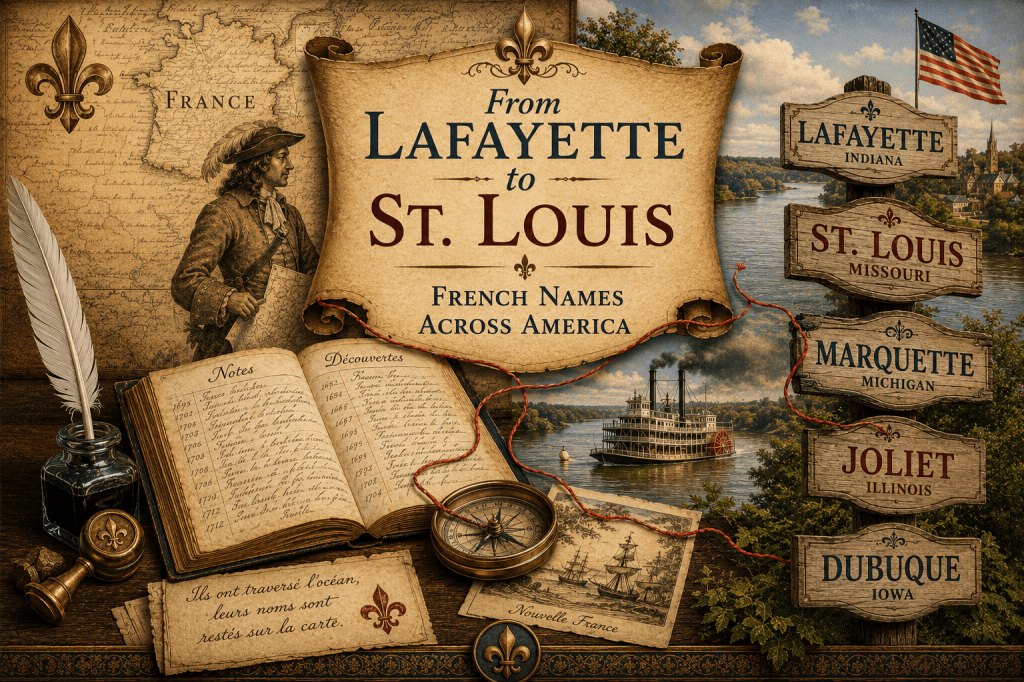
Many Americans pass French names every day without realizing that they are reminders of a shared history stretching back to the days of New France.
Long before the United States became an independent nation, France played an important role in the exploration and settlement of North America. Beginning in the sixteenth century, French explorers, missionaries, traders, and settlers traveled across vast regions of the continent, from the St. Lawrence River and the Great Lakes to the Mississippi Valley and the Gulf of Mexico.
The French established colonies in Canada, Acadia, Louisiana, and other territories collectively known as New France. Explorers such as Jacques Cartier, Samuel de Champlain, Jacques Marquette, Louis Jolliet, and René-Robert Cavelier de La Salle helped map waterways, build alliances with Indigenous nations, and expand France’s presence deep into the interior of the continent.
Although France eventually lost most of its North American territories following the Seven Years’ War (1756–1763), its legacy did not disappear. French influence remained visible in local culture, architecture, language, and religion—and perhaps most noticeably, on the map itself. Across the United States, countless cities, counties, rivers, and landmarks still bear French names, preserving a connection to people and events that shaped the history of North America centuries ago.
Famous American places named after French people
Lafayette
Named after Gilbert du Motier, Marquis de Lafayette (1757-1834), known as “The Hero of Two Worlds”. In French, his full name is “Marie-Joseph Paul Yves Roch Gilbert du Motier de La Fayette“.
The Marquis de Lafayette was a French nobleman, military officer and politician. He volunteered to join the Continental Army, led by General George Washington, during the American Revolutionary War. When he came back to France, he became a key figure in the French Revolution (1789).
Here are just a few places named after him:
- Cities: Alabama, Colorado, Indiana, Louisiana, Oregon
- Fayetteville, North Carolina and Arkansas
- West Lafayette, Indiana (Home to Purdue University)
- Lafayette Hill, Pennsylvania
- La Fayette, Rhode Island
- Counties: Arkansas, Florida, Mississippi, Missouri, Wisconsin
- Institutions: streets, squares, schools, parks
- Geography: Mount Lafayette (in the White Mountains, New Hampshire); Lafayette River, Virginia
St. Louis
Named after Louis IX of France (1214-1270), canonized as Saint Louis. As mentioned in my recent post about Madeleine de Hénin-Liétard, his name still echoes across the world. Here are just a few places or monuments named after him:
- Cities: Illinois (East St. Louis), Indiana (Old St. Louis), Michigan, Mississipi (Bay St. Louis), Missouri, Oklahoma, Oregon, Virginia
- Counties: Missouri, Minnesota
- Other: San Luis Rey, Oceanside, California; San Luis, Colorado
- Churches:
- The Basilica of St. Louis, King of France, in St. Louis, Missouri
- The Cathedral-Basilica of St. Louis, King of France, in New Orleans, Louisiana
- The Saint Louis Roman Catholic Church and School in Clarksville, Maryland
- Saint Louis Catholic Church and School in Fairfax County, Virginia
- St. Louis the King Catholic Church, in Marquette, Michigan
- St. Louis Catholic Church and School, in Memphis, Tennessee
- Saint Louis King of France Catholic Church and School, in Austin, Texas
- A bas-relief of St. Louis is one of the carved portraits of historic lawmakers that adorn the chamber of the United States House of Representatives.
Marquette
Named after Jacques Marquette (1637-1675), French Jesuit missionary who founded Michigan’s first European settlement, Sault Sainte Marie. In 1673, both he and Louis Jolliet explored and mapped the Upper Mississippi River Valley.
- Marquette, Michigan
- Marquette County
- Marquette University
Jacques Marquette appears with Louis Jolliet on a 1968 United States postage stamp honoring their exploratory voyage.
Joliet
Named after Louis Jolliet (1645-1700), French-Canadian who explored and mapped the Upper Mississippi River with Jacques Marquette in 1673.
- Joliet, Illinois
- The Louis Joliet Mall in Joliet, Illinois
- Joliet, Montana
- Jolietville, neighborhood of Westfield, Indiana
- Numerous high schools in North America
Louis Jolliet appears with Jacques Marquette on a 1968 United States postage stamp honoring their exploratory voyage.
Dubuque
Named after Julien Dubuque (1762-1810), French-Canadian explorer of Norman descent. He was one of the first European men to settle in the area that would become the state of Iowa. He was a friend of the Native Americans in the area and fought for their cause.
- Dubuque, Iowa
One of Iowa’s oldest settlements.
La Salle
Named after René-Robert Cavelier de La Salle (1643-1687), French explorer and fur trader who expanded France’s colonial presence in North America. He is best known for claiming the Mississippi River basin for France in 1682, naming it “Louisiana” in honor of King Louis XIV.
- LaSalle County, City and the LaSalle Speedway, Illinois
- LaSalle Street, Chicago, Illinois
- LaSalle Parish, Louisiana
- La Salle County, Texas
- La Salle, Minnesota
- Numerous parks and streets
- Buildings, High schools, hotels
Iberville
Named after Pierre Le Moyne d’Iberville (1661-1706), French-Canadian of Normand origin, founder of the colony of Louisiana in New France.
- Iberville Parish, Louisiana
- D’Iberville, Mississippi
- Iberville Museum in Plaquemine, Louisiana
- Schools and High schools
The Frenchmen Behind…
Ampere (Amp)
The unit of electric current is named after André-Marie Ampère (1775-1836), a French physicist who laid the foundations for electromagnetism in the early 1800s.
Begonia
Named after Michel Bégon (1638-1710), a French colonial politician and avid plant collector who served as the governor of the French Caribbean colonies.
Bougainvillea
Named after Louis Antoine de Bougainville (1729-1811), a French admiral and explorer who led the first official French circumnavigation of the globe in the 1760s.
Braille
Named after Louis Braille (1809-1852), French inventor who lost his own sight as a child. He invented in 1829 the tactile reading system used by visually impaired people worldwide.
Cadillac
Named after Antoine de la Mothe Cadillac (1658-1730), French soldier, explorer, and colonial administrator of New France. He is best known as the founder of Detroit, Michigan, in 1701, and later served as 3rd French Colonial Governor of French Louisiana.
- The luxury car brand Cadillac
- Numerous American schools, roads, and institutions
Pasteurization
Named after Louis Pasteur (1822-1895), French chemist, pharmacist, and microbiologist, known for multiple discoveries, one of them being the Rabies vaccine .
Silhouette
Named after Étienne de Silhouette (1709-1767), French Controller-General of Finances under Louis XV. He imposed harsh economic cutbacks on the wealthy, causing his name to become synonymous with anything made cheaply or reduced to its simplest outline—like the inexpensive shadow-cut portraits of the era.
From cities and counties to scientific terms, French names remain deeply embedded in the geography, language, and culture of the United States.
✨
Many of these names also appear in my own genealogical research, connecting historical figures to personal family history.
🌿 Genealogy on my Geneanet tree
Here are the links to several pages on my Geneanet tree related to individuals, events or places mentioned in this post: (FYI: on Geneanet, the little “green circle” on an individual’s image indicates my direct lineage with the individuals).
Note: some individuals might be “alone” on my tree but check on the right: you will find a link to another page.
Individuals:
- Marquis de La Fayette (Lafayette) (1757-1834)
- George Washington (1732-1799)
- St. Louis (Louis IX of France) (1214-1270)
- Pierre Le Moyne d’Iberville (1661-1706)
- Louis Pasteur (1822-1895)
- Louis Braille (1809-1852)
- Jacques Cartier (1491-1557)
- Samuel de Champlain (1574-1635)
Events:
- Seven Years’ War (1756–1763)
- American Revolutionary War (1775-1783)
- French Revolution (1789-1799)
- Fondation of Louisiana (1812)
- Foundation of the city of Lafayette, Louisiana (1821)
Monument:
History of countries:
Sources to prepare this post: Wikipedia, Château de Versailles website, websites of the States, cities, counties, individuals, etc, discussed.

