After last week’s post about the Stewarts and the nightmare of Scottish genealogy, I felt like going back to some of my old English and Scottish ancestors. So this week, I’m taking you to one of my earlier discoveries: Margaret of Scotland.
✨
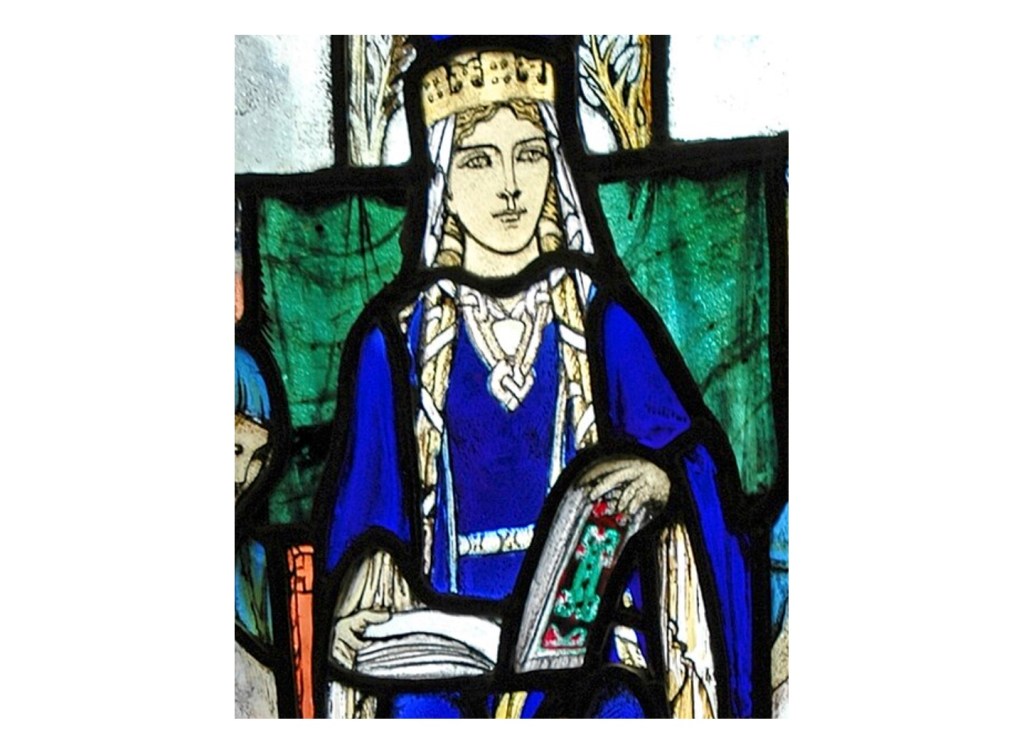
Saint Margaret of Scotland was born a princess of the English House of Wessex. Her family had taken refuge in the Kingdom of Hungary, where Margaret was born around 1045.
Her life would take her from Hungary to Scotland, where she became queen in 1070 when she married King Malcolm III of Scotland.
Margaret was known for her deep faith and her compassion for the poor. She regularly gave food and clothing to those in need and cared for pilgrims and orphans. She encouraged religious life in Scotland, brought Benedictine monks to Dunfermline, and worked to reform and strengthen the Scottish Church. Her piety, charity, and devotion became an important part of the reputation that eventually led to her canonization.
She died in 1093 at Edinburgh Castle, Scotland, only a few days after hearing that her husband, Malcolm III, and their son Edward had both died at the Battle of Alnwick.
But Margaret’s story did not end with her death.
Both Margaret and her husband Malcolm III were initially buried at Dunfermline Abbey, in Scotland.
Centuries later, Margaret’s remains would travel far beyond Scotland — and some would eventually disappear altogether.
After the Scottish Reformation of 1560, Margaret’s relics were dispersed. Her head eventually made its way to the Scots College at Douai, France, where it disappeared during the French Revolution.
The remaining relics of Margaret and Malcolm III were brought to the Royal Monastery of San Lorenzo de El Escorial, near Madrid, Spain, around 1580, at the instigation of Philip II of Spain.
Another few centuries later, in 1862, Bishop James Gillis of Edinburgh traveled to El Escorial in search of Margaret’s relics. He succeeded in obtaining an authenticated relic believed to be part of her body and brought it back to Scotland. The relic, identified as part of her shoulder bone, is now preserved at St Margaret’s RC Memorial Church in Dunfermline.
So even after Margaret’s death, her story continued to cross borders: from Scotland to France, from France to Spain, and eventually back to Scotland.
Margaret was canonized in 1250 by Pope Innocent IV. In 1673, Pope Clement X named her Patron Saint of Scotland.
🌿 Genealogy
For a genealogist, perhaps one of the most remarkable parts of Margaret’s story is her legacy through her descendants.
Saint Margaret is a direct ancestor of numerous Scottish and English monarchs (including Queen Elizabeth II and her son Charles III, the current King of the United Kingdom) — and, through her descendants, her family tree reaches far beyond royal history.
Saint Margaret was also the ancestor of my ancestor Alix de Thouars (1200-1221), Duchess of Brittany, the subject of my post about Alix de Thouars.
My American husband David and I both have direct lineage to Saint Margaret of Scotland through Alix de Thouars. I have a direct line through both Alix’s children, Jean Ier de Bretagne (1217-1286) and Yolande de Bretagne (1218-1272). David also has a direct line through Yolande de Bretagne.
Suddenly, Saint Margaret is no longer just a medieval queen I encountered while researching Scottish history. She is part of our own family story. A French-born woman (moi) and an American-born man (David), both descendants of Saint Margaret of Scotland.
A Legacy in Scotland and Beyond
Margaret’s name lives on in churches and chapels dedicated to her, including St Margaret’s Chapel at Edinburgh Castle, founded and built around 1130 by her son, King David I.
Other churches and institutions bearing her name can be found in England and Scotland, including the Church of St Margaret of Scotland in Twickenha, St Margaret the Queen, Buxted, and St Margaret of Scotland in Aberdeen.
Of these, St Margaret’s Chapel at Edinburgh Castle is particularly special. Traditionally associated with Margaret herself, the chapel was founded by her son King David I in her memory and is considered one of the oldest surviving buildings in Edinburgh.
A queen, a saint, a mother, an ancestor — and, centuries later, a name I would find in my own family tree.
Are you and I related through Saint Margaret of Scotland?
✨
🌿 Genealogy on my Geneanet tree
Here are the links to several pages on my Geneanet tree related to individuals, events or places mentioned in this post: (FYI: on Geneanet, the little “green circle” on an individual’s image indicates that the person is part of my direct lineage).
Note: Some individuals or events might appear “alone” on my tree, but be sure to check the links to other pages.
- Saint Margaret of Scotland and her husband Malcolm III (ca 1031-1093)
- Their son, David I, King of Scotland (ca 1080-1153)
- William I (Guillaume Le Lion) (ca 1143-1214)
- Pope Innocent IV (1180-1254)
- Pope Clement X (1590-1676)
- Philip II of Spain (1527-1598)
- Queen Elizabeth II (1926-2022)
- King Charles III (born 1948)
I haven’t created a page about the History of Scotland yet, but I created these:
- Castles of Scotland (Châteaux d’Écosse)
- Churches of Scotland (Églises d’Écosse)
In Spain:
Other pages you might enjoy visiting:
- House of Wessex (519-1066)
- History of France
- French Revolution (1789-1799)

