A little bit about d’Artagnan
His full name was Charles de Batz de Castelmore, dit d’Artagnan (ca 1611-1673). He was captain of the Musketeers of the Guard (Mousquetaires de la garde), an elite military unit in the service of King Louis XIV of France.
I’m not sure how famous he is outside of France, but d’Artagnan is “a big deal” in France. Most people probably know him through Alexandre Dumas’ famous novels: Les Trois Mousquetaires, Vingt ans après and Le Vicomte de Bragelonne (The Three Musketeers, Twenty Years After and The Vicomte de Bragelonne).
Growing up, we would watch movies based on these stories.
But d’Artagnan did exist.
And I was going to marry him.
A clarification about which king d’Artagnan served
There is a little confusion about which king d’Artagnan served. The Musketeers of the Guard were actually created under King Louis XIII in 1622. Alexandre Dumas’ The Three Musketeers takes place during the reign of Louis XIII, which is why his fictional d’Artagnan is associated with that king.
The real-life d’Artagnan, however, served King Louis XIV, who became king in 1643. It was under Louis XIV that the Musketeers reached their golden age.
And here is a fun connection: one of Louis XIV’s interests was fencing — the world I grew up in!
D’Artagnan and Nicolas Fouquet
In 1661, d’Artagnan was given one of his most important missions by Louis XIV: to arrest Nicolas Fouquet, the king’s superintendent of finances.
Nicolas Fouquet was a very wealthy and powerful man. The magnificent Château de Vaux-le-Vicomte was his creation, built with the talents of architect Louis Le Vau, painter and decorator Charles Le Brun, and landscape designer André Le Nôtre. The castle is privately owned today but open to visitors. It is only about a ten-minute drive from where I grew up!
On August 17, 1661, Fouquet organized a spectacular fête at Vaux-le-Vicomte for Louis XIV. We often hear that this event was what caused Louis XIV to order his arrest, because the king had been struck (and made jealous) by the magnificence of the castle. The story is a little more complicated.
Jean-Baptiste Colbert, Controller-General of Finances, another of Louis XIV’s ministers, had been deeply hostile toward Fouquet for awhile, and had already been working against him. The decision to arrest Fouquet had actually been made several weeks before the famous fête.
A few weeks after the fête at Vaux-le-Vicomte, while staying at the Château des Ducs de Bretagne in Nantes, the king gave d’Artagnan the order to arrest Nicolas Fouquet. The following day, d’Artagnan and fifteen Musketeers caught up with Fouquet near the Nantes cathedral and arrested him.
Fouquet’s trial lasted three years. He was spared the death penalty thanks to Olivier Lefèvre d’Ormesson (1616-1685), judge in Fouquet’s trial, who was none other than the 9th generation ancestor of Jean d’Ormesson, the famous French writer and member of the Académie Française, who died in 2017.
Nicolas Fouquet was emprisoned in different castles and fortresses:
- September 1661 — Château d’Angers
- December 1661 — Château d’Amboise
- December 31, 1661 — May 30, 1663 — Donjon de Vincennes
- May 30, 1663 — December 27, 1664 — Bastille
- December 27, 1664 — January 16, 1665 — Transfer to Pignerol (Italy, under French control at the time), where he stayed until his death in 1680.
The château de Vaux-le-Vicomte and its gardens inspired the king’s decision to transform and greatly enlarge the former hunting lodge at Versailles into the magnificent royal residence we know today. And who did Louis XIV hire to transform Versailles? Architect Louis Le Vau, painter and decorator Charles Le Brun, and landscape designer André Le Nôtre.
What was a Musketeer?
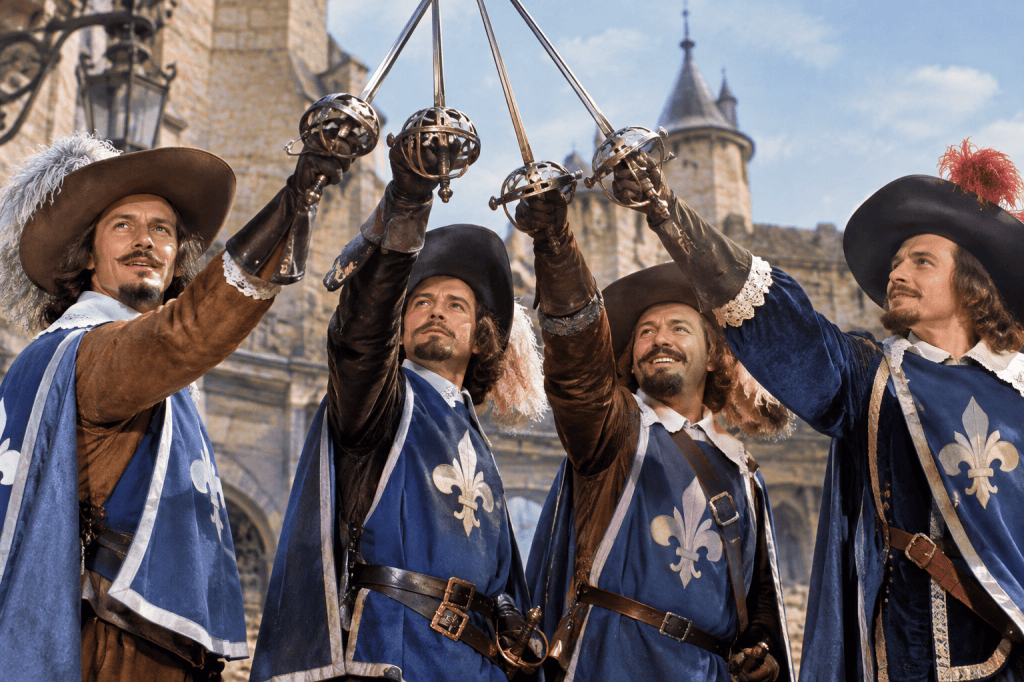
A Musketeer was a soldier armed with a musket. The Musketeers of the Guard, however, were an elite mounted military unit serving the king. In Dumas’ novels, d’Artagnan was joined by Athos, Porthos and Aramis — and, just like d’Artagnan, they were based on real people.
⚔️ Their famous “devise” associated with Dumas’ Musketeers was “Tous pour un, un pour tous!” (“All for one, one for all!”).
Another clarification
You might have heard the Musketeers’ famous motto as “Un pour tous, tous pour un!” (“One for all, all for one!”). But… that’s not quite what Alexandre Dumas wrote! In The Three Musketeers, published in 1844, the phrase in Chapter 9 is actually “Tous pour un, un pour tous!” (“All for one, one for all!”).
What D’Artagnan was to me when I was a child
I grew up in a fencing family. My father, Daniel Revenu, was a four-time Olympian (foil) trained by… my grandfather. My siblings and I also were fencers (we never made it to fame in that area, though!).
“D’Artagnan” meant homework was done, family time watching the movies in the attic, my little sister and I being in awe of the actresses’ long, pretty dresses, their beautiful jewelry, and even their weird-looking wigs, watching the fencing, my little brother “playing d’Artagnan” next to us with anything looking like a stick (a toothbrush would do the trick!), and eating coffee ice cream! Great memories…
The discovery of our cousin relationship
So… A few months ago, I was thinking about d’Artagnan. I looked him up on Geneastar to see his ancestry.
Geneastar is another website owed by Geneanet where I have my online family tree. They display the genealogy of famous people (my father is listed there). You can search by name, or by topics (sports, business & inventions, Arts & Culture, Sciences, etc).
Once you discover your own relationship to a famous person, you submit your request to Geneastar and they add it to your Geneanet home page, so you can brag to the entire world. It’s a lot of fun! Who doesn’t like to discover a relationship with someone famous? While I have discovered many famous cousins over the years, so far, I prefer to only have my father and d’Artagnan added to my home page.
It took just a few clicks to discover d’Artagnan’s ancestry. I immediately recognized two families I was very familiar with: the de Craon and de Rochechouart families. I have direct ancestors with both of them. Immediately, my interest got tickled!
After a little bit of research in different sources, I found our common ancestors! All I had to do was to add a few more individuals to my own tree down to d’Artagnan until I could establish the relationship between us.
Et voilà ! Oh joy! I have a new cousin! And not just any cousin! D’Artagnan had been part of my childhood!
Our common ancestor line
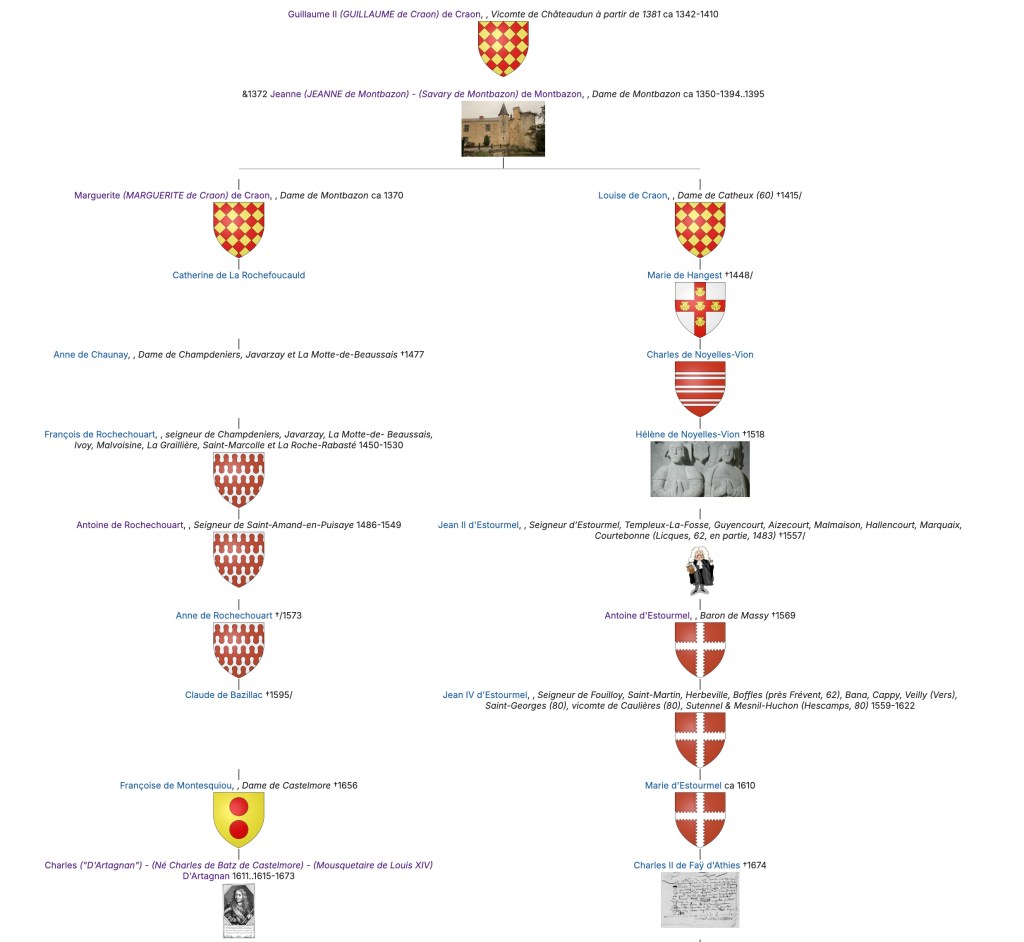
One of the lines of common ancestors between d’Artagnan and me is from Guillaume II de Craon (ca 1342-1410) and Jeanne de Montbazon (ca 1350-after 1395). They had to have a papal dispensation from Pope Urbain V for 3rd and 4th degrees of consanguinity (pretty common in those times).
Guillaume II de Craon was “chambellan” of King Charles VI of France. He was Jeanne de Montbazon’s second husband.
D’Artagnan’s line is on the left, mine on the right. I descend from their daughter Louise de Craon. (Click on the image below to view them on my Geneanet tree).
D’Artagnan, also cousin with… my American husband!
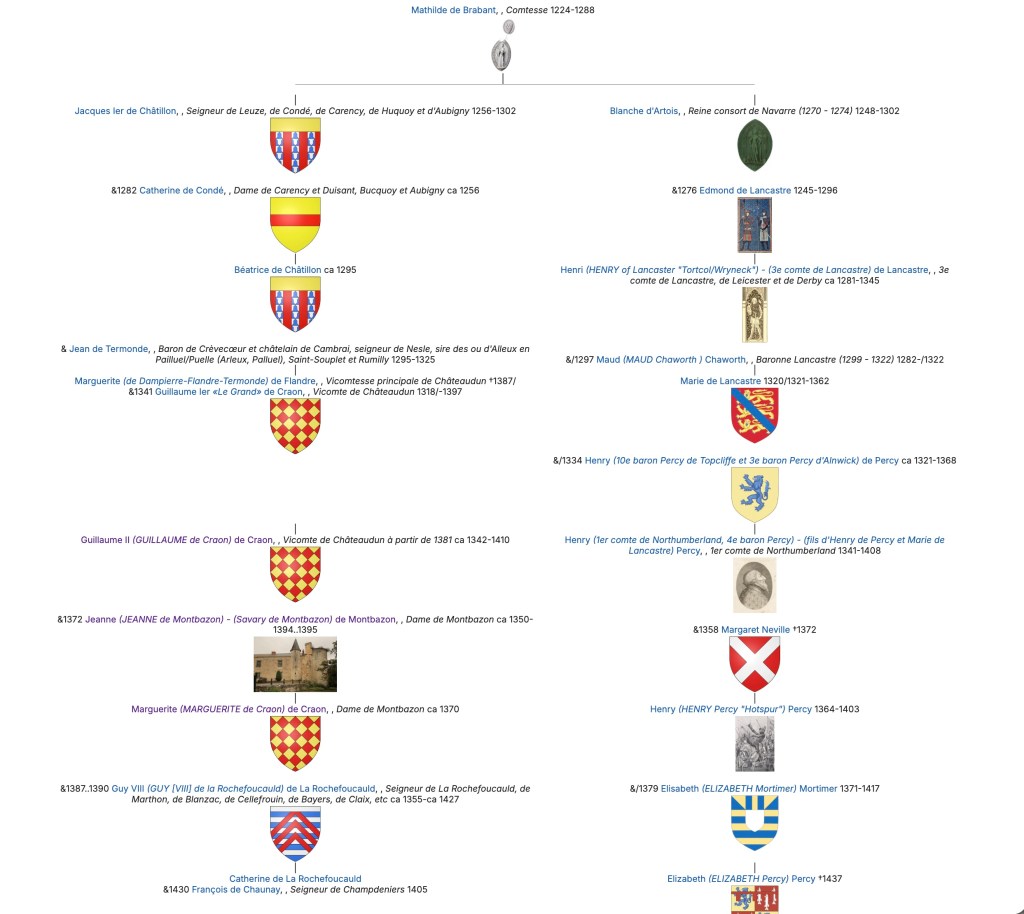
One of the lines between my husband David and d’Artagnan are from Mathilde de Brabant (1224-1288). D’Artagnan’s line is on the left, David’s on the right. (Click on the image below to view them on my Geneanet tree).
Another confirmation, if we needed one, that we are all connected.
Do you have any connection to d’Artagnan?
Keep searching for your ancestors!
✨
🌿 Genealogy on my Geneanet tree
Here are the links to several pages on my Geneanet tree related to individuals, events or places mentioned in this post: (FYI: on Geneanet, the little “green circle” on an individual’s image indicates that the person is part of my direct lineage).
Note: Some individuals or events might appear “alone” on my tree, but be sure to check the links to other pages.
- Guillaume II de Craon (ca 1342-1410) and his wife Jeanne de Montbazon (ca 1350-after 1395)
- King Charles VI of France (1368-1422)
- Charles de Batz de Castelmore, dit d’Artagnan (ca 1611-1673)
- King Louis XIII of France (1601-1643)
- King Louis XIV of France (1638-1715)
- Nicolas Fouquet (1615-1680)
- Olivier Lefèvre d’Ormesson (1616-1685)
- Louis Le Vau (1612-1670)
- André Le Nôtre (1613-1700)
- Jean-Baptiste Colbert (1619-1683)
- Alexandre Dumas (père) (1802-1870)
- Jean d’Ormesson (1925-2017)
Other pages linking to individuals and events:
- History of France
- Académie Française (founded in 1634 by Cardinal de Richelieu)
- Château de Vaux-le-Vicomte (built by Fouquet)
- Château des Ducs de Bretagne in Nantes
- Cathédrale Saint-Pierre-et-Saint-Paul de Nantes (St. Peter and St. Paul Cathedral)
- Château d’Angers
- Château d’Amboise
- Donjon de Vincennes
- Bastille
- Château de Versailles (initially the hunting lodge of Louis XIII, transformed by his son Louis XIV in the palace we know today)
- My page of castles in France and other countries
- My page of churches, cathedrals, etc, in France and other countries

