When we research our French ancestors, we often take their family names for granted. But those names have a history of their own.
How did French family names come about? When did they become hereditary? And what can a surname really tell us about the people who first carried it?
Let’s take a look at how names evolved in France — and at some of the clues they can offer genealogists today.
✨
Before family names: one name was usually enough
In early medieval France, most people were known by a single given name. This worked reasonably well when communities were small. But as populations grew, villages became larger, towns developed, and the same given names were shared by many people. If several men in a village were named Jean, simply saying “Jean” was no longer enough to identify the right person. People therefore began adding a second name or identifying description.
For example:
- Jean, fils de Pierre (son of Pierre)
- Jean, de Paris (from Paris)
- Jean, le boulanger (the baker)
- Jean, le petit (the little one)
Over time, some of these additional names became hereditary family names.
When did surnames appear in France?
There was no single moment when French surnames suddenly appeared. The process was gradual. Additional names began becoming increasingly common during the Middle Ages, particularly from about the 11th–12th centuries onward. In many places, hereditary surnames became established during the 13th to 15th centuries. The timing varied considerably according to region, social class, and whether people lived in a town or in the countryside. Some families adopted hereditary surnames relatively early, while others continued to be identified by changing descriptions for generations.
🌿 An important point for genealogists:
A second name in a medieval record does not automatically mean that it was already a hereditary surname. A man’s father might be named Pierre, for example, and his son could be called Jean Pierre simply because Jean was Pierre’s son. The name might eventually become hereditary — but not necessarily.
Where did French family names come from?
Many French surnames can be placed into a few broad categories.
1. Patronymic names — based on an ancestor
These names originally identified someone through their father or another ancestor.
Examples:
- Martin — derived from the given name Martin
- Robert
- Bernard
- Richard
- Thomas
- Michel
A person called Jean Martin might originally have been Jean, son of Martin. Over generations, Martin could become the inherited family name.
And this explains something interesting…
Because certain given names were extremely popular, they produced a great many surnames. That is one reason names such as Martin became so widespread in France.
2. Names based on a place
A person could be identified according to where he or she came from or where they lived.
Examples include names derived from:
- a village
- a town
- a region
- a geographical feature
- a house or estate
- a nearby river, forest, hill, etc.
Examples:
- Paris
- Lyon
- Normand
- Picard
- Lorrain
- Bourguignon
These could indicate a person’s origin or association with a particular place, rather than necessarily meaning that the family had always lived there.
3. Occupational names
Some surnames came from a person’s occupation or trade.
Examples:
- Leroy — (le roy) — “the king”
- Lefèvre — smith / metalworker
- Boulanger — baker
- Meunier — miller
- Charpentier — carpenter
- Berger — shepherd
- Marchand — merchant
- Chevalier — knight (in medieval times) or “horseman”
These names are particularly interesting for genealogists because they can give us a glimpse into the work performed by an ancestor — although we should be careful not to assume that every person bearing the name actually practiced that occupation.
4. Nicknames and physical characteristics
A person’s appearance, personality, or some other distinguishing characteristic could also become a family name.
Examples:
- Petit — small or young
- Le Grand / Legrand — tall
- Le Blanc / Leblanc — fair-haired or light-colored
- Le Noir / Lenoir — dark-haired or dark-complexioned
- Roux — red-haired
- Le Bon / Lebon — “the good one”
A nickname that originally described one individual could eventually become the surname of his descendants.
5. Names connected to animals, plants and nature
Some surnames came from objects in the natural world, perhaps as nicknames or associations with a place.
Examples include names derived from:
- animals
- birds
- trees
- flowers
- geographical features
Examples:
- Lebœuf — “the ox”
- Lechat — “the cat”
- Renard — “fox”
- Dubois — “of the wood” or “from the wood”
The importance of the words “Le,” “La,” “Du,” “De,” etc.
French surnames often preserve words that originally formed part of the description:
- Le Blanc
- Le Roux
- Legrand
- Delorme
- Dubois
- Dumont
- Deschamps
- Dupont
These can sometimes be understood as:
- le = the
- du = of the / from the
- de = of / from
- des = of the / from the
For example:
- Dubois can be understood as du bois — “from the woods” or “of the wood.”
- Dumont = du mont — “from the hill/mountain.”
- Deschamps = des champs — “from the fields.”
But the original meaning does not necessarily tell us exactly where the family lived generations later.
A note about noble names and the French Revolution
There is another interesting wrinkle for genealogists: the French Revolution.
Before the Revolution, members of noble families often used a particle such as de as part of their name. During the Revolution, however, signs of nobility became politically sensitive, and some people stopped using the particle or used their names in a different form.
This means that a family name may appear with or without de in different records, particularly around the revolutionary period.
For genealogists, this is another reason not to rely solely on the spelling or form of a surname. A name that appears as Lescuyer in one record and de Lescuyer in another does not necessarily indicate two different families — the historical context matters.
A real-life example from my own family
I have a wonderful example of this in my own family.
One of my ancestors was an écuyer, a member of the French nobility. His name was Gérard L’Escuyer (?-1537) (that’s him on my Geneanet tree). He was ennobled and served as an archer in the King’s Ordinances. He was the first person in the family that I could find to bear the name L’Escuyer.
At one point, the place name d’Hagnicourt (in the Ardennes département) was added to the family name (with Charles II de L’Escuyer d’Hagnicourt (ca 1672-ca 1723)). The form of the name then continued to evolve, with variations in both the use of the particle de and the spelling of L’Escuyer.
These are the different forms of the family name that I found in documentation and records over the centuries:
L’Escuyer → de L’Escuyer → de Lescuier → de L’Escuyer d’Hagnicourt → Lécuyer D’Agnicourt → de L’Escuyer → Lecuyer → Lescuyer
A few members of the family actually signed their name differently on different records.
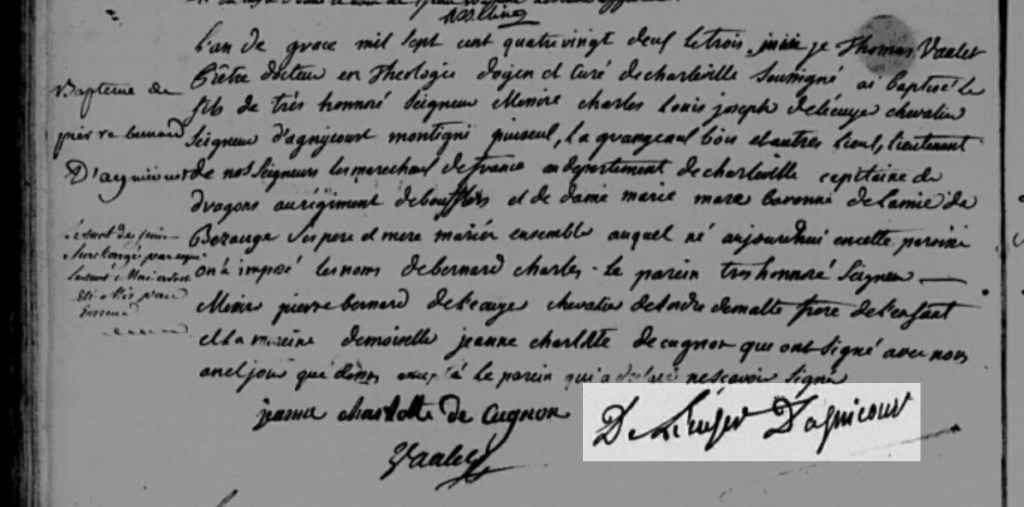
[EDEPOT/CHARLEVILLE/GG 73] – Charleville-Mézières (Ardennes, France) – BMD Records (Births, Marriages, Deaths) | 1, image 30 of 63
Eventually, the name evolved into its current form, Lescuyer, last name of my great-grandmother Madeleine Lescuyer. Here is my post about her.
This is a wonderful reminder that a French surname is not necessarily a fixed, unchanging label. Its form can evolve over time — and even the way a person signed his or her own name could vary from one period or record to another.
For genealogists, this is yet another reason not to rely solely on the exact form of a surname when determining whether two records concern the same family.
A surname was not necessarily spelled the same way
This is very important for French genealogy.
During the medieval and early modern periods, spelling was not standardized in the way it is today. Many people could not read or write. Priests, notaries and other record keepers often wrote names according to how they heard them. The same person could therefore appear under several spellings.
For example, a surname might appear with:
- different accents
- spaces or no spaces
- altered vowels
- different endings
- phonetic variations
And the spelling could change from one document to another.
🌿 For genealogists:
Don’t assume that a different spelling means a different family.
The surrounding evidence — place, parents, spouse, occupation, witnesses, dates — is often much more important than the exact spelling.
When did surnames become truly hereditary?
This is where the story becomes particularly interesting.
A name could begin as a description of one person, then gradually become associated with his descendants.
For example:
Jean, le meunier (the miller) → could become → Jean Meunier → and eventually → the Meunier family
The original occupation might disappear completely, while the name remained.
So a modern French surname can be a kind of linguistic fossil — preserving something about an ancestor who lived hundreds of years ago.
🌿 The role of parish registers
A major development for genealogists came in the 16th century.
1539 — the Ordinance of Villers-Cotterêts: King Francis I issued the Ordinance of Villers-Cotterêts in 1539.
Among other things, it required the keeping of baptismal and burial registers and required certain official records to be written in French rather than Latin. This was enormously important for later genealogists.
But there is an important distinction:
The 1539 ordinance did not create French surnames.
French family names had already existed for centuries.
Instead, the development of systematic parish records eventually gave us a much richer documentary trail through which we can follow those families.
You will find more information about this here Vital records (Parish and Civil registration) and on my Timeline of Historical Events in France and in the World page.
So… when did YOUR French ancestor get a surname?
The answer may be:
We don’t always know.
For some families:
- the surname can be traced back to medieval records;
- it may clearly come from an occupation or place;
- it may remain remarkably stable for centuries.
For others:
- the name may appear in different forms;
- the family may have acquired a hereditary surname relatively late;
- the earliest records may not survive;
- or the original meaning may simply have been lost.
Do you have a French-sounding last name?
✨

