
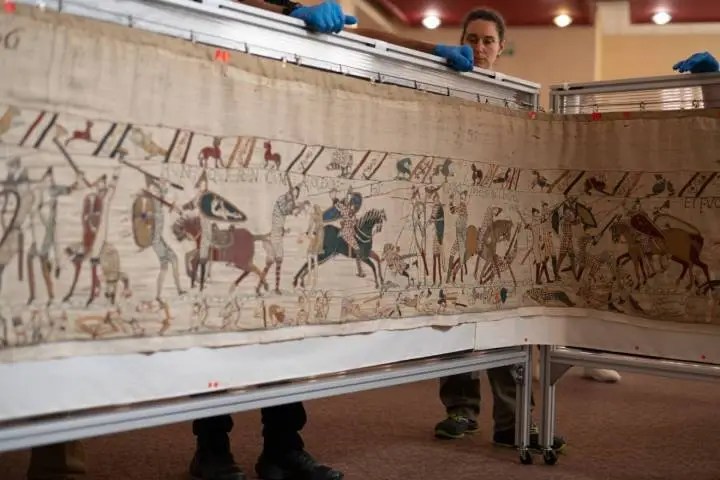
Nearly 1,000 years after the Norman Conquest, the Bayeux Tapestry is crossing the English Channel as part of an extraordinary cultural exchange between France and the United Kingdom.
I saw the Tapestry in Bayeux as a child. I don’t remember how old I was, but I still remember being speechless in front of it (pretty rare for me!).
✨
The Bayeux Tapestry leaves France
Something extraordinary is happening in 2026.
For the first time in its history, the Bayeux Tapestry, which tells the story of the Norman conquest of England in 1066, has left France to go to England. But this time, thankfully, there is no invasion! It is going as a very special guest.
On July 9, 2026, this nearly 1,000-year-old treasure left Bayeux, Normandy, on its journey to London. It arrived at the British Museum early the following morning, after crossing the English Channel through the Eurotunnel under exceptionally strict security.
And in just three days, on September 10, 2026, it will open to the public at the British Museum, where it will remain until July 11, 2027.
This video from the Ministère de la Culture is in French, but it gives a fascinating behind-the-scenes look at the Tapestry’s preparation and journey from France to England.
A cultural exchange between France and the United Kingdom
This historic loan is part of something even more interesting: a cultural exchange between France and the United Kingdom.
While France is lending the Bayeux Tapestry to the British Museum, the British Museum is lending important treasures to France. Among them is the famous Sutton Hoo treasure, which includes the extraordinary seventh-century Anglo-Saxon helmet and other objects from the ship burial discovered in Suffolk. The Lewis Chessmen, dating from the 12th century, are also among the objects being lent to France, along with other works.
There is something wonderfully symbolic about this exchange. France is sending England the story of the Norman conquest of England. Britain is sending France treasures from the Anglo-Saxon world that existed before the Norman Conquest.
Almost 1,000 years later, pieces of the two histories are meeting again — peacefully this time, on opposite sides of the Channel.
First, a little clarification: it isn’t technically a tapestry!
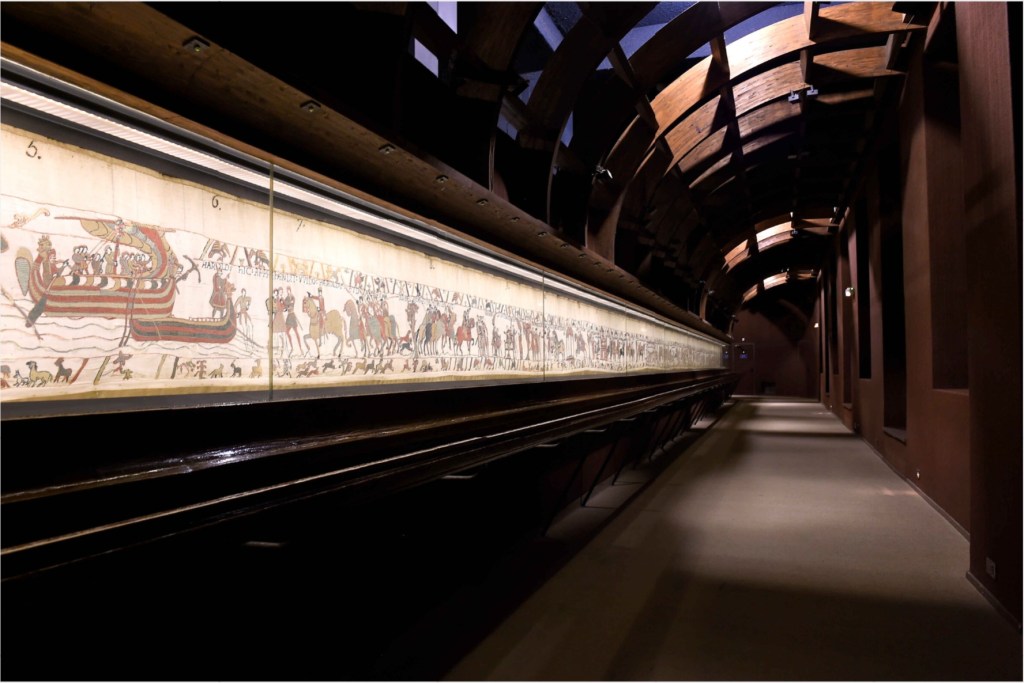
Although everyone calls it the Bayeux Tapestry, it is technically an embroidery. Instead of being woven on a loom, it was created with wool threads embroidered onto linen. And it’s enormous! It’s nearly 70 meters (230 feet) long and about 50 centimeters (20 inches) high. It contains 58 scenes telling the story of the events surrounding the Norman conquest of England in 1066. Hundreds of people, horses, ships, weapons, buildings and animals appear in the embroidery.
It is almost like an enormous medieval picture book — except that this picture book tells the story of events that changed the history of England and Normandy forever.
Here is what the Tapestry looks like:
The Bayeux Museum has a fantastic page, “Explore the Bayeux Tapestry online“, where you can view the Tapestry scene by scene with high resolution images. You can either scroll left and right or use the progress bar at the bottom to move between different views. You can also zoom in and out.
The Tapestry of Queen Mathilde?
For a very long time, the Bayeux Tapestry was known as the “Tapestry of Queen Mathilde” (la “Tapisserie de la Reine Mathilde”) — referring to Mathilde de Flandre, the wife of William the Conqueror.
According to the old romantic story, Mathilde and her ladies-in-waiting embroidered the enormous work themselves while William was away.
It is a beautiful story.
It is also almost certainly not what happened.
The Musée de la Tapisserie de Bayeux (Museum of the Bayeux Tapestry) explains that this image of Mathilde as a medieval Penelope is a romantic tradition rather than established history. Historians today do not know who actually created the embroidery, and the most widely accepted theory is that Odo, Bishop of Bayeux and William’s half-brother, commissioned it.
There is an amusing twist to the story, too.
The name “Tapestry of Queen Mathilde” became popular in the early 19th century, when Napoleon had the Tapestry brought from Bayeux to Paris in preparation for his planned invasion of England.
So even the Tapestry’s nickname has a history of its own!
Today, it is simply known as the Bayeux Tapestry — although “Tapestry of Queen Mathilde” remains one of its historical names.
The story of 1066
The story begins before the famous Battle of Hastings. We see Edward the Confessor, King of England, and Harold Godwinson, one of the most powerful men in England. Harold travels to Normandy and meets William, Duke of Normandy.
Then things become complicated.
After Edward’s death in January 1066, Harold becomes King of England. But William believes that he has a claim to the English throne for two reasons: Edward had promised him the English Crown, and Harold Godwinson had previously sworn an oath to support William’s claim.
That disagreement would lead to one of the most famous events in English history. William prepares an army and a fleet and crosses the English Channel. The Norman invasion begins.
The story culminates at the Battle of Hastings on October 14, 1066, where Harold’s army is defeated. William wins the English crown and becomes William the Conqueror. England enters a new chapter of its history.
More than a story about a battle
For genealogists and family historians, the Bayeux Tapestry can feel surprisingly personal.
For those of us who have managed to trace our family trees back into the medieval period, some of the people and families connected to this story may actually appear in our own ancestry.
William the Conqueror is one of my own ancestors, for example. So is Harold Godwinson.
And even when we cannot connect ourselves directly to a particular person depicted in the Tapestry, its scenes give us a fascinating glimpse into the world in which our medieval ancestors lived, revealing so many details of life in the 11th century.
Clothing. Horses. Ships. Weapons. Buildings. Animals. Customs. And even Halley’s Comet, which appears in the sky shortly before the Battle of Hastings.
The borders contain even more surprises, including real and imaginary animals and scenes inspired by the fables of Aesop.
These are not simply illustrations from a distant past. They help us imagine the world inhabited by the people we find, generation after generation, as we travel farther back through our family trees.
For a genealogist, that can make the Bayeux Tapestry feel remarkably close to home and help us make the distant past feel just a little less distant.
Where was the Bayeux Tapestry actually made?
And here we come to one of its great mysteries.
For centuries, its association with Bayeux naturally led people to think that it had been made in Normandy. But historians do not know for certain where it was created.
The French heritage database states very clearly that the place of creation is unknown, while noting that a widely shared hypothesis places its creation within the sphere of St Augustine’s Abbey in Canterbury, England.
The Bayeux Museum also says that the most common historical hypotheses point toward an Anglo-Saxon origin. Canterbury is one of the proposed locations.
The work was probably commissioned by Odo, Bishop of Bayeux and half-brother of William the Conqueror, perhaps for Bayeux Cathedral.
A remarkable survivor
The Bayeux Tapestry has survived almost a thousand years of European history. And it came surprisingly close to being lost.
1794 – During the French Revolution, it was reportedly in danger of being used as a military covering. The Commission des arts of the Bayeux district seized the Tapestry in the name of the Nation, thereby protecting it and making it public property.
1803–1804 – Napoleon brought the Tapestry to Paris while preparing his planned invasion of England. It was displayed at the Louvre from December 6, 1803, to February 18, 1804, allowing Napoleon to view this famous depiction of the Norman conquest of England. Did he see it as propaganda for his own planned conquest? Perhaps. The Bayeux Museum says this remains a question.
1941 – During the Second World War, the Nazis took a particular interest in the Tapestry. German researchers from the Ahnenerbe were assigned to study it because of its political and ideological significance.
1944 – As Allied forces advanced through Normandy, German authorities ordered the Tapestry to be transferred from its hiding place at Château de Sourches to the Louvre in Paris. It remained there until after the Liberation of Paris. It was finally returned to Bayeux in March 1945.
Yet it survived. Almost 1,000 years after its creation, it was still there — ready to tell its story again.
The Tapestry was documented in the treasury of Bayeux Cathedral in 1476, and the Bayeux Museum explains that it remained associated with the cathedral for approximately seven centuries.
Today, it is a French national historic monument and has been included in UNESCO’s Memory of the World Register since 2007.
And now, it has begun another extraordinary chapter in its long history.
From conquest to cultural exchange
There is something almost poetic about the Bayeux Tapestry crossing the English Channel in 2026.
In 1066, William and his Norman army crossed the Channel to conquer England.
In 2026, the Tapestry crosses that same Channel.
But this time, it travels peacefully.
It is not carrying an army.
It is carrying history.
After nearly 1,000 years, the story of the Norman Conquest is returning to England — not as a symbol of conquest, but as part of a remarkable cultural exchange between two countries whose histories have been intertwined for centuries.
🇫🇷 🇬🇧
🌿 Genealogy on my Geneanet tree
Here are the links to several pages on my Geneanet tree related to individuals, events or places mentioned in this post: (FYI: on Geneanet, the little “green circle” on an individual’s image indicates that the person is part of my direct lineage).
Note: Some individuals or events might appear “alone” on my tree, but be sure to check the links to other pages.
- William the Conqueror and his wife Mathilde de Flandre
- Odo, Bishop of Bayeux (William’s half-brother)
- Edward the Confessor
- Harold Godwinson
A few “History” pages linking to other individuals and events:
- History of France
- Norman Conquest of England in 1066
- Battle of Hastings (October 14, 1066)
- French Revolution (1789-1799)
- Napoleon
- World War II (1939-1945)
- History of England
- Halley’s Comet
- St Augustine’s Abbey in Canterbury, England
- UNESCO
Sources used to prepare this post:
- French Ministry of Culture — Tapisserie de Bayeux: un prêt historique
- French Ministry of Culture — The Bayeux Tapestry Arrived at the British Museum
- Bayeux Museum — Discover the Bayeux Tapestry
- French Ministry of Culture — POP Heritage Database
- BnF — Bayeux Tapestry
- UNESCO — Memory of the World

