

One year to remember: 1792
No… it’s not my year of birth… it’s the year that will help you to determine where to research your ancestors’ birth, marriage, and death records.
| Before 1792: Registres paroissiaux (parish records) | After 1792: Registres d’État civil (civil registration) |
| * 1539: baptisms and burials records are kept by priests at the request of King Francis I of France (it’s called the Ordonnance de Villers-Cotterêts) * 1579: King Henri III of France adds the mandatory recording of marriages (it’s called the Ordonnance de Blois) | * On September 20, 1792, the recording of baptisms, marriages and deaths previously done by priests were taken away from the Church and given to city officials. They became “civil registration”. |
As discussed in the “Researching in France” section, you can find tons of free French records online without having to create an account. Birth, marriage, death, census, military, war, notaries records, to name a few. All of these records are organized by department (département), and each département has its own website, with its own digitized archives. While some departments might organize their website and online archives a little differently, you can usually find the above records on a page/section called “Archives numérisées” (digitized archives) or “Documents numérisés” (digitized documents).
If you see “Archives en salle de lecture“, it means that archives are only available in person, not online.
The older the records, the more difficult they are to decipher. However, they exist. Well… most of the time.
If you can’t find a record online, it could be for one of the following reasons:
- You’ve climbed pretty high back in time on your tree, and records were not mandatory, yet;
- They haven’t been digitized and uploaded yet;
- The “Tribunal de Grande Instance” (Court of major instance) hasn’t yet registered them.
What you will not find online
Vital records (birth, marriage and death) of the previous 100 years from the date of your research are confidential to protect the privacy of living individuals.
If it has been more than 100 years and the record is still not available, it might be because they haven’t been digitized and uploaded yet. In that case, you can contact the town halls (mairies) directly to obtain them (records are free).
If it hasn’t been 100 years but you are a direct descendant of this person, there too, contact the town hall of your ancestor’s birth, marriage or death location to request their certificate(s). You will need to provide a proof of direct descendance (your name, DOB, your parents, grandparents’ DOB, mariage, etc, the more information you can provide the better).
You could also find information in the “Tables de succession et absences” section. These were mandatory records of deceased people established after the French Revolution for taxe purposes (the law passed on 22 frimaire an VII (December 12, 1798). These tables are also available in the digitized archives of French departments.
Mentions marginales (marginal annotations)
“Mentions marginales“, or marginal annotations, are entries of a civil status made in the margin of a civil record, indicating the content of another record. They are a great source of information! You may find vital record information that is not available online yet in an actual marriage or death record.
Below is a perfect example of this. It is the birth certificate of my great-grandfather, Eugène Berjot (1883-1963). Because he died “within the last 100 years”, his death record won’t be available online for awhile. However, the date of his death is listed on his birth certificate, as well as his two marriages! All I had to do was to find his date of divorce from his first marriage. For this, I sent an email to the Mairie de Montdauphin (77) (town hall of Montdauphin) to request the marriage certificate of Eugène with his second wife, my great-grandmother, Fernande Monclin. They emailed me back their marriage certificate, which contained, in the margin, his divorce information from his first marriage! Did I mention that adding his first marriage and their children to my tree lead to my finding new living cousins with whom I am now in contact? Ah, the beauty of genealogy!
Here is what’s listed on his birth certificate:
- His first marriage (city, department, date of the marriage, name of his spouse, date the city official wrote the annotation on the record)
- His second marriage (city, department, date of the marriage, name of his second spouse, my great-grandmother, date the city official wrote the annotation on the record)
- His death information (city, department, date of his death, date the city official wrote the death annotation on the record)
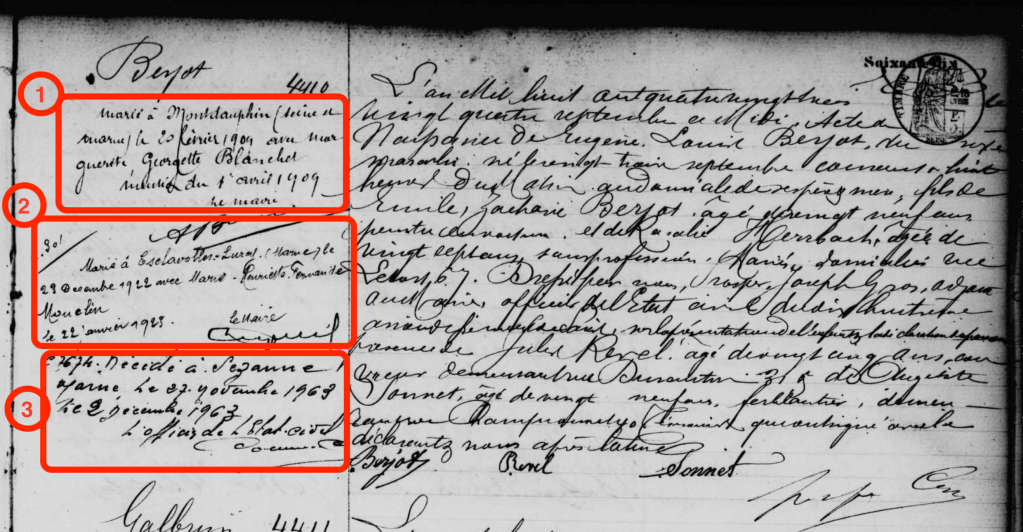
Some departments don’t have a “permalink” for archives, like on this birth certificate. So if you click on the link above, it will take you to the first page of the records. On the bottom right of the page, you will be able to select the page, or “vue” (view), 17.
Example to find a birth certificate
I will give the steps to find my great-grandfather’s birth certificate. He was born in Paris (that tiny village in France. You know, the one with the Eiffel Tower?)
Let’s pretend I didn’t know his exact date of birth so that we can first search for him in the “tables décennales” (ten-year index).
- Do an online search for “Archives de Paris”
- Click on their website: https://archives.paris.fr/
- Click on “Archives numérisées” at the top of the page
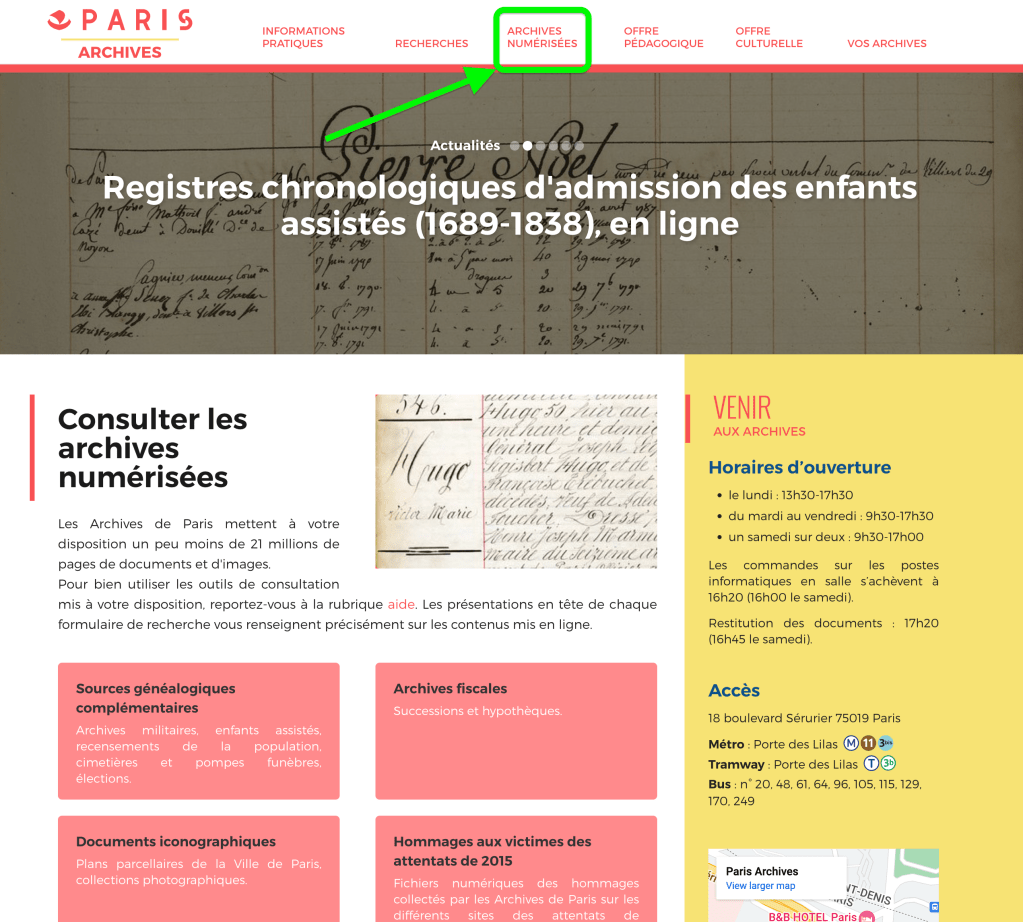
- Click on “État civil de Paris“
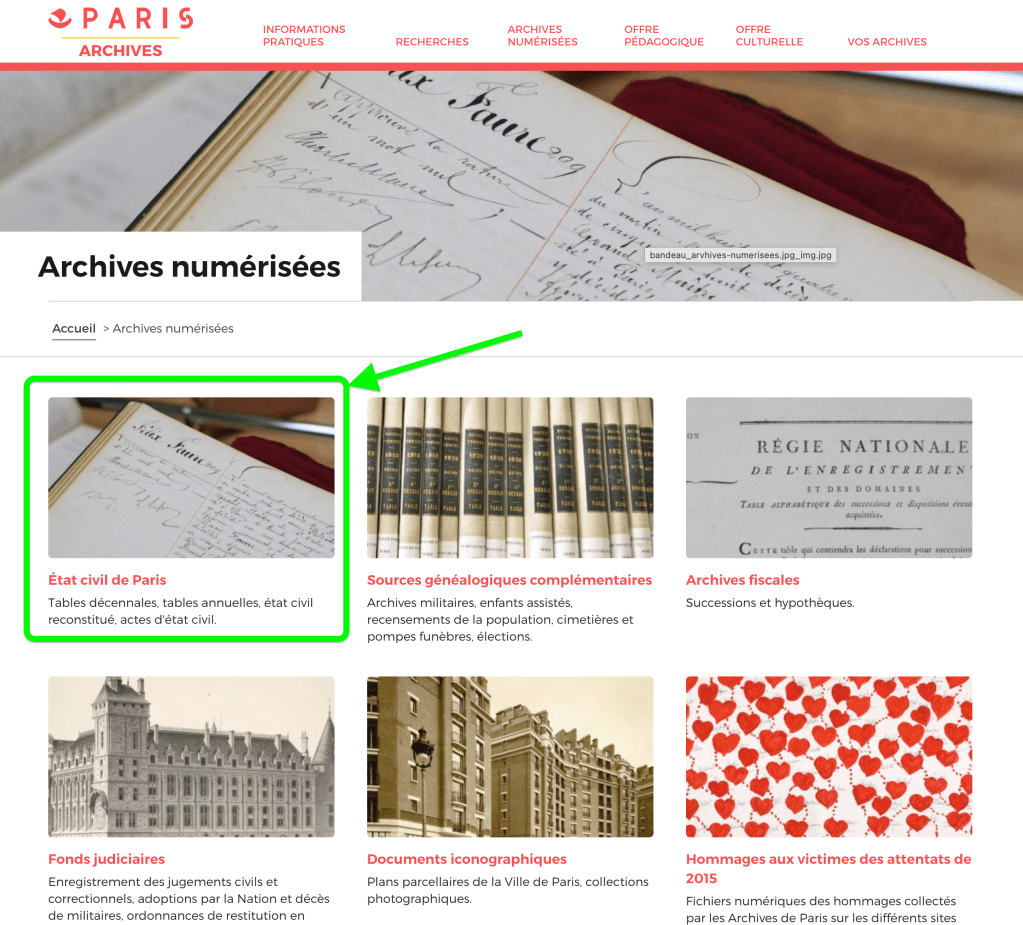
- Click on “État civil à partir de 1860“
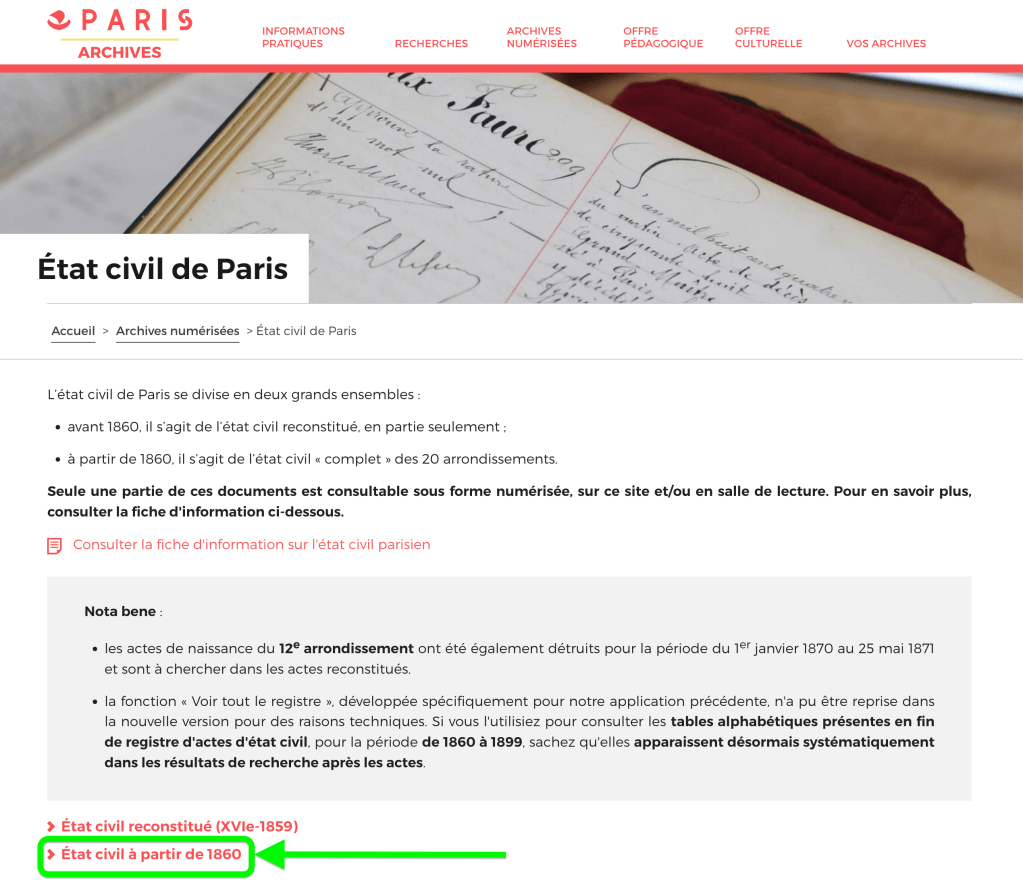
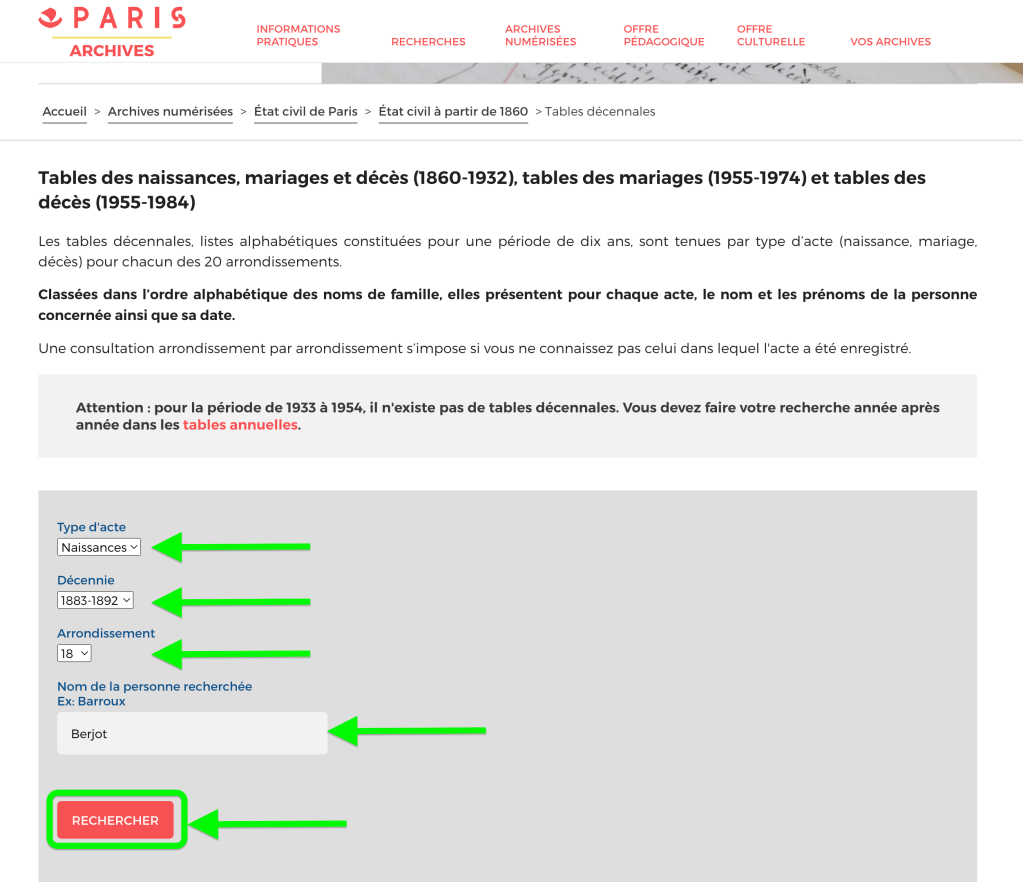
- Click on “Tables décennales”

- Scroll down to the bottom of the page and fill out the information you have, or try different options for “décennie” (decade) and “arrondissement” (Paris has 20 “arrondissements” (districts).
- Click on “Rechercher” (search)
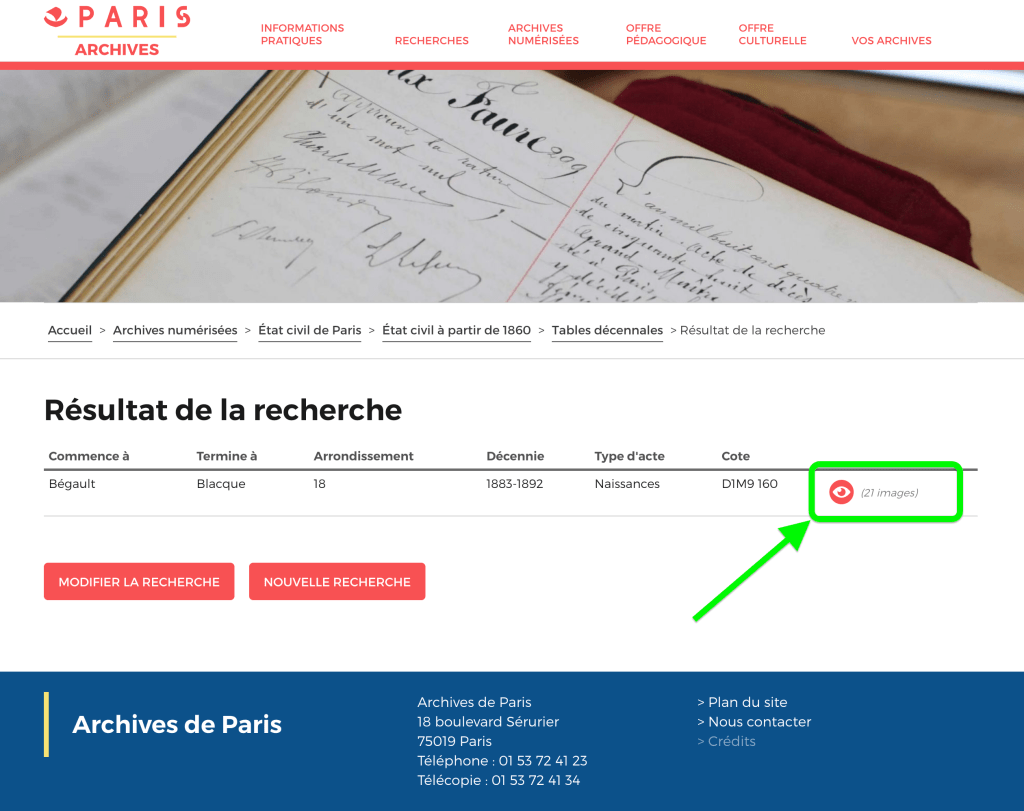
The next page indicates that 21 images are available. The index starts with (commence à) the last name “Bégault” and ends with (termine à) the last name “Blacque”. So my great-grandfather, with the last name “Berjot”, should be listed somewhere in this record. Let’s find out by clicking on “21 images”.
He is on page (vue) 6/21. Take note of the date on the right (it’s usually the date the “acte” (record) was written), and also notice if you see anybody with the same last name on this page: they might be his relatives (write down their own dates too).

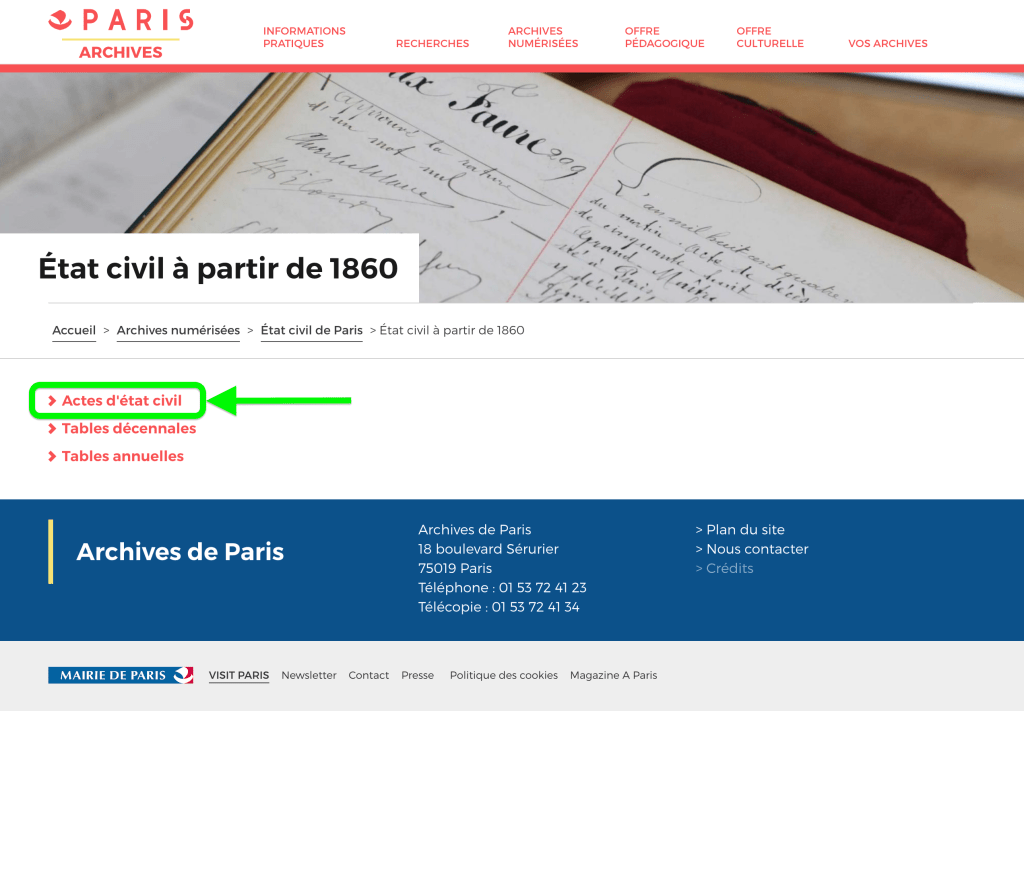
Close the “tables décennales” window and go back to the page “État civil à partir de 1860” on the site of the Archives of Paris.
- This time, click on “Actes d’état civil“
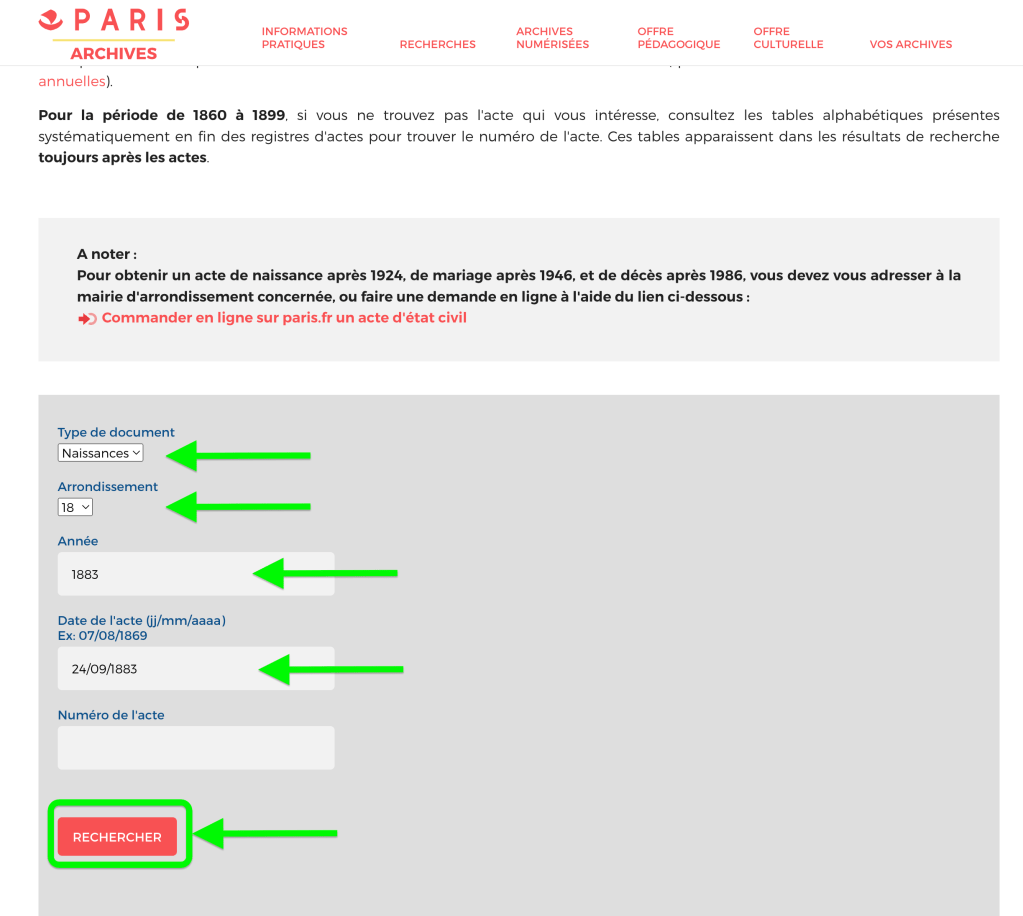
- Scroll down to the bottom section and fill out the information you have.
- Click on “Rechercher” (search)
You will see the page below. Click on the images icon of the top result which will display all the records (the second result indicates the index).
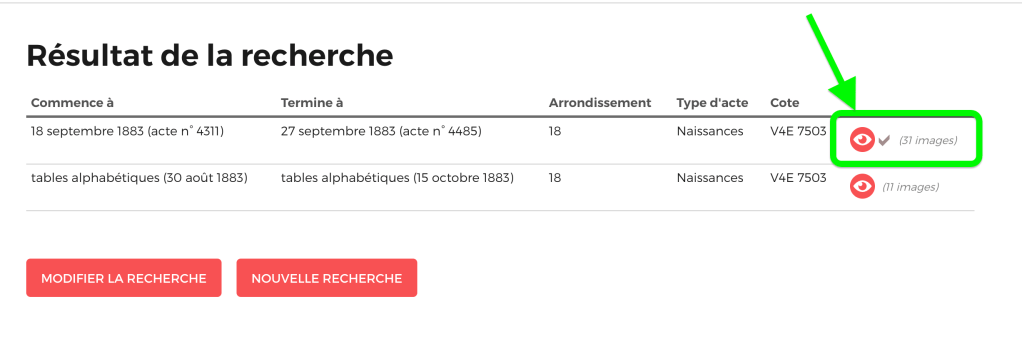
It will open to the very first page of the records (31 pages, or “vues“). Use the navigation on the bottom right of the page to find your ancestor!

 My French Lineage