Major historical events that shaped French genealogy and records
What historical events in France and in the world were happening during our ancestors’ lives? Which major discovery made their lives easier? Did they participate in world events? Did they move to a different village, country or continent because of a war, an epidemic, or religious persecution?
Here are just a few of the Historical events that happened during our ancestors’ lives to help us understand better the individuals we are researching.
This timeline combines major events in French and world history with genealogy perspectives, helping readers understand the historical context in which their ancestors lived.
How to use this timeline
✔ Match your ancestors’ lifetime to events below
✔ Focus on record changes, migrations and wars
✔ Click on each arrow to expand sections for content
*** Timeline updated 2026-MAY-18: all the hyperlinks within the century sections take you to the respective events, monuments, or individuals on my Geneanet tree. As we go further back in time, my ancestors are probably yours too.
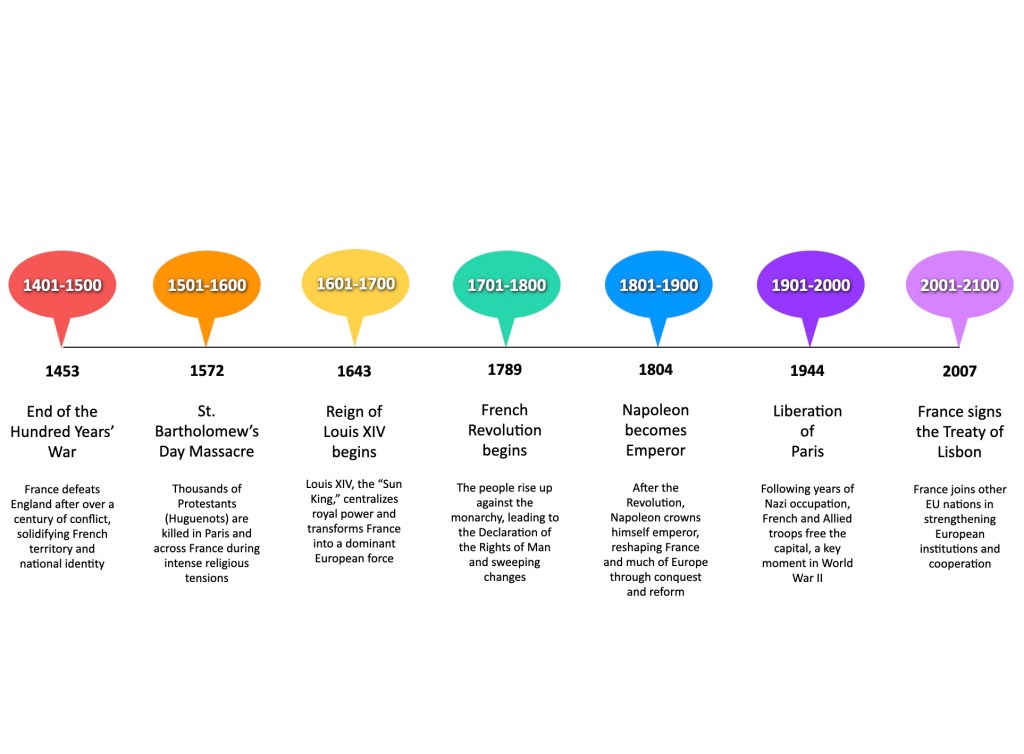
Jump to a century
1st • 2nd • 3rd • 4th • 5th • 6th • 7th • 8th • 9th • 10th • 11th • 12th • 13th • 14th • 15th • 16th • 17th • 18th • 19th • 20th • 21st
Browse events by topic
🔵 Records • 🔴 Wars • 🟢 Migration • 🟡 Society • 🟣 Religion
🔵 Genealogy records & Administration (parish registers, civil registration, censuses)
🔴 Wars & Conflicts (wars, invasions, revolutions)
🟢 Migration & Population (emigration waves, settlement movements)
🟡 Society & Innovation (printing press, railways, industrialization, major social changes)
🟣 Religion
🌿 Indicates a Major genealogy turning point
Jump to 12 Key Events That Shaped French Genealogy
1st century (1-100) (Ier siècle)
The 1st century sees the Roman Empire reach the height of its power while Gaul becomes increasingly Romanized. Cities, roads, monuments, and trade flourish across what is now France. Christianity emerges in the eastern Mediterranean and gradually spreads westward, laying foundations that will profoundly shape European history. Several Roman emperors rule during the century, while the destruction of Jerusalem and the eruption of Mount Vesuvius become defining events of the ancient world.
🟡 c. AD 8
Census of Gaul 🌿
(Recensement de la Gaule)
Rome conducts censuses throughout Gaul to collect taxes, organize administration, and record populations.
Your ancestors:
➤ Roman censuses help organize taxation and local administration, although the records themselves have not survived.🟡 AD 14
Augustus dies; Tiberius becomes Roman Emperor
(Mort d’Auguste ; Tibère devient empereur romain)
After the death of Augustus, Tiberius succeeds him as Roman Emperor, ensuring continuity across the Empire, including Gaul.
Your ancestors:
➤ Greater political stability encourages commerce, road maintenance, taxation, and urban development across Roman Gaul.🟡 AD 21
Revolt of Sacrovir
(Révolte de Sacrovir)
Gaulish nobles Julius Sacrovir and Julius Florus lead a rebellion against Roman rule before being defeated.
Your ancestors:
➤ Families living in central and northeastern Gaul may experience the effects of military operations and political repression.🟣 AD 33
Crucifixion of Jesus Christ 🌿
(Crucifixion de Jésus-Christ)
Jesus Christ is crucified in Jerusalem. His death and the belief in His Resurrection become the foundation of Christianity.
Your ancestors:
➤ Christianity begins as a small movement within the Roman Empire and gradually spreads across Europe. It will profoundly shape the history, culture, laws, and records that future generations of your French ancestors leave behind.🟡 c. AD 40
Lugdunum (modern Lyon) reaches its peak 🌿
(Lugdunum (Lyon) atteint son apogée)
Lugdunum (modern Lyon) grows into one of the largest and most important cities in Roman Gaul.
Your ancestors:
➤ Urban life expands, bringing improved roads, commerce, public baths, and economic opportunities.🔴 AD 43
Roman conquest of Britain (modern Great Britain)
(Conquête romaine de la Bretagne insulaire (Grande-Bretagne actuelle))
Emperor Claudius launches the Roman conquest of Britain (modern Great Britain), using Gaul as the principal base for troops and supplies.
Your ancestors:
➤ Communities along the northern coast of Gaul participate in military logistics and trade with Britain.🟡 AD 48
Claudius opens the Roman Senate to Gallic nobles
(Claude ouvre le Sénat romain aux notables gaulois)
Emperor Claudius allows leading men from Gallia Comata to enter the Roman Senate, strengthening the integration of Gaul into the Roman Empire.
Your ancestors:
➤ Local elites gain greater political influence within the Roman Empire.🟣 c. AD 50
Christianity begins reaching Gaul 🌿
(Le christianisme commence à atteindre la Gaule)
Christian missionaries, evangelizers, merchants, travelers, and soldiers gradually introduce Christianity into Roman Gaul. Some early Christian communities begin forming in major cities.
Your ancestors:
➤ Although Christianity remains a small minority at first, its gradual spread will profoundly transform French society and the future development of parish records and genealogy.🟣 AD 64
Great Fire of Rome under Emperor Nero
(Grand incendie de Rome sous l’empereur Néron)
A devastating fire destroys much of Rome during the reign of Emperor Nero. Suspected by some of having caused the disaster, Nero blames Christians for the fire and begins one of the first major persecutions of Christians in the Roman Empire.
Your ancestors:
➤ Although Christianity remains a small minority, persecutions under Roman emperors shape the history of the early Church that will later become central to European society.🟣 c. AD 66
Saint Martial traditionally evangelizes Limoges 🌿
(Saint Martial évangélise traditionnellement Limoges)
According to later Christian tradition, Saint Martial begins preaching in Limoges during the 1st century.
Your ancestors:
➤ This tradition reflects the earliest remembered beginnings of Christianity in parts of Gaul.🔴 AD 66
First Jewish–Roman War begins
(Début de la première guerre judéo-romaine)
The First Jewish-Roman War is a major revolt that begins in Judaea against Roman rule. The Roman campaign is led by generals Vespasian and his son Titus, while Jewish forces include leaders such as Yosef ben Matityahu (Josephus), who later records the events of the war as the historian Flavius Josephus.
Note: Josephus did not remain a leader of the revolt throughout the war. He commanded Jewish forces in Galilee in 66–67, surrendered to Vespasian, and later became an advisor and historian under Roman patronage.
Your ancestors:
➤ The destruction of Jerusalem and the Jewish diaspora that follows become major events in the history of the Roman Empire and the development of Christianity.🔴 AD 70
Siege and Destruction of Jerusalem by Titus
(Siège et destruction de Jérusalem par Titus)
Roman forces under the command of Titus, son of Emperor Vespasian, capture Jerusalem and destroy the Second Temple during the First Jewish-Roman War. This event is recorded in detail by the Jewish historian Flavius Josephus in Books V and VI of The Jewish War.
Your ancestors:
➤ The destruction of Jerusalem becomes a major turning point in Jewish history and profoundly influences the development of Christianity and the Roman world.🟡 AD 79
Eruption of Mount Vesuvius
(Éruption du Vésuve)
October 24, 79. Mount Vesuvius erupts and buries the Roman cities of Pompeii and Herculaneum under volcanic ash. The disaster preserves an extraordinary record of daily life in the Roman Empire. Historian Pliny the Elder dies during the eruption while attempting to help friends trapped near the volcano.
Your ancestors:
➤ The archaeological discoveries at Pompeii and Herculaneum provide valuable insights into the lives, homes, occupations, and customs of people living under Roman rule.🟡 c. AD 80
Roman roads expand across Gaul 🌿
(Le réseau routier romain se développe en Gaule)
Roman engineers continue improving roads linking major cities throughout Gaul.
Your ancestors:
➤ Better roads improve travel, commerce, communication, and military movement throughout the country.
Or jump to a century: • 1st • 2nd • 3rd • 4th • 5th • 6th • 7th • 8th • 9th • 10th • 11th • 12th • 13th • 14th • 15th • 16th • 17th • 18th • 19th • 20th • 21st
2nd century (101-200) (IIe siècle)
The 2nd century is one of the most peaceful and prosperous periods of the Roman Empire. Roman Gaul flourishes with thriving cities, roads, trade, aqueducts, and public monuments. Christianity begins to spread quietly despite periodic persecution, while Rome reaches its greatest territorial extent under Emperor Trajan before entering a slower period of transition under Marcus Aurelius.
🟡 107 🌿
Construction of the Aqueduct of Gier reaches Lugdunum
(Construction de l’aqueduc du Gier jusqu’à Lugdunum)
One of the longest Roman aqueducts supplies fresh water to Lugdunum (modern Lyon), supporting its growth as one of Gaul‘s greatest cities.
(Note: It’s also in 107, but in Rome, that the construction of Trajan’s Column begins.)
Your ancestors:
➤ Better water supplies improve sanitation, agriculture, crafts, and daily life for thousands of families living around Lugdunum.🟡 117 🌿
Trajan dies; Hadrian becomes Roman Emperor
(Trajan meurt ; Hadrien devient empereur romain)
Emperor Hadrian succeeds Trajan and shifts imperial policy from expansion to strengthening borders and improving administration throughout the empire, including Gaul.
Your ancestors:
➤ Greater political stability encourages commerce, road maintenance, taxation, and urban development across Roman Gaul.🟡 c. 120🌿
Roman roads in Gaul continue major expansion
(Le réseau routier romain continue de s’étendre en Gaule)
The Roman road network reaches an exceptional level of development, linking towns, military camps, and ports across Gaul.
Your ancestors:
➤ Improved roads make travel, trade, military service, and communication easier for ordinary people.🟡 122
Hadrian’s Wall (United Kingdom)
(Mur d’Hadrien en Angleterre)
Emperor Hadrian orders the construction of the Hadrian’s Wall to defend the northern frontier of Roman Britain.
🟣 c. 150 🌿
Christianity spreads into Roman Gaul
(Le christianisme se diffuse en Gaule romaine)
Christian communities gradually appear in several Gallic cities through merchants, soldiers, and travelers arriving from other parts of the empire.
Your ancestors:
➤ Early Christian communities begin appearing in Roman Gaul. Some later French Christian traditions trace their origins to this period.🟡 161
Marcus Aurelius becomes Roman Emperor
(Marc Aurèle devient empereur romain)
Marcus Aurelius begins his reign and governs during a period marked by both philosophical achievement and increasing military challenges.
🔴 165🌿
Antonine Plague reaches the Roman Empire
(La peste antonine atteint l’Empire romain)
A devastating epidemic called the Antonine Plague spreads throughout the Roman Empire, reducing the population and affecting cities, trade, and the army. I will last until 190.
Your ancestors:
➤ Many families experience illness, labor shortages, economic disruption, and demographic decline.🔴 170
Germanic raids threaten Roman frontiers
(Les raids germaniques menacent les frontières romaines)
Germanic peoples increase pressure along Rome‘s northern frontiers, forcing greater military efforts to defend the empire.
🟣 177 🌿
Martyrs of Lyon (Persecution in Lyon)
(Les martyrs de Lyon)
Christians in Lugdunum (modern Lyon) suffer persecution under Emperor Marcus Aurelius. Among the victims are Blandina, Pothinus (the first known bishop of Lyon), and many other believers.
🟡 180
Commodus becomes Roman Emperor
(Commode devient empereur romain)
Emperor Commodus succeeds Marcus Aurelius. His reign marks the end of the period traditionally known as the “Five Good Emperors.”
🔴 193
Year of the Five Emperors
(L’année des Cinq Empereurs)
Following political turmoil after Emperor Commodus‘ death, five men claim the imperial throne before Septimius Severus establishes control.
Those five men are: Pertinax, Didius Julianus, Pescennius Niger, Clodius Albinus, and Septimius Severus.
🟡 197 🌿
Septimius Severus strengthens Roman administration in Gaul
(Septime Sévère renforce l’administration romaine en Gaule)
Following his victory in the civil wars, Septimius Severus reorganizes and reinforces imperial authority throughout the western provinces, including Gaul.
Your ancestors:
➤ Stronger administration brings greater military security, taxation, infrastructure maintenance, and economic stability.
Or jump to a century: • 1st • 2nd • 3rd • 4th • 5th • 6th • 7th • 8th • 9th • 10th • 11th • 12th • 13th • 14th • 15th • 16th • 17th • 18th • 19th • 20th • 21st
3rd century (201-300) (IIIe siècle)
The 3rd century is a period of major crisis and transformation in the Roman Empire. Gaul experiences invasions, political instability, and economic difficulties, but also important cultural changes. Christianity spreads gradually despite persecution. The century ends with the reforms of Emperor Diocletian, which reshape the administration of the Empire and prepare the transition toward Late Antiquity.
🟡 212 🌿
Edict of Caracalla grants Roman citizenship throughout the Empire
(Édit de Caracalla : la citoyenneté romaine accordée dans tout l’Empire)
Emperor Caracalla grants Roman citizenship to almost all free inhabitants of the Roman Empire, including people living in Roman Gaul. This creates more complete legal records for many families living under Roman rule.
Your ancestors:
➤ Ancestors living in Roman Gaul may have gained Roman citizenship through this decree, although surviving genealogical records from this period are extremely rare.🔴 235
Beginning of the Crisis of the Third Century
(Début de la crise du IIIe siècle)
The assassination of Emperor Alexander Severus begins a period of political instability known as the Crisis of the Third Century. The Roman Empire faces civil wars, economic problems, and repeated invasions.
🔴 240s
Germanic raids into Roman Gaul (240s–260s)
(Incursions germaniques en Gaule romaine)
Germanic groups, including the Franks and the Alamanni, cross the Rhine frontier and raid parts of Roman Gaul. Roman defenses weaken during the wider imperial crisis.
Your ancestors:
➤ Ancestors living in northern or eastern Gaul may have experienced these migrations, conflicts, or population movements along the Rhine frontier.🟣 250 🌿
Beginning of the Decian persecution of Christians
(Début de la persécution de Dèce contre les chrétiens)
Emperor Decius orders Christians throughout the Empire to perform sacrifices to the Roman gods. Many Christians refuse, creating the first empire-wide persecution.
Your ancestors:
➤ Early Christian communities begin appearing in Gaul. Some later French Christian traditions trace their origins to this period.🟣 250s 🌿
Saint Denis traditionally arrives in Gaul and becomes first bishop of Paris
(Saint Denis arrive traditionnellement en Gaule et devient premier évêque de Paris)
According to Christian tradition, Denis is sent as a missionary to Gaul and becomes the first bishop of Paris. He is later considered the patron saint of Paris.
The Basilica of Saint-Denis (built in 639) is dedicated to him; it was built on the place where he was buried. (The present building dates from the 12th century, but the sacred site and royal abbey tradition go back to the Merovingian period.)
Your ancestors:
➤ If your ancestors lived around Paris in later centuries, they lived in a region shaped by this early Christian tradition.(Note: the exact historical dates of Saint Denis are uncertain; the mid-3rd century is the traditional dating.)
🔴 260
Creation of the Gallic Empire
(Création de l’Empire des Gaules)
During the Roman crisis, several western provinces including Gaul separate from imperial control. A series of rulers governs the so-called Gallic Empire until reunification with Rome.
Your ancestors:
➤ Ancestors in Gaul lived through a period when local authorities temporarily replaced direct Roman imperial rule.🔴 274
Emperor Aurelian reunifies the Gallic Empire with Rome
(L’empereur Aurélien réintègre l’Empire des Gaules dans Rome)
Emperor Aurelian defeats the Gallic ruler Tetricus and restores Roman unity in Gaul.
🟡 284
Diocletian becomes Emperor and begins major reforms
(Dioclétien devient empereur et entreprend de grandes réformes)
Emperor Diocletian reorganizes the Roman Empire, strengthening administration and dividing responsibilities between rulers. These reforms transform the structure of Roman government.
🟣 286
Creation of the Diocese of Gaul under Diocletian’s reforms
(Création du diocèse des Gaules dans les réformes de Dioclétien)
The Roman administration reorganizes Gaul into larger administrative units, preparing the structure that will define Late Roman Gaul.
Your ancestors:
➤ Administrative changes influence later records, church organization, and the development of local communities that eventually appear in medieval sources.🔴 287–288
Frankish and Saxon raids along the northern Gallic coast
(Raids francs et saxons sur les côtes du nord de la Gaule)
Frankish and Saxon groups attack Roman territories along the northern coast. Rome strengthens coastal defenses.
By 300, Roman Gaul is still part of the Roman Empire, but the foundations of medieval France are beginning to appear: stronger Christianity, changing populations, new administrative structures, and increasing influence of Germanic peoples.
Or jump to a century: • 1st • 2nd • 3rd • 4th • 5th • 6th • 7th • 8th • 9th • 10th • 11th • 12th • 13th • 14th • 15th • 16th • 17th • 18th • 19th • 20th • 21st
4th century (301-400) (IVe siècle)
The 4th century marks one of the great turning points of European history. Christianity rises from persecution to become the dominant religion of the Roman Empire, while Roman authority in Gaul begins to weaken under increasing pressure from Germanic peoples. New cities flourish, Roman administration evolves, and the foundations of medieval Europe slowly begin to emerge. Although France does not yet exist, Roman Gaul becomes the stage on which many future developments of French history are prepared.
🟣 313
Edict of Milan
(Édit de Milan)
Christianity becomes legal throughout the Roman Empire after centuries of persecution. Churches can openly worship, own property, and grow rapidly.
Your ancestors:
➤ If your ancestors lived in Roman Gaul, this marks the beginning of Christianity becoming part of everyday life.🟣 314 🌿
Council of Arles
(Concile d’Arles)
A major church council organized by Emperor Constantine I meets in Arles (Gaul) to settle disputes within Christianity. It demonstrates the growing importance of Gaul in the Christian world.
Your ancestors:
➤ Arles becomes one of the earliest major Christian centers in Gaul, influencing religious life for generations.🟣 325
First Council of Nicaea
(Premier concile de Nicée)
The first ecumenical council, organized by Roman Emperor Constantine I, defines core Christian beliefs and adopts the Nicene Creed, helping unify Christian doctrine.
Your ancestors:
➤ The beliefs established here shape the Christian faith practiced by most of your European ancestors.🟡 330
Byzantium becomes Constantinople
(Byzance devient Constantinople)
(Constantinople will be officially renamed Istanbul in 1930).
Emperor Constantine I officially dedicates Constantinople, enlarging and renaming the ancient city of Byzantium, which becomes the new eastern capital of the Roman Empire.
🔴 355 🌿
Julian becomes Caesar in Gaul
(Julien devient César en Gaule)
Emperor Constantius II appoints Julian as Caesar (junior emperor) to govern Gaul. Julian restores order after years of Germanic invasions.
Your ancestors:
➤ Roman authority temporarily strengthens in Gaul, improving security for local communities.🟣 360 🌿
Julian proclaimed Augustus in Paris
(Julien est proclamé Auguste à Paris)
Roman troops proclaim Julian Augustus (Emperor) at Lutetia (Paris). Paris briefly becomes the center of imperial politics.
Your ancestors:
➤ Paris gains prestige that contributes to its future importance in French history.🟣 380
Christianity becomes the official religion of the Roman Empire
(Le christianisme devient la religion officielle de l’Empire romain)
Emperor Theodosius I declares Nicene Christianity the official religion of the Roman Empire.
Your ancestors:
➤ Christianity now becomes the dominant religious tradition throughout Roman Gaul.🟡 382 🌿
Roman treaty with the Visigoths
(Traité entre Rome et les Wisigoths)
The Roman Empire allows the Visigoths to settle within imperial territory as federate allies. This changes the balance of power inside the Empire.
Your ancestors:
➤ This marks the beginning of the settlement of Germanic peoples who will later establish kingdoms in Gaul.🔴 394
Battle of the Frigidus
(Bataille de la rivière froide ou Bataille du Frigidus)
Emperor Theodosius I defeats the western usurper Eugenius, briefly reuniting the Roman Empire under one emperor.
🟡 395
Permanent division of the Roman Empire
(Division définitive de l’Empire romain)
After the death of Emperor Theodosius I, the Roman Empire is permanently divided into Western and Eastern Empires.
Or jump to a century: • 1st • 2nd • 3rd • 4th • 5th • 6th • 7th • 8th • 9th • 10th • 11th • 12th • 13th • 14th • 15th • 16th • 17th • 18th • 19th • 20th • 21st
5th century (401-500) (Ve siècle)
The 5th century marks the end of Roman rule in Western Europe and the rise of new Germanic kingdoms. In Gaul, the Franks gradually expand their power, while the Roman administration disappears. The century witnesses major migrations of peoples, the fall of the Western Roman Empire in 476, and the beginning of the Merovingian dynasty with Clovis, whose conversion to Christianity prepares the foundation of medieval France.
The 5th century also marks the beginning of the Middle Ages (476), following the fall of the Western Roman Empire.
🔴 406
Crossing of the Rhine by Germanic peoples
(Passage du Rhin par les peuples germaniques)
December 31, 406 – Germanic peoples, including Vandals, Alans, and Suebi, cross the frozen Rhine frontier and enter Roman Gaul, accelerating the weakening of Roman control. It is considered a climactic moment in the decline of the Western Roman Empire.
Your ancestors:
➤ Your Gallo-Roman ancestors may have lived through this period of instability, migrations, and changes in political authority. Many families remained attached to local Roman traditions despite new rulers.🔴 410
Sack of Rome by the Visigoths
(Sac de Rome par les Wisigoths)
The Visigoths under King Alaric I capture and sack Rome, a shocking event that symbolizes the decline of the Western Roman Empire.
🟣 410s
Christianity spreads further in Gaul
(Expansion du christianisme en Gaule)
Christian communities grow throughout Gaul, and bishops increasingly become important local leaders as Roman institutions weaken.
Your ancestors:
➤ For genealogy, this period is important because many later medieval families and places preserve traditions connected to early Christian foundations, saints, and bishoprics.🔴 451 🌿
Battle of the Catalaunian Plains (Battle of the Campus Mauriacus)
(Bataille des champs Catalauniques)
A coalition led by the Roman general Aetius and King Theodoric I of the Visigoths defeats Attila the Hun in Gaul, stopping further westward expansion of the Huns.
Your ancestors:
➤ Ancestors living in northern and eastern Gaul may have experienced the consequences of warfare, population movements, and changing political alliances.🔴 455
Sack of Rome by the Vandals
(Sac de Rome par les Vandales)
The Vandals capture and plunder Rome, further demonstrating the collapse of imperial authority in the West.
🟡 476 🌿
Fall of the Western Roman Empire
(Chute de l’Empire romain d’Occident)
The Germanic leader Odoacer removes Emperor Romulus Augustulus, traditionally marking the end of the Western Roman Empire.
Your ancestors:
➤ This is one of the greatest turning points for European genealogy. After 476, written records become much rarer, and family history increasingly depends on later medieval documents, noble genealogies, and church records.🟡 476 🌿
Beginning of the Middle Ages
(Début du Moyen-Âge)
The Western Middle Ages is the period of history between Antiquity and the Modern Era, traditionally dated from 476 AD (the fall of the Western Roman Empire) to 1492 AD (Christopher Columbus’s first voyage to the Americas, marking the beginning of European exploration of the New World).
Your ancestors:
➤ The beginning of the Middle Ages marks a major transition in the lives of your ancestors. After the fall of the Western Roman Empire, populations in Gaul experience new political rulers, migrations, and social structures. Over the following centuries, Roman traditions blend with Frankish and other Germanic influences, creating the foundations of medieval France. For genealogists, this period marks the gradual transition from ancient written sources to medieval records preserved mainly through churches, monasteries, and later noble genealogies.🟡 481 🌿
Clovis becomes King of the Franks
(Clovis devient roi des Francs)
Clovis I, leader of the Salian Franks, succeeds his father Childeric I and begins expanding Frankish power in Gaul.
Your ancestors:
➤ If you have medieval French ancestry, the Merovingian dynasty represents the beginning of the long political tradition that eventually leads to the Kingdom of France.🔴 492 🌿
Franco-Visigothic Wars (492-508)
(Guerres franco-wisigothiques)
The Franco-Visigothic Wars were a series of wars involving the Franks (Clovis I), the Romans, the Visigoths (Alaric II), the Burgundians (Gundobad), the Ostrogoths (Theoderic the Great), the Alamans . The most noteworthy war of the conflict would be the Second Franco-Visigothic War that included the famous Battle of Vouillé and resulted in Frankish annexation of most of Southern France.
Your ancestors:
➤ Ancestors from Burgundy and surrounding regions lived through the gradual transition from Burgundian and Roman traditions toward Frankish rule.🟣 498 🌿
Clovis converts to Christianity
(Conversion de Clovis au christianisme – “Baptême de Clovis)”
Clovis I is baptized into Nicene Christianity, strengthening the alliance between the Frankish rulers and the Catholic Church.
Gregory of Tours mentioned 496 but most historians indicate 498-499.
Your ancestors:
➤ This event is a major turning point because medieval French identity becomes closely connected with Catholic Christianity. Many later French noble families traced symbolic origins to the world created by Clovis.
Or jump to a century: • 1st • 2nd • 3rd • 4th • 5th • 6th • 7th • 8th • 9th • 10th • 11th • 12th • 13th • 14th • 15th • 16th • 17th • 18th • 19th • 20th • 21st
6th century (501-600) (VIe siècle)
The 6th century is the period when the Frankish kingdoms become the dominant power in former Roman Gaul, laying the foundations of medieval France. After Clovis’ victory over the Visigoths, his sons and grandsons divide and expand the Frankish realm. Christianity continues to shape society, monasteries develop as centers of literacy and record preservation, and Europe experiences major migrations, including the arrival of the Lombards in Italy. The century remains a transition between the late Roman world and the early medieval kingdoms.
🔴 507 🌿
Battle of Vouillé: The Franks defeat the Visigoths
(Bataille de Vouillé : Les Francs vainquent les Wisigoths)
King Clovis I of the Franks defeats the Visigothic king Alaric II near Vouillé, allowing the Franks to expand into much of former Roman Gaul and establish themselves as the dominant power in the region.
Your ancestors:
➤ For people researching French ancestry, this period marks the beginning of the long transition from Gallo-Roman society to Frankish medieval society. However, individual genealogical records do not survive from this period.🟡 511 🌿
Death of Clovis I and division of the Frankish Kingdom
(Mort de Clovis Ier et partage du royaume des Francs)
Clovis I, King of the Franks, dies. His four sons divide the Frankish kingdom according to Frankish custom, creating several royal territories that continue to expand and compete.
Your ancestors:
➤ This division creates the political landscape of early medieval Francia, the society from which many later French noble and regional families eventually emerge.🔴 534 🌿
The Franks conquer the Kingdom of Burgundy
(Les Francs conquièrent le royaume burgonde)
The sons of Clovis I defeat the Burgundians and incorporate Burgundy into the Frankish kingdoms. The region becomes an important part of medieval Francia.
Your ancestors:
➤ Families with later roots in Burgundy are connected to a region whose political identity changes significantly during this period.🟣 530 🌿
Benedict of Nursia establishes the Rule of Saint Benedict
(Benoît de Nursie établit la règle bénédictine)
The Rule of Saint Benedict becomes one of the foundations of Western monastic life. Monasteries preserve religious texts, historical writings, and genealogical information for later generations.
Your ancestors:
➤ Monasteries later become important sources for medieval genealogy because monks preserve charters, necrologies, and family records.🟡 527
Justinian I becomes Byzantine Emperor
(Justinien Ier devient empereur byzantin)
Justinian I becomes Emperor of the Byzantine Empire and attempts to restore Roman authority across the Mediterranean. His reign influences European law, politics, and Christianity.
🟣 🔵 529
Justinian’s Code
(Code de Justinien)
Ordered by Justinian I. The Byzantine Empire organizes Roman laws into the Corpus Juris Civilis, which later influences European legal traditions.
🟡 541
Spread of the Plague of Justinian (541-767)
(La peste de Justinien se répand)
A major plague pandemic, the Plague of Justinien reaches the Byzantine Empire and spreads through Mediterranean regions, Europe and the Near East, causing severe demographic and economic disruption.
The plague is named after Byzantine Emperor Justinian I who contracted the disease and recovered in 542.
🟢 568
The Lombards migrate into Italy
(Les Lombards migrent en Italie)
The Lombards enter Italy and establish a new Germanic kingdom. Their migration reshapes the political map of the Italian peninsula.
🔴 561 🌿
Death of Clotaire I and renewed division of the Frankish Kingdom
(Mort de Clotaire Ier et nouveau partage du royaume franc)
Clotaire I, King of the Franks, dies and his sons divide the Frankish realm again into competing kingdoms: Neustria, Austrasia, Burgundy, and Aquitaine.
- Charibert received the ancient kingdom of Childebert I, between the Somme and Pyrénées, with Paris as its capital, and including the Paris Basin, Aquitaine and Provence.
- Guntram received Burgundy with a part of the Kingdom of Orléans, where he established his capital.
- Sigebert received the Kingdom of Metz with its capital Reims and Metz.
- Chilperic received the territories north of the Kingdom of Soissons.
Your ancestors:
➤ These regional divisions help shape the identities of areas that later become important provinces of France.🟣 589
Third Council of Toledo strengthens Visigothic Catholic identity
(Troisième concile de Tolède et affirmation du catholicisme wisigoth)
The Visigothic kingdom officially adopts Catholic Christianity, strengthening religious unity in Iberia.
🟣 590
Gregory the Great becomes Pope
(Grégoire le Grand devient pape)
Gregory the Great becomes pope and plays a major role in shaping medieval Christianity, church administration, and missionary activity.
His name later becomes associated with Gregorian chant, the form of medieval plainchant that develops from earlier Christian musical traditions and becomes central to Western liturgy.
Or jump to a century: • 1st • 2nd • 3rd • 4th • 5th • 6th • 7th • 8th • 9th • 10th • 11th • 12th • 13th • 14th • 15th • 16th • 17th • 18th • 19th • 20th • 21st
7th century (601-700) (VIIe siècle)
The 7th century is a period of transformation in both the Frankish kingdoms and the wider world. In Gaul, the Merovingian dynasty rules while aristocratic families and the Church gain influence. Meanwhile, the rise of Islam reshapes the Mediterranean world.
🌿 Genealogy perspective: The 7th century is generally too early for most documented family trees of ordinary Europeans, but it is the period when some of the aristocratic and royal lineages that later appear in medieval genealogies begin to emerge.
🟣 610
Muhammad begins receiving revelations
(Début des révélations de Mahomet)
Muhammad begins receiving the revelations that become the foundation of Islam. A new monotheistic religion emerges in Arabia and soon transforms the history of the Mediterranean world.
Your ancestors:
➤ For ancestors living around the Mediterranean or in regions later influenced by Islamic expansion, this marks the beginning of centuries of political, cultural, and religious changes that affect Europe, North Africa, and the Near East.🟡 613 🌿
Clotaire II reunifies the Frankish kingdoms
(Clotaire II réunifie les royaumes francs)
Clotaire II becomes the sole ruler of the Frankish kingdoms after defeating his rivals. The Frankish realm is temporarily reunited under one king.
Your ancestors:
➤ Your ancestors living in Frankish territories are part of a society increasingly organized around royal estates, noble families, and the Christian Church.🔴 622
The Hijra: Muhammad migrates from Mecca to Medina
(L’Hégire : Mahomet émigre de La Mecque à Médine)
Muhammad leaves Mecca for Medina. This migration becomes the starting point of the Islamic calendar and marks the beginning of the first Muslim community.
Your ancestors:
➤ This event does not directly affect most ancestors in Western Europe at the time, but it begins a movement that soon influences Mediterranean trade, politics, and conflicts.🟣 629 🌿
Foundation of the Abbey of Saint-Denis tradition expands
(Développement du culte de Saint-Denis)
The Abbey of Saint-Denis and cult of Saint Denis grow in importance near Paris. The site later becomes the burial place of kings and queens of France.
Your ancestors:
➤ Church institutions preserve many of the written records that later allow genealogists to trace medieval families.🟣 630 🌿
Monastic expansion across Gaul (630s-650s)
(Expansion du monachisme en Gaule)
Monasteries multiply throughout Frankish territories. They become centers of religion, education, agriculture, and record preservation.
Your ancestors:
➤ For future genealogists, monasteries are essential because many medieval documents survive through religious archives.🟣 632 🌿
Death of Muhammad and beginning of Islamic expansion
(Mort de Mahomet et début de l’expansion islamique)
Muhammad dies, and the first caliphs lead the Muslim community. Islamic expansion begins across the Middle East, North Africa, and later parts of Europe.
🔴 636
Battle of Yarmouk
(Bataille du Yarmouk)
The Muslim army defeats the Byzantine Empire at the Battle of Yarmouk, leading to the loss of much of Byzantine Syria.
🟡 639
Death of Dagobert I, last powerful Merovingian king
(Mort de Dagobert Ier, dernier grand roi mérovingien)
Dagobert I, King of the Franks, dies. After his reign, Merovingian kings become increasingly weakened while the mayors of the palace gain power.
Your ancestors:
➤ This period marks the strengthening of local aristocratic families. Some noble families that later appear in medieval genealogies trace their influence back to this transformation of Frankish society.🟡 639 🌿
Clovis II becomes King of Neustria and Burgundy
(Clovis II devient roi de Neustrie et de Bourgogne)
Clovis II becomes King of Neustria and Burgundy as a child after the death of his father, Dagobert I. His reign belongs to the later Merovingian period, when royal authority gradually weakens and the mayors of the palace become increasingly powerful.
Your ancestors:
➤ This period is important because political power shifts from the Merovingian kings toward powerful aristocratic families, including the ancestors of the later Carolingian dynasty.🟣 664
Synod of Whitby
(Concile de Whitby)
The Synod of Whitby helps align the English Church with Roman Christian traditions rather than Celtic practices.
🟢 670 🌿
Slavic migrations expand across Eastern Europe
(Expansion des migrations slaves en Europe orientale)
Slavic populations continue spreading across Eastern Europe and the Balkans, reshaping the cultural map of Europe.
Your ancestors:
➤ For ancestors in Central or Eastern Europe, these migrations contribute to the formation of later peoples, languages, and regional identities.🔴 680🌿
Battle of Ongal and rise of the First Bulgarian Empire
(Bataille d’Ongal et naissance du Premier Empire bulgare)
The Bulgars defeat Byzantine forces and establish the First Bulgarian Empire in the Balkans.
🟣 687 🌿
Battle of Tertry: rise of the Carolingian family
(Bataille de Tertry : montée de la famille carolingienne)
The Frankish nobleman Pepin of Herstal defeats his rivals at Tertry and becomes the dominant political figure in the Frankish kingdoms as Mayor of the Palace.
Your ancestors:
➤ This is a major genealogy turning point because the Carolingian family rises to power. Later descendants include Charlemagne, whose descendants become connected with many medieval noble genealogies.
By 700, the Merovingian kings still exist, but real power increasingly belongs to the Carolingian family. Christianity has deeply shaped European society, monasteries preserve knowledge, and the Islamic world has become a major Mediterranean power.
Or jump to a century: • 1st • 2nd • 3rd • 4th • 5th • 6th • 7th • 8th • 9th • 10th • 11th • 12th • 13th • 14th • 15th • 16th • 17th • 18th • 19th • 20th • 21st
8th century (701-800) (VIIIe siècle)
The 8th century marks the rise of the Carolingian dynasty, transforming the Frankish kingdoms into the dominant power of Western Europe. Islam expands into Europe, Viking activity begins to appear, monasteries preserve knowledge, and Charlemagne unites much of Western Europe before being crowned Emperor at the very end of the century.
🟣 711
Muslim conquest of Hispania
(Conquête musulmane de l’Hispanie)
Muslim armies cross the Strait of Gibraltar and rapidly conquer most of the Visigothic Kingdom of Hispania, reshaping the political and religious map of southwestern Europe.
Your ancestors:
➤ Families living in southern Gaul may hear news of the conquest through merchants, pilgrims, and soldiers. The new Muslim frontier soon reaches the Pyrenees.🔴 722
Battle of Covadonga
(Bataille de Covadonga)
Christian forces led by Pelagius (Pelayo), a Visigothic nobleman, defeat a Muslim expedition in the mountains of Asturias. The victory becomes a symbolic starting point of the Christian kingdoms’ resistance against Muslim rule in Iberia.
Your ancestors:
➤ Families living in northern Iberia or connected regions experience a changing frontier between Christian and Muslim territories. Over the following centuries, these conflicts and migrations reshape many family histories.🔴 732
Battle of Tours (Battle of Poitiers)
(Bataille de Tours (bataille de Poitiers))
Frankish forces led by Charles Martel defeat an Umayyad army advancing into Gaul. The victory strengthens Frankish power and becomes one of the most famous battles of medieval Europe.
Your ancestors:
➤ If your ancestors live in western or central France, they may witness troop movements, requisitions of food, or increased military activity.🟡 741 🌿
Death of Charles Martel
(Mort de Charles Martel)
October 22, 741 – Charles Martel dies after uniting much of the Frankish realm under his leadership. His sons inherit his authority and prepare the way for the Carolingian dynasty.
Your ancestors:
➤ The transition brings new local rulers, changing alliances, and increasing royal influence throughout Frankish territories.🟡 751 🌿
Pepin the Short becomes King of the Franks
(Pépin le Bref devient roi des Francs)
Pepin the Short is anointed and becomes King of the Franks, replacing the last Merovingian king. This marks the official beginning of Carolingian rule.
🟣 754
Donation of Pepin the Short
(Donation de Pépin le Bref)
Pepin the Short grants territories in central Italy to the Pope, laying the foundations of the Papal States and strengthening the alliance between the Frankish monarchy and the papacy.
🟡 768 🌿
Charlemagne becomes King of the Franks
(Charlemagne devient Roi des Francs)
October 9, 768 – After Pepin’s death, Charlemagne and his brother Carloman become Kings of the Franks. Charlemagne later rules alone and begins expanding the Frankish kingdom.
Your ancestors:
➤ Charlemagne’s reign gradually brings greater political stability, improved administration, and stronger royal authority across much of Western Europe.🌿 Most Europeans descend from Charlemagne.
🔴 772 🌿
Saxon Wars begin
(Début des guerres des Saxons)
Charlemagne begins a series of campaigns against the pagan Saxons. The wars last for more than thirty years and greatly expand the Frankish kingdom.
Your ancestors:
➤ Frankish families may provide soldiers, taxes, horses, or supplies to support the king’s long military campaigns.🔴 774 🌿
Charlemagne becomes King of the Lombards
(Charlemagne devient Roi des Lombards)
Charlemagne conquers the Lombard Kingdom in northern Italy and becomes King of the Lombards, extending Frankish influence south of the Alps.
🔴 778
Battle of Roncevaux Pass
(Bataille de Roncevaux)
Charlemagne‘s rear guard is ambushed while returning from Spain. The death of Roland later inspires the medieval epic The Song of Roland (la célèbre Chanson de Roland).
🔵 c. 789🌿
Charlemagne encourages better record keeping
(Charlemagne encourage une meilleure tenue des documents)
Charlemagne promotes reforms in administration, education, and literacy. Royal officials and monasteries increasingly produce written records, improving government throughout the Frankish realm.
Your ancestors:
➤ Although parish registers do not yet exist, written charters, monastic records, and royal documents become more common, slowly increasing the chances that people or places connected to your family are preserved in history.🔴 793
Viking raid on Lindisfarne (England)
(Raid viking de Lindisfarne – Angleterre)
Vikings attack the monastery of Lindisfarne in northeastern England. The Viking raid shocks Christian Europe and traditionally marks the beginning of the Viking Age.
Your ancestors:
➤ News of the attack spreads across Europe. In later generations, Viking expansion will influence trade, warfare, settlement, and genealogy throughout northern France.
Or jump to a century: • 1st • 2nd • 3rd • 4th • 5th • 6th • 7th • 8th • 9th • 10th • 11th • 12th • 13th • 14th • 15th • 16th • 17th • 18th • 19th • 20th • 21st
9th century (801-900) (IXe siècle)
Welcome to the 9th century — an era of both expansion and fragmentation. Charlemagne’s empire reaches its height before breaking apart into separate kingdoms that gradually evolve into medieval France and Germany. Viking, Magyar, and Saracen raids reshape European society, while Christianity continues spreading across Europe. For genealogists, this century marks one of the most important turning points: the political foundations of medieval France begin to emerge.
🟣 800🌿
Charlemagne is crowned Emperor
(Charlemagne est couronné empereur)
December 25, 800.
Pope Leo III crowns Charlemagne Emperor in Rome, strengthening the alliance between the Frankish rulers and the Church.
🌿 While technically hapening the last year of the 8h century, this event is often used as an introduction to the 9th century because it shapes almost everything that follows.
🟡 802
Missi dominici are expanded throughout the empire
(Déploiement des missi dominici)
Charlemagne strengthens royal administration by sending royal envoys to supervise local officials across the empire.
🔴 810
Viking raids intensify along the Frankish coasts
(Intensification des raids vikings sur les côtes franques)
Viking fleets repeatedly attack northern Frankish territories and establish seasonal bases.
Your ancestors:
➤ Coastal communities strengthen defenses, abandon vulnerable settlements, and seek refuge farther inland.🟡 814 🌿
Death of Charlemagne
(Mort de Charlemagne)
January 28, 814 – Charlemagne dies after ruling much of Western Europe. His son, Louis the Pious, succeeds him, and the Carolingian Empire gradually begins to weaken.
Charlemagne is buried at the Aachen Cathedral (Cathédrale d’Aix-la-Chapelle), in Germany.
Your ancestors:
➤ Most people notice little immediate change in daily life, but the empire’s growing instability eventually leads to new kingdoms, shifting borders, and changing rulers that shape medieval France.🔵 842 🌿
Oaths of Strasbourg
(Serments de Strasbourg)
Military pact made on 14 February 842 by two grandsons of Charlemagne, Charles the Bald and Louis the German, against their older brother Lothair I, the designated heir of Louis the Pious, the successor of Charlemagne. One year later the Treaty of Verdun was signed, with major consequences for Western Europe’s geopolitical landscape.
This alliance using both an early Romance language and Old High German, creates one of the earliest written records of Old French.
Your ancestors:
➤ Although your ancestors remain illiterate, the language they speak begins appearing in written documents instead of only Latin.🔴 843 🌿
Treaty of Verdun
(Traité de Verdun)
August 843 – Treaty of Verdun
Charlemagne‘s three grandsons, surviving sons of Louis the Pious, divide the Carolingian Empire into three kingdoms, laying the foundations for modern France and Germany.
- Lothair I receives Francia Media (Middle Frankish kingdom): from the center of Italie to North-West of Europe (Francie médiane, du centre de l’Italie à la Frise)
- Louis the German receives Francia Orientalis (East Frankish kingdom): future Holy Roman Empire (Francie orientale, noyau du futur Saint Empire romain germanique)
- Charles the Bald receives Francia Occidentalis (West Frankish kingdom) (Francie occidentale), which will become the Kindgom of France and will be called “France” around 1200.
Your ancestors:
➤ Families now belong to different kingdoms without moving. Over time, laws, rulers, taxes, and identities begin to diverge on either side of the new frontiers.🔴 845
Vikings sack Paris
(Sac de Paris par les Vikings)
March 28, 845 – A Viking fleet led by Ragnar (according to later tradition) sails up the Seine and sacks Paris after receiving a large ransom.
Your ancestors:
➤ Families living near the Seine may flee, lose property, or rebuild after repeated attacks.🟣 863🌿
Saints Cyril and Methodius begin the mission to Great Moravia
(Début de la mission de Cyrille et Méthode en Grande-Moravie)
The two brothers spread Christianity among the Slavic peoples and develop the first Slavic liturgical language.
🟣 864🌿
Edict of Pistres
(Édit de Pîtres)
King Charles the Bald orders fortified bridges to be built across rivers to slow Viking attacks and reorganizes the kingdom’s defense.
Your ancestors:
➤ Local populations may help build fortifications or contribute labor and supplies to strengthen regional defenses.🔴 885
Siege of Paris (885-886)
(Siège de Paris)
Vikings besiege Paris for nearly a year, but the city’s defenders successfully resist.
Your ancestors:
➤ Communities throughout the Seine valley experience insecurity, shortages, and the growing need for fortified settlements.
Or jump to a century: • 1st • 2nd • 3rd • 4th • 5th • 6th • 7th • 8th • 9th • 10th • 11th • 12th • 13th • 14th • 15th • 16th • 17th • 18th • 19th • 20th • 21st
10th century (901-1000) (Xe siècle)
Welcome to the 10th century — a fascinating period because it sits right at the transition between the Carolingian world and the emergence of medieval France. This century is especially important genealogically because written records become more frequent among nobles and religious institutions, while ordinary families remain mostly invisible in surviving documents.
🔴 901
Viking Raids Continue Across Western Europe
(Les raids vikings continuent en Europe occidentale)
Viking attacks continue along the coasts and rivers of France, England, and other parts of Europe. These raids contribute to political instability and encourage local rulers to strengthen defenses.
Your ancestors:
➤ Your ancestors living near rivers, monasteries, or coastal areas may experience insecurity caused by raids. Some communities relocate inland, while local lords begin building stronger fortified sites that later become medieval castles.🟣 909🌿
Foundation of the Abbey of Cluny
(Fondation de l’abbaye de Cluny)
The Abbey of Cluny is founded in Burgundy and becomes one of the most influential religious centers in medieval Europe. The Cluniac reform spreads across thousands of monasteries and transforms medieval Christianity.
🌿 Genealogy turning point:
Religious institutions such as Cluny preserve charters, donations, and property records. These documents later become valuable sources for tracing noble and landowning families.➤ Your ancestors:
If your ancestors live near a monastery, they may interact with monks through land donations, farming arrangements, religious ceremonies, or burial practices. Monasteries become some of the few places where names are written down.🔴 911 🌿
Treaty of Saint-Clair-sur-Epte: Creation of Normandy
(Traité de Saint-Clair-sur-Epte: création de la Normandie)
With the Treaty of Saint-Clair-sur-Epte, King Charles the Simple grants territory in northern France to the Viking leader Rollo in exchange for peace. This territory becomes Normandy, a powerful duchy that shapes French and European history.
🌿 Genealogy turning point:
Normandy develops a distinct noble class whose descendants later appear in many documented genealogies, including families connected to the Norman Conquest of England.Your ancestors:
➤ Families living in Normandy experience a gradual blending of Frankish and Scandinavian traditions. New landowners appear, and villages reorganize around castles, churches, and feudal relationships.🟡 936 🌿
Hugh Capet’s Father Dies; Rise of the Robertian Dynasty
(Mort du père d’Hugues Capet ; montée de la dynastie robertienne)
Hugh the Great dies, and his son Hugh Capet becomes one of the most powerful nobles in France. The Robertian family continues gaining influence, preparing the way for the Capetian dynasty.
🌿 Genealogy turning point:
The Robertian and Capetian families become among the best-documented medieval lineages. Many later European royal families descend from Hugh Capet.Your ancestors:
➤ For ordinary families, this period means loyalty shifts from distant kings to powerful local lords. Land, protection, and obligations increasingly define daily life.🟣 966 🌿
Christianization of Poland
(Christianisation de la Pologne)
Christianity spreads further into Eastern Europe as rulers adopt the new religion. Churches and monasteries begin preserving more written records.
The Christianization of Poland starts with the baptism of Mieszko I, first ruler of the future Polish state, and much of his court. Mieszko’s wife, Dobrawa of Bohemia, is often seen as a major influence on Mieszko’s decision to accept Christianity.
Your ancestors:
➤ Across Europe, conversion changes calendars, names, ceremonies, and burial customs. Religious institutions gradually become important centers of literacy and record keeping.🔴 987 🌿
Hugh Capet Becomes King of the Franks
(Hugues Capet devient roi des Francs)
Hugh Capet is elected King of the Franks, beginning the Capetian dynasty. His descendants rule France for centuries, until the 19th century.
🌿 Genealogy turning point:
This is one of the greatest genealogy milestones in European history. Many documented noble and royal lines eventually connect back to Hugh Capet.Your ancestors:
➤ Most people never meet their king, but royal authority slowly becomes more centralized. Local communities continue farming, trading, worshiping, and living under regional lords.🟡 Late 10th Century🌿
Growth of Feudal Society
(Développement de la société féodale)
Political power becomes increasingly local as nobles control territories through castles, land ownership, and personal relationships of loyalty. The foundations of medieval feudal society take shape.
🌿 Genealogy turning point:
Feudal families begin leaving more traces through land charters, marriages, donations, and inheritance records.Your ancestors:
➤ Your ancestors (if they are not nobles/royalty) are likely living in small villages organized around a church and a lord’s estate. Their lives revolve around agriculture, seasons, religious festivals, and obligations connected to the land.🔵 Late 10th Century 🌿
Expansion of Written Charters and Records
(Expansion des chartes et des documents écrits)
Monasteries, churches, and nobles increasingly produce written charters recording land transfers, donations, and agreements. These documents become important sources for medieval genealogy.
🌿 Genealogy turning point:
This marks the beginning of a period where some family lines can be followed through historical documents, especially among nobility and landowners.Your ancestors:
➤ While most peasants remain unnamed in surviving records, some appear indirectly through land transactions, witnesses, or relationships with religious institutions.
Or jump to a century: • 1st • 2nd • 3rd • 4th • 5th • 6th • 7th • 8th • 9th • 10th • 11th • 12th • 13th • 14th • 15th • 16th • 17th • 18th • 19th • 20th • 21st
11th century (1001-1100) (XIe siècle)
One of the most important centuries in European genealogy. This is the period when written records slowly become more common, hereditary surnames begin to emerge in some regions, castles reshape the landscape, and the Norman Conquest forever changes England. Many documented noble lineages become much easier to trace during this century.
🟣 1027🌿
The Church begins requiring parish priests to keep closer oversight of marriages
(L’Église renforce la surveillance des mariages)
The medieval Church increasingly standardizes marriage rules and prohibits marriages between close relatives. Marriage becomes more carefully regulated across Christian Europe.
Your ancestors:
➤ Their marriage is increasingly expected to follow Church law, making family relationships more important to document and remember.🟡 1030🌿
Hereditary surnames begin spreading among nobles (c. 1030-1100)
(Les noms de famille héréditaires commencent à se répandre chez les nobles)
Noble families increasingly pass the same family name from one generation to the next. This practice slowly spreads to other social classes over the following centuries.
➤ Your ancestors:
If your documented lineage reaches medieval nobility, this is often when recognizable family names begin appearing consistently.🔴 1031
Henry I becomes King of the Franks
July 20, 1031 (Henri Ier devient roi des Francs)
Henry I succeeds to the French throne, continuing as the third King of the Capetian dynasty. Royal authority remains limited, while powerful local lords control much of the kingdom.
🔴 1066🌿
Norman Conquest of England
(Conquête normande de l’Angleterre)
William, Duke of Normandy, defeats King Harold II Godwinson at the Battle of Hastings and becomes King of England. Norman French culture, language, and nobility reshape English history.
Your ancestors:
➤ Families from Normandy may settle in England, while noble lineages on both sides of the Channel become closely connected.🔵 1086🌿
Domesday Book
(Le Domesday Book)
King William the Conqueror orders a detailed survey of England’s landowners, villages, and resources. This manuscript, written in Medieval Latin, is one of the most remarkable medieval records still preserved, and is an invaluable primary source for modern historians.
Your ancestors:
➤ If you have ancestors from France who participated in the Norman Conquest of England in 1066, or if you have family who lived in England after 1066, wealthy landholders and tenants might appear in the Domesday Book.🟣 1095
Pope Urban II calls the First Crusade
(Le pape Urbain II prêche la première croisade)
November 27, 1095 – At the Council of Clermont in France, Pope Urban II calls Christians to recover Jerusalem. Thousands of nobles and common people join the expedition, called the First Crusade.
Your ancestors:
➤ Some may leave their homes for the Holy Land, while others remain behind to manage farms, villages, and families during years of absence.🔴 1096
The First Crusade (1096-1099) captures Jerusalem
(La première croisade s’empare de Jérusalem)
The armies of the First Crusade capture Jerusalem and establish several Crusader States in the eastern Mediterranean. Trade and contacts between Europe and the Near East increase.
Your ancestors:
➤ If your ancestors participated in the First Crusade (and the other Crusades), their arms might be in exhibit at the Palace of Versailles in the Salles des Croisades (“Hall of Crusades”)).🟡 🌿 11th century
Stone castles spread across France and Europe
(Les châteaux de pierre se répandent en France et en Europe)
Wooden fortifications are increasingly replaced by stronger stone castles. These fortresses become centers of local government, defense, and noble life.
(You will find multiple castles in different countries listed on my page title “Origines de la Famille Châteaux” (on my Geneanet tree). All of them link to individuals on my tree.)
Your ancestors:
➤ Many families live under the protection and authority of a nearby castle, paying taxes or providing labor to the local lord.🟡 🌿 11th century
Towns begin growing again in Western Europe
(Les villes recommencent à se développer en Europe occidentale)
Trade expands, markets become more active, and many medieval towns begin growing after centuries of slower development.
(You will find a few cities, towns, and villages in different countries listed on my page title “Villes – Villages” (on my Geneanet tree). All of them link to individuals on my tree.)
Your ancestors:
➤ Some leave rural villages to become merchants, artisans, or apprentices in growing towns.🟢 11th century
Population grows across much of Europe
(La population augmente dans une grande partie de l’Europe)
A warmer climate and improved farming techniques support steady population growth. New villages are founded, and forests are gradually cleared for agriculture.
Your ancestors:
➤ Your family may settle newly cleared farmland, helping establish villages that survive for centuries.
Or jump to a century: • 1st • 2nd • 3rd • 4th • 5th • 6th • 7th • 8th • 9th • 10th • 11th • 12th • 13th • 14th • 15th • 16th • 17th • 18th • 19th • 20th • 21st
12th century (1101-1200) (XIIe siècle)
🌿 The 12th century is a major transition point for genealogists:
- Parish registers do not yet exist, but charters, cartularies, and religious archives begin preserving more names.
- Noble and seigneurial families become easier to trace.
- Town growth creates new records for merchants, craftsmen, and property owners.
- Monasteries preserve thousands of documents that sometimes mention ordinary people.
🌿 For a French genealogy timeline, the 12th century is really the moment when we move from “legendary medieval ancestry” toward the first fragile documentary footprints.
🔴 1099-1187🌿
Crusades reshape medieval Europe and the Mediterranean world
(Les croisades transforment l’Europe médiévale et le monde méditerranéen)
The Crusades connect Western Europe with the Byzantine Empire and the Muslim world. Thousands of knights, nobles, and common people travel east, creating new political, economic, and cultural connections that influence European society for centuries.
Your ancestors:
➤ Some of your ancestors may have participated in crusades, or may live in villages whose lords participate in crusading expeditions. Charters mentioning donations to monasteries before departure sometimes become some of the earliest surviving documents connected to medieval families.🟣 1129🌿
Order of the Knights Templar (foundation)
(Fondation de l’Ordre du Temple)
January 13, 1129
A small group of knights founds the Knights Templar in Jerusalem to protect Christian pilgrims traveling to the Holy Land. The order soon expands across France and Europe, leaving behind thousands of records, land transactions, and family connections.
➤ Your ancestors:
Ancestors living near Templar estates may appear indirectly in medieval records through land exchanges, donations, or disputes involving these powerful religious institutions.🟣 1146
Second Crusade (1146-1149)
(Seconde croisade)
Kings and nobles from France, Germany, and other European regions join the Second Crusade after the fall of the County of Edessa. The expedition ends unsuccessfully but strengthens the role of religious ideals in medieval society.
A few of them: Louis VII of France and his wife Eleanor of Aquitaine; Stephen, King of England; Geoffroy V of Anjou; King Alfonso VII; King Konrad III.
🔵 1150s 🌿
Written charters become increasingly important sources
(Les chartes écrites deviennent des sources de plus en plus importantes)
1150s–1200s
Monasteries, nobles, and towns produce increasing numbers of written charters recording land transfers, donations, privileges, and legal agreements. These documents become some of the earliest sources available for tracing medieval families.
Your ancestors:
➤ This is one of the most important periods for genealogy before parish registers. An ancestor may not appear in a birth record, but their name can survive in a charter as a witness, landowner, tenant, donor, or neighbor.🔴 1154🌿
The Plantagenets come to power in England
(Les Plantagenêts arrivent au pouvoir en Angleterre)
Henry II becomes King of England, creating a vast territory ruled by the Plantagenet dynasty, including large parts of western France. The political rivalry between the English kings and the French Capetian kings shapes medieval France.
Your ancestors:
➤ Ancestors living in Normandy, Anjou, Aquitaine, or other western regions may experience changing rulers and conflicts between French and English crowns.🟡 1163🌿
Construction begins on Notre-Dame de Paris
(Début de la construction de Notre-Dame de Paris)
Construction begins on Notre-Dame Cathedral during the rise of Gothic architecture. Cathedrals become major religious, economic, and social centers in medieval communities.
(You will find multiple Churches in different countries listed on my page title “Origines de la Famille Églises (churches)” (on my Geneanet tree). All of them link to individuals on my tree.)
Your ancestors:
➤ Many ancestors participate indirectly in cathedral building through farming, supplying materials, transporting goods, or working in crafts connected to these enormous projects.🟣 1170
The Cathar movement grows in southern France
(Le mouvement cathare se développe dans le sud de la France)
1170s–1180s
A religious movement known as Catharism spreads in parts of southern France. Its growth eventually leads to the Albigensian Crusade (1209-1229) in the following century.
🔴 1180🌿
Reign of Philip II Augustus (start)
(Début du règne de Philippe II Auguste)
1180-1223: The reign of Philip II Augustus strengthens the French monarchy.
Philip II Augustus expands royal authority and increases the power of the Capetian monarchy. His reign marks a major step toward the creation of a stronger centralized French kingdom.
🔴 1189
Third Crusade (1189-1192)
(Troisième croisade)
European rulers, including Richard the Lionheart of England, Philip II Augustus of France, Frederick Barbarossa, Leopold V, Duke of Austria, join the Third Crusade after Jerusalem is captured by Saladin. The campaign increases contacts between Europe and the eastern Mediterranean.
Or jump to a century: • 1st • 2nd • 3rd • 4th • 5th • 6th • 7th • 8th • 9th • 10th • 11th • 12th • 13th • 14th • 15th • 16th • 17th • 18th • 19th • 20th • 21st
13th century (1201-1300) (XIIIe siècle)
🟡 1200
University of Paris recognized
(Université de Paris officiellement reconnue)
In 1200, King Philip II Augustus officially recognized the University of Paris, which quickly became one of Europe’s leading centers of theology, philosophy, and education. It attracted scholars from across Christendom.
🔴 1204🌿
Normandy reunited with France
(Rattachement de la Normandie continentale au domaine royal français)
March 6, 1204
King Philip II Augustus conquered Normandy from King John of England, greatly strengthening the French monarchy and reshaping the political map of medieval France.
Your ancestors:
➤ Families living in Normandy suddenly found themselves subjects of the French king rather than the English crown.🟢 1206
Mongol Empire Founded
(Fondation de l’Empire mongol)
Genghis Khan united the Mongol tribes and founded the Mongol Empire, which would become the largest contiguous land empire in history.
Your ancestors:
➤ Although very far away, the Mongol Empire would eventually reshape trade routes connecting Europe and Asia.🔴 1214 🌿
Battle of Bouvines (French victory)
(Bataille de Bouvines – Victoire française)
July 27, 1214 – Battle of Bouvines
Philip II‘s decisive victory over a coalition led by England and the Holy Roman Empire secured the French kingdom and became one of the defining moments in French history.
Your ancestors:
➤ If your ancestors lived in northern France, they may have supplied troops, food, horses, or witnessed the aftermath of one of medieval Europe’s most important battles.🟣 1215
Magna Carta Signed
(Signature de la Grande Charte)
June 15, 1215 – Magna Carta is signed
King John of England sealed the Magna Carta, establishing that the king was subject to the law and laying foundations for constitutional government.
Your ancestors:
➤ While this occurred in England, its legal principles later influenced governments around the world.🟣 1226
Reign of Saint Louis Begins
(Début du règne de Saint Louis (Louis IX))
November 8, 1226 – Reign of Saint Louis (Louis IX) Begins
Louis IX became King of France at the age of twelve. Later canonized as Saint Louis, he strengthened royal justice, promoted charitable works, and became one of France’s most admired medieval kings.
Your ancestors:
➤ Many ordinary people experienced greater access to royal justice during Saint Louis’ reign, helping shape the authority of the French Crown.🟣 1248
Seventh Crusade
(Septième croisade)
August 25, 1248
King Louis IX and his wife Queen Marguerite of Provence depart on the Seventh Crusade to Egypt. Although ultimately unsuccessful, the expedition became one of the best-known crusades led by a European monarch.
Your ancestors:
➤ Some French knights, craftsmen, and sailors may have joined or supported the crusade, while many families remained behind awaiting their return.🟡 1252 🌿
Gold coins return to France
(Retour des monnaies d’or en France)
Saint Louis introduced the écu d’or, marking the return of gold coinage in France after several centuries and facilitating trade throughout the kingdom.
Your ancestors:
➤ If your ancestors were merchants or artisans, they may have benefited from the growing use of stable royal currency.🔴 1270
Death of Saint Louis (Louis IX)
(Mort de Saint Louis – Louis IX)
August 25, 1270
King Louis IX dies near Tunis during the Eighth Crusade. His reputation for justice and piety led to his canonization only twenty-seven years later
🟡 1271
Travels of Marco Polo Begin
(Début du voyage de Marco Polo)
1271
Venetian merchant Marco Polo began his famous journey to Asia, introducing Europeans to detailed accounts of distant civilizations.
Your ancestors:
➤ Such journeys gradually expanded Europe’s knowledge of the wider world, even though most medieval villagers never traveled far from home.🟣 1297
Canonization of Saint Louis
(Canonisation de Saint Louis – Louis IX)
August 11, 1297
Pope Boniface VIII canonized King Louis IX, making him the only King of France officially recognized as a saint. He became a lasting symbol of Christian kingship.
Or jump to a century: • 1st • 2nd • 3rd • 4th • 5th • 6th • 7th • 8th • 9th • 10th • 11th • 12th • 13th • 14th • 15th • 16th • 17th • 18th • 19th • 20th • 21st
14th Century (1301-1400) (XIVe siècle)
🟣 1309
Avignon Becomes the Seat of the Papacy
(Avignon devient le siège de la cour pontificale)
March 9, 1309 – Pope Clement V moves the papal court from Rome to Avignon, making the city the center of the Catholic Church for nearly seventy years. The first Palais des Papes is built by Pope Jean XXII in 1317.
Le pape Clément V transfère la cour pontificale de Rome à Avignon, faisant de la ville le centre de l’Église catholique pendant près de soixante-dix ans. Le premier Palais des Papes est construit par le pape Jean XXII en 1317.
Your ancestors:
➤ If they lived in France, church life, taxes, and religious authority become more closely tied to the French kingdom than ever before.🔴 1337 🌿
Beginning of the Hundred Years’ War
(Début de la Guerre de Cent Ans)
May 24, 1337 – Beginning of the Hundred Years’ War
England’s King Edward III of England claims the French throne, beginning the Hundred Years’ War between France and England. This war began in the 14th century and actually lasted 116 years, 4 months and 15 days. It finally concluded with a decisive French victory. It greatly impacted the political landscape of both nations and contributed to the rise of more centralized monarchies.
(Un conflit dynastique entre l’Angleterre et la France déclenche la guerre de Cent Ans, qui marquera profondément l’histoire de France pendant plus d’un siècle.)
Your ancestors:
➤ If they lived in northern or western France, they may experience repeated invasions, higher taxes, famine, displacement, or military service. Some families leave devastated regions in search of safer homes.🔴 1346
Battle of Crécy (English victory)
(Bataille de Crécy: victoire anglaise)
August 26, 1346 – Battle of Crécy
English forces achieve a decisive victory over France, demonstrating the effectiveness of the English longbow during the Hundred Years’ War.
(Les forces anglaises remportent une victoire décisive sur la France, démontrant l’efficacité de l’arc long anglais durant la guerre de Cent Ans.)
Your ancestors:
➤ Nearby communities may suffer looting, food shortages, and the destruction of farmland as armies move across the countryside.🟡 1347 🌿
The Black Death Reaches France
(La Peste Noire arrive en France)
The Black Death spreads across France, killing millions of people and transforming society, the economy, and daily life throughout Europe.
(La peste noire se répand en France, causant la mort de millions de personnes et transformant la société, l’économie et la vie quotidienne dans toute l’Europe.)
Your ancestors:
➤ If they survive, they may inherit property unexpectedly, marry later because of population losses, or relocate to areas needing workers.🔴 1356
Battle of Poitiers
(Bataille de Poitiers)
September 19, 1356 – Battle of Poitiers
King John II of France is captured by the English (Edward of Woodstock, know as the Black Prince), creating a major political crisis within the French kingdom.
(Le roi Jean II le Bon est capturé par les Anglais (Édouard de Woodstock, dit “Le Prince Noir”), provoquant une grave crise politique au sein du royaume.)
Your ancestors:
➤ Heavy taxation is imposed to raise the king’s ransom, making life even more difficult for ordinary families.🟡 1358
The Jacquerie Revolt
(La Grande Jacquerie)
Lasted from May 28 to June 10, 1358
French peasants launch a large uprising against the nobility during the turmoil of war and famine.
(Les paysans français se soulèvent massivement contre la noblesse durant les troubles causés par la guerre et les famines.)
Your ancestors:
➤ If they were peasants in northern France, they may have witnessed violence, fled their villages, or struggled to rebuild after the revolt ended.🔴 1360
Treaty of Brétigny
(Traité de Brétigny ou Traité de Calais)
May 8, 1360 – Treaty of Brétigny
France cedes vast territories to England in exchange for the release of King John II of France, temporarily ending a phase of the Hundred Years’ War.
(La France cède de vastes territoires à l’Angleterre en échange de la libération du roi Jean II, mettant temporairement fin à une phase de la guerre de Cent Ans.)
Your ancestors:
➤ Families living in the affected regions may suddenly find themselves under English rule without ever leaving their homes.🟣 1378
Beginning of the Western Schism
(Le grand schisme d’Occident (souvent appelé « le Grand Schisme »))
Rival popes in Rome and Avignon divide the Catholic Church, creating a religious crisis that lasted nearly forty years. Although daily life changes little, confusion over church authority affects clergy, monasteries, and religious institutions across Europe.
(Des papes rivaux à Rome et à Avignon divisèrent l’Église catholique, provoquant une crise religieuse qui dura près de quarante ans.)
🟡 1368
Beginning of the Ming Dynasty
(Début de la dynastie Ming)
1368-1644
The Ming Dynasty overthrows the Mongol Yuan Dynasty, restoring Chinese rule and ushering in a period of cultural and economic growth. This event has little immediate impact on families in France but marks the rise of one of history’s greatest dynasties.
(La dynastie Ming renverse la dynastie mongole Yuan, rétablissant un pouvoir chinois et inaugurant une période de prospérité culturelle et économique.)
🟡 1397
Kalmar Union
(L’union de Kalmar)
1397-1523
Denmark, Norway, and Sweden are united under a single monarch, creating one of medieval Europe’s largest political unions. For families in Scandinavia, political stability encourages trade and movement across the Nordic kingdoms.
(Le Danemark, la Norvège et la Suède s’unissent sous un même souverain, formant l’une des plus importantes unions politiques de l’Europe médiévale.)
Or jump to a century: • 1st • 2nd • 3rd • 4th • 5th • 6th • 7th • 8th • 9th • 10th • 11th • 12th • 13th • 14th • 15th • 16th • 17th • 18th • 19th • 20th • 21st
15th Century (1401-1500) (xve siècle)
The 15th century marks the beginning of the Modern Era (1492), following Christopher Columbus’s first voyage to the Americas and the beginning of European exploration of the New World.
The Modern Era brings major changes to the lives of your ancestors. European societies experience overseas exploration, expanding trade networks, political transformations, and major cultural changes. For genealogists, this period eventually leads to increasingly abundant written records, including notarial documents, parish registers, and civil records that make it possible to trace family histories in greater detail.
🔴 1415🌿
Battle of Agincourt (English victory)
(Bataille d’Azincourt – Victoire anglaise)
October 25, 1415 – Henry V of England defeats a much larger French army at the Battle of Agincourt during the Hundred Years’ War, one of France’s most famous military defeats.
🟡 1422
Charles VII, King of France
(Roi de France)
October 21, 1422 – Beginning of the reign of Charles VII of France. Born in 1403, he is the last surviving son of Charles VI and Isabeau of Bavaria.
His reign saw the end of the Hundred Years’ War.
His reign is inseparable from the epic tale of Joan of Arc (Jeanne d’Arc) who, after lifting the siege of Orléans, led him to be crowned in Reims on July 17, 1429. He died in 1461.
🔴 1429🌿
Joan of Arc meets Charles VII
February 25, 1429 – First meeting between Joan of Arc (Jeanne d’Arc) and Charles VII of France (Première rencontre entre Jeanne d’Arc et Charles VII)
A young French peasant girl, Joan of Arc (Jeanne d’Arc), claimed divine guidance and played a pivotal role in the latter stages of the Hundred Years’ War. She successfully led French forces to victory at Orléans, a turning point in the conflict, and helped secure the coronation of Charles VII at the Cathedral Notre-Dame of Reims. Her actions significantly boosted French morale.
Later captured by the Burgundians, sold to the English, and tried for heresy by an English-backed ecclesiastical court, she was tragically burned at the stake in 1431. Despite her short military career, her legacy as a national heroine and Saint has endured.
🟡 1451
Gutenberg invents the printing press
(Gutenberg invente l’imprimerie)
Johannes Gutenberg‘s development of the movable-type printing press revolutionized the spread of information. This invention made books far more accessible and affordable, leading to increased literacy, the faster dissemination of new ideas (including those of the Renaissance and later the Reformation), and a profound impact on education and communication.
🔴 1453
Fall of Constantinople
(Chute de Constantinople)
May 29, 1453 – Fall of Constantinople
The capital of the Byzantine Empire, Constantinople, fell to the Ottoman Turks led by Sultan Mehmed II. This event marked the end of the Byzantine Empire, a direct continuation of the Roman Empire, and solidified the Ottoman Empire’s dominance in Southeastern Europe and parts of Asia and Africa. It also significantly disrupted traditional trade routes between Europe and Asia, spurring further exploration.
🔴 1453
End of the Hundred Years’ War
(Fin de la Guerre de Cent Ans)
October 9, 1453 – End of the Hundred Years’ War
Long-running conflict between England and France triggered on May 24, 1337, by a claim to the French throne made by Edward III of England.
This war began in the 14th century and actually lasted 116 years, 4 months and 15 days. It finally concluded with a decisive French victory.
This greatly impacted the political landscape of both nations and contributed to the rise of more centralized monarchies.
🟢 1492🌿
Christopher Columbus reaches America
(Christophe Colomb arrive en Amérique)
October 11, 1492 – Christopher Columbus reaches America
Departing in August from Palos de la Frontera, Spain, with three ships, sailing under the Spanish crown, Christopher Columbus reached the Atlantic islands of the Bahamas in October. Believing he had sailed all the way to India, he called the inhabitants “Indians”.
This marked the beginning of the Age of Exploration, leading to profound global consequences, and ultimately European colonization of the continents.
🟡 1492🌿
Beginning of the Modern Era
(Début des Temps Modernes)
1492 marks the beginning of the Modern Era, following Christopher Columbus’s first voyage to the Americas and the beginning of European exploration of the New World.
Your ancestors:
➤ The beginning of the Modern Era brings major changes to the lives of your ancestors. European societies experience overseas exploration, expanding trade networks, political transformations, and major cultural changes. For genealogists, this period eventually leads to increasingly abundant written records, including notarial documents, parish registers, and civil records that make it possible to trace family histories in greater detail.🔴 1494
Italian Wars begin (1494-1559)
(Début des Guerres d’Italie)
While extending slightly before the 16th century, these Italian Wars saw successive French monarchs (Charles VIII, Louis XII, Francis I, Henry II) invade various Italian city-states, primarily vying for control of Naples and Milan, against a shifting array of alliances involving Spain, the Holy Roman Empire, and various Italian powers.
While ultimately failing to secure lasting territorial gains in Italy, these wars exposed France to the Italian Renaissance, leading to a significant cultural infusion and artistic flourishing within France, particularly under Francis I.
Or jump to a century: • 1st • 2nd • 3rd • 4th • 5th • 6th • 7th • 8th • 9th • 10th • 11th • 12th • 13th • 14th • 15th • 16th • 17th • 18th • 19th • 20th • 21st
16th century (1501-1600) (xvie siècle)
🔵 1539 🌿
Ordinance (French language + parish records)
August 1539 – French becomes the official administrative language – Mandatory recording of baptisms and burials (parish records)
(le français devient la langue administrative officielle – début officiel de l’état civil en France)
King Francis I of France signed the Villers-Cotterêts Ordinance (Ordonnance de Villers-Cotterêts). This document:
1) made French the exclusive official language of administration and law, replacing Latin.
2) required priests to registrer births and keep a register of baptisms and burials. This is the beginning of civil status in france.
Your ancestors:
➤ From this point on, your ancestors may appear in parish registers that still survive today.🟡 1543
Copernicus
May 1543 – Nicolaus Copernicus publishes De revolutionibus orbium coelestium (Copernic publie “Des révolutions des sphères célestes”).
Copernicus formulated the heliocentric model (model of the universe that placed the Sun at its center, rather than Earth). He died shortly after publication.
🔴 1562 🌿
French Wars of Religion begin
(Début des Guerres de Religion en France)
March 1, 1562 – French Wars of Religion are a series of civil wars between French Catholics and Protestants (called Huguenots) from 1562 to 1598. Between two and four million people died from violence, famine or disease directly caused by the conflict, and it severely damaged the power of the French monarchy.
One of its most notorious episodes was the St. Bartholomew’s Day massacre in 1572. The fighting ended with a compromise in 1598, when Henry of Navarre, who had converted to Catholicism in 1593, was proclaimed King Henry IV of France and issued the Edict of Nantes, which granted substantial rights and freedoms to the Huguenots. However, Catholics continued to disapprove of Protestants and of Henry, and his assassination in 1610 triggered a fresh round of Huguenot rebellions in the 1620s.
🟣 1572
St. Bartholomew’s Day Massacre
(Massacre de la Saint-Barthélémy)
August 24, 1572 – St. Bartholomew’s Day massacre – Thousands of Protestants (Huguenots) are killed by Catholics in Paris and across France during intense religious tensions.
🔵 1579 🌿
Marriage records
1579 – Mandatory recording of marriages by priests (parish records) (enregistrement obligatoire des mariages par les curés)
King Henri III of France signed the Blois Ordinance (Ordonnance de Blois). Among other things, this document requires priests to also record marriages.
🟡 1582
Gregorian calendar begins
October 1582 – (Début du calendrier grégorien)
The Gregorian calendar is the calendar used in most parts of the world. It went into effect in October 1582 following the papal bull Inter gravissimas issued by Pope Gregory XIII, which introduced it as a modification of, and replacement for, the Julian calendar, introduced in 46 BC by Julius Caesar.
The principal change was to space leap years slightly differently.
🟣 1598 🌿
Edict of Nantes
(Édit de Nantes)
April 30, 1598
Issued by King Henry IV of France, the Edict of Nantes granted substantial rights to Huguenots (Protestants) in predominantly Catholic France.
This act brought an end to the French Wars of Religion, providing a period of religious tolerance and stability, though it would later be revoked.
Or jump to a century: • 1st • 2nd • 3rd • 4th • 5th • 6th • 7th • 8th • 9th • 10th • 11th • 12th • 13th • 14th • 15th • 16th • 17th • 18th • 19th • 20th • 21st
17th century (1601-1700) (xviie siècle)
🟢 1608 🌿
Foundation of Québec
(fondation de la ville de Québec par Samuel de Champlain)
July 3, 1608 – Foundation of Québec by Samuel de Champlain
Start of major French migration to New France, creating genealogical links between France and North America.
🟡 1609
Galileo
August 21, 1609 – Galileo demonstrates his telescope
(Galilée perfectionne la lunette astronomique)
In Venice, Galileo presents to officials his improved telescope. This opened a new era in astronomy and scientific discovery.
🔴 1610 🍫
Louis XIII “the Just” (r. 1610–1643)
(Règne de Louis XIII « le Juste »)
May 14, 1610: Reign of Louis XIII begins. Son of Henry IV and Marie de’ Medici. He is 8 years old when his father is assassinated in 1610, so his mother, Marie de’ Medici, served as regent until 1614.
1617–1642: Power dominated by Cardinal de Richelieu, chief minister.
- Involves France in the Thirty Years’ War (from 1635) to oppose Habsburg power.
- Richelieu centralizes royal authority, weakens nobles, and suppresses Protestant fortresses.
🍫 *** Very important: Louis XIII introduces the chocolate in France!! You’ve got to love that King!
🔴 1618
Thirty Years’ War begins
May 23, 1618 – Thirty Years’ War begins
(Début de la Guerre de Trente Ans)
This brutal European conflict begins in the Holy Roman Empire over religion and power. It’s a series of armed conflicts which tore Europe apart from May 23, 1618 to October 24, 1648.
There were multiple causes but its trigger was the revolt of Protestant Czech subjects of the House of Habsburg, the repression which followed, and the desire of the Habsburgs to increase their hegemony and that of the Catholic religion in the Holy Roman Empire.
🟢 1620 🌿
Pilgrims / Mayflower
November 21, 1620 – Pilgrims’ Movement to America (Arrival of the Mayflower in Cape Cod)
(Pèlerins vers l’Amérique – Arrivée du Mayflower à Cape Cod, en Amérique du Nord)
The pilgrims came to America in search of religious freedom. At the time, England required its citizens to belong to the Church of England. People wanted to practice their religious beliefs freely, and so many fled to the Netherlands, where laws were more flexible. After several years there, fearing the loss of their native language and cultural heritage, they decided to set out for the New World and build a new life. With the help of the Virginia Company’s financing, the pilgrims boarded the Mayflower in 1620 and sailed to the Americas.
Not all the passengers on the Mayflower were seeking a separation from the Church of England. Some were merely sympathetic to the cause and seeking a new life. Others were skilled workers, such as craftsmen or soldiers, who served vital roles in the success of both the voyage and the new settlement.
🟡 1643
Louis XIV, the “Sun King” (r. 1643-1715)
(Règne de Louis XIV, “le Grand”, le “Roi-Soleil”: 1643-1715)
May 14, 1643 – Beginning of the reign of Louis XIV, Louis The Great, the “Sun King” (r. 1643-1715)
Son of Louis XIII and Anne of Austria (daughter of King Philip III of Spain).
His reign of 72 years was one of the longest in European history and the longest in French history.
Became king at age 4, on May 14, 1643, upon the death of his father, Louis XIII. Due to his young age, his mother, Anne of Austria, ruled as regent with the help of Cardinal Mazarin, until Louis assumed full power in 1661, at the age of 22.
Supported artists, architects, writers, and musicians, making France a cultural leader in Europe.
Constructed the Hôtel des Invalides in Paris and transformed the hunting lodge of his father into today’s Palace of Versailles.
🔴 1648
Thirty Years’ War ends
(Fin de la guerre de Trente Ans)
October 24, 1648 – End of the Thirty Years’ War
It caused 4 to 7 million deaths (military and civilians) on all sides throughout Europe, leading to numerous migrations, the impoverishment of the population and the nobility, and widespread destruction. The Peace of Westphalia ceded Alsace to France.
🟣🟢 1685 🌿
Revocation of the Edict of Nantes
October 18, 1685 – Revocation of the Edict of Nantes
(Révocation de l’Édit de Nantes)
Major migration trigger
Louis XIV revoked the Edict of Nantes (1598) with the Edict of Fontainebleau, outlawing Protestantism in France. Protestant churches were destroyed; Huguenot schools were closed; pastors were expelled. Huguenots were forced to convert to Catholicism or face severe punishment — imprisonment, galley slavery, confiscation of property.
Although emigration was illegal, over 200,000 Huguenots (about 1% of the kingdom) fled France in secret, often leaving behind wealth, land, and family. They resettled primarily in Protestant-friendly countries, where they were welcomed for their skills, education, and craftsmanship.
Destination of Huguenot exile: Dutch Republic (Netherlands), England, Switzerland, German states, South Africa, North America, Piedmont/Savoy, Sweden.
Or jump to a century: • 1st • 2nd • 3rd • 4th • 5th • 6th • 7th • 8th • 9th • 10th • 11th • 12th • 13th • 14th • 15th • 16th • 17th • 18th • 19th • 20th • 21st
18th century (1701-1800) (xviiie siècle)
🔴 1701
War of the Spanish Succession (start)
(Début de la Guerre de Succession d’Espagne)
July 7, 1701 – Start of the War of the Spanish Succession
A major European conflict for the succession to the Spanish throne.
🟡 1709
Great frost
(Début du “Grand hiver”)
January 6, 1709 – Start of the “Great Frost”
An intense cold snap from January 6 to 22, then at the beginning and the end of February, leading to famine and high mortality. France was particularly hard hit by the winter, with the subsequent famine estimated to have caused 600,000 deaths by the end of 1710. It was the coldest European winter in over 500 years. In England, the thaw caused widespread flooding.
🔴 1714
War of the Spanish Succession (end)
(Fin de la Guerre de Succession d’Espagne)
September 7, 1714 – End of the War of the Spanish Succession
Second Treaty of Utrecht – End of the War of the Spanish Succession. Spain ceded the Spanish Netherlands, the Kingdom of Naples, the Duchy of Milan, and Sardinia to the Habsburg Monarchy of Austria; the kingdom of Sicily to the duchy of Savoy; Gibraltar and Minorca to Great Britain; and recognized Portuguese sovereignty over the Amazon River in South America. France recognized British sovereignty over Rupert’s Land, Newfoundland and Acadia.
🔴 1740
War of the Austrian Succession (start)
(Début de la Guerre de Succession d’Autriche)
December 16, 1740 – Start of the War of the Austrian Succession
A European conflict born from the contestation, by states which had subscribed to it, of the Pragmatic Sanction of 1713 by which the Emperor Charles VI of the Holy Roman Empire bequeathed to his daughter Maria Theresa of Austria the hereditary States of the House of Habsburg.
It opposed two coalitions: Prussia, Bavaria and France on one side; Austria, Great Britain, the United Provinces, and Russia on the other.
🔴 1748
War of the Austrian Succession (end): Treaty of Aix-la-Chapelle
(Traité d’Aix-la-Chapelle – met fin à la guerre de Succession d’Autriche)
October 18, 1748 – Treaty of Aix-la-Chapelle
End of the War of the Austrian Succession
🔴 1756
Seven Years’ War (start) (French and Indian War)
(Début de la guerre de Sept Ans)
May 17, 1756 – Start of the Seven Years’ War
A major conflict in the history of Europe, the first which could be described as a “world war” because it involved the great European powers grouped into two alliance systems, and taking place in theaters of operations located on several continents, particularly in Europe, North America (where it was called the French and Indian War) and India.
🔴 1763
Seven Years’ War (end): Treaty of Paris
(Traité de Paris de 1763)
February 10, 1763 – Treaty of Paris (of 1763)
Signed in Paris, it ended the Seven Years’ War which pitted France and her allies against England, Spain and Portugal. The British Empire took a dominant position in North America with the annexation of New France while the transfer of Louisiana to Spain confirmed the expulsion of France from the continent. The new situation laid the foundations of the American and then French revolutions.
🟡 1765
American Revolution (start)
(Début de la Révolution américaine)
March 22, 1765 – Beginning of the American Revolution
Colonial rebellion and war of independence in which the Thirteen Colonies broke from British rule to form the United States of America. The revolution culminated in the American Revolutionary War.
🔴 1775
American Revolutionary War (start)
(Début de la Guerre d’indépendance des États-Unis)
April 19, 1775 – Beginning of the American Revolutionary War
The American Revolutionary War (April 19, 1775 – September 3, 1783), also known as the Revolutionary War or American War of Independence, was the armed conflict that comprised the final eight years of the broader American Revolution, in which American Patriot forces organized as the Continental Army and commanded by George Washington defeated the British Army.
🟡 1776
Birth of the United States of America
(Naissance des États-Unis)
July 4, 1776 – Birth of the United States
The United States was born on July 4, 1776, with the adoption of the Declaration of Independence by the Continental Congress. This declaration formally severed the political connections between the thirteen American colonies and Great Britain.
🔴 1778
France enters the American Revolutionary War
(Traité d’alliance: la France rejoint la Guerre d’indépendance des États-Unis)
February 6, 1778 – Treaty of Alliance: France entered the American Revolutionary War
Prior to this formal alliance, France had been covertly providing the Americans with military supplies and financial assistance. The key factor that led to France’s formal entry into the war was the decisive American victory at the Battles of Saratoga in the fall of 1777. This victory convinced the French that the Americans were capable of resisting the British and made a formal alliance worthwhile.
The Treaty of Alliance, signed in Paris in February 1778, formalized the alliance, and French troops and naval forces soon began arriving in America to support the Continental Army. France’s support was crucial, providing the Continental Army with supplies, weapons, troops, and naval support. Their involvement shifted the balance of power, forcing Great Britain to fight a global war.
🟡 1783
First flights of the Mongolfier hot air balloon
(Premiers vols de la montgolfière des frères Montgolfier)
In 1783, the Montgolfier brothers demonstrate their hot air balloon invention (“montgolfière“) in a series of historic flights:
* June 4: first unmanned hot air balloon rises at Annonay.
* September 19: a balloon carrying a sheep, a duck, and a rooster flies before Louis XVI and the royal court at Versailles.
* November 21: Jean-François Pilâtre de Rozier and François Laurent d’Arlandes make the first free flight carrying humans, marking the beginning of manned aviation.
🔴 1783
American Revolution War (end): Treaty of Paris
(Traité de Paris de 1783)
September 3, 1783 – Treaty of Paris
Signed in Paris by representatives of King George III of Great Britain and representatives of the United States.
It officially ended the American Revolutionary War (also known as the Revolutionary War, or American War of Independence) and recognized the Thirteen Colonies, which had been part of colonial British America, to be free, sovereign and independent states.
🔴 1783
Treaty of Versailles (of 1783)
(Traité de Versailles de 1783)
September 3, 1783
This treaty is composed of three treaties of peace and friendship signed by Great Britain in the Palace of Versailles the same day as the Treaty of Paris.
The Treaty of Versailles was signed by representatives of King George III of Great Britain, King Louis XVI of France and King Charles III of Spain.
- Treaty with France: ends the Franco-English War
- Treaty with Spain: ends the Anglo-Spanish War
- Treaty with the United Provinces: ends the Fourth Anglo-Dutch War (it will only be signed in 1784).
🔴 1789 🌿
French Revolution (start)
(Début de la Révolution française)
May 5, 1789 – Beginning of the French Revolution
The French Revolution started on May 5, 1789, and ended on November 9, 1799.
It was a period of political and societal change in France and its colonies, as well as in Europe. It began with the Estates General of May 5, 1789 —representing the clergy, nobility and commons—and ended with the Coup of 18 Brumaire of Napoleon Bonaparte on 9 November 1799.
The French Revolution put an end to the “Ancien Régime” (“Old Regime”, which was the absolute monarchy) replaced with the constitutional monarchy (1789-1792), then by the First Republic.
Your ancestors:
A farmer in Brittany or Burgundy might suddenly see church authority disappear and new civil authorities take control of records.(Here is my post about my ancestor who died during the French Revolution. His name was Charles Louis Joseph de L’Escuyer d’Hagnicourt).
🔴 1789
Storming of the Bastille
(Prise de la Bastille)
July 14, 1789
The Storming of the Bastille (built in 1370 by Charles V of France) occurred in Paris, France, on July 14, 1789. At the time, the Bastille represented royal authority in the center of Paris.
This day is considered the first major intervention of the Parisian people in the course of the Revolution and in French political life. Its fall was the flashpoint of the French Revolution.
🟡 1789
Declaration of the Rights of Man
(Déclaration des droits de l’homme et du citoyen)
August 26, 1789 – Declaration of the Rights of Man and of the Citizen
Fundamental human and civil rights document from the French Revolution which presents a set of individual and common natural rights, as well as the conditions for their implementation.
🟣 1790
Civil constitution of the clergy
(Constitution civile du clergé)
July 12, 1790 – Civil constitution of the clergy
This decree adopted at the beginning of the French Revolution ended Catholicism as France’s official religion and reorganized the French clergy under secular control and subject to elections.
It was condemned by Pope Pius VI and created a schism between the constitutional clergy (jurors, who swore allegiance to the state) and refractory clergy (non-jurors, who refused the oath). It was repealed by the Concordat of 1801.
🟡 1791
Louis XVI becomes “King of the French”
(Louis XVI, Roi des Français (monarchie constitutionelle))
September 13, 1791 – Louis XVI, King of the French (constitutional monarchy)
Having taken an oath to the Constitution, the monarch lost his title of “King of France” and became “King of the French”.
🔴 1792
Coalition Wars (start)
(Début des guerres de Coalition)
April 20, 1792 – Start of the Coalition Wars
Seven wars fought by different military alliances (mainly Great Britain, the Austrian Empire, the Russian Empire and the Kingdom of Prussia) against France, encompassing the French Revolutionary Wars (1792–1802) and the Napoleonic Wars (1803-1815), with the Peace of Amiens between (1802-1803).
🔵 1792 🌿
Civil registration / Divorce / First Republic
(Convention Nationale – Première République – Tenue des registres retirée de l’Église – Divorce)
September 20, 1792 –
First law to allow for a modern form a divorce, in which both men and women could divorce on equal terms and remarry. At the time, it was unique in Europe. (It will be abolished in 1816, then reintroduced in 1884).
September 21, 1792 – National Convention (First Republic) – Beginning of the “civil registration”)
On September 21, 1792, the recording of baptisms, marriages and deaths previously done by priests were taken away from the Church and given to city officials. They became “civil registration”.
Successor to the Legislative Assembly, the Convention founded the First Republic; 77 Presidents will lead it until 1848.
Your ancestors:
➤ From this point on, births, marriages, and deaths are recorded at the town hall rather than the church. Therefore, your ancestors appear in civil records instead of parish registers.Also, you might see divorce records.
🔴 1793
Louis XVI executed
(Louis XVI est guillotiné)
January 21, 1793 – Louis XVI is guillotined
Imprisoned since August 10, 1792, the King was guillotined at 10:22AM, in the Place de la Révolution in Paris (the former Place Louis XV, which became Place de la Concorde in 1795).
🟡 1793
Republican calendar (start)
(Début du Calendrier républicain, 15 vendémiaire an II)
October 6, 1793 – Start of the French Republican calendar
Created and implemented during the French Revolution and used by the French government for about 12 years from late 1793 to 1805, and for 18 days by the Paris Commune in 1871.
Your ancestors:
➤ For your research of your ancestors who lived during that time, you will find the date conversions on my Glossary page here.🟡 1799
Consulate (Napoleon)
(Consulat – Coup d’État du 18 brumaire an VIII)
November 9, 1799
Replacing the overthrown Directorate, there were three Consuls: Napoleon Bonaparte as First Consul, Cambacérès as Second Consul, and Lebrun as Third Consul.
Or jump to a century: • 1st • 2nd • 3rd • 4th • 5th • 6th • 7th • 8th • 9th • 10th • 11th • 12th • 13th • 14th • 15th • 16th • 17th • 18th • 19th • 20th • 21st
19th century (1801-1900) (xixe siècle)
🔴 1804 🌿
Napoleonic Code under Napoleon Bonaparte
(Code civil, ou « Code Napoléon »)
March 21, 1804 – Napoleonic Code becomes effective
French civil code promulgated by Napoleon Bonaparte and established during the French Consulate in 1804. Standardized civil law and record keeping across France and territories under French influence.
It is still in force in France, although heavily and frequently amended since its inception.
🔴 1804
Napoleon, Emperor of the French
(Napoléon Ier, Empereur des Français)
May 18, 1804 – Napoleon Bonaparte becomes Emperor of the French
Born in 1769, Napoleon reigned after dissolving the Consulate and proclaiming the Empire, crowning himself.
Author of the Napoleonic Wars which swept Europe with the “Grande Armée”, he died in exile in 1821.
🟡 1814
Louis XVIII, King of France
(Louis XVIII, Roi de France)
April 6, 1814 – Louis XVIII, King of France
Born in 1755, brother of Louis XVI, he reigned after the fall of Napoleon Bonaparte. He died in 1824.
🔴 1815
Napoleon returns
(Retour de Napoléon Ier – Période des Cent-Jours)
March 1st, 1815
Having escaped exile on the Island of Elba, Napoleon Bonaparte regained power and reconstituted his army as he headed north in the period called the “Hundred Days”.
🟡 1815
Bourbon restoration: Napoleonic Wars end
July 8, 1815 – Louis XVIII is restored
(Retour de Louis XVIII: Restauration bourbonienne et fin des Guerres Napoléoniennes)
Louis XVIII regained power (the Bourbon Restoration) following Napoleon‘s defeat at the Battle of Waterloo, ending the Napoleonic Wars.
🔵 1816
Divorce abolished
(Divorce est abrogé sous la Restauration)
May 8, 1816 –
The law which had authorized modern divorce in 1792 is now abolished under the Restoration. (It will be reintroduced in 1884).
🟡 1824
Charles X, King of France
(Charles X, Roi de France)
September 16, 1824: death of Louis XVIII; succeeded by his brother Charles X
Born in 1757, he reigned following the death of his brother, Louis XVIII. He died in 1836.
🟡 1827 🌿
First railway line (France and Continental Europe)
(Première ligne de chemin de fer de France et d’Europe continentale)
June 30, 1827
Located in France, powered by teams of horses, it linked the mines and industries of Saint-Étienne to the port of Andrézieux in the Loire.
Rapid development in France. Travel becomes easier, increasing internal migration and movement to cities.
Rapid developments in the United Kingdom brought Robert Stephenson and Co. steam-powered locomotives to new railroads throughout Europe.
🟡 1828
First gaslights for night illumination
(Premiers becs de gaz dans les rues)
December 31, 1828
Installed on Rue de la Paix in Paris, gaslights replaced the oil-based public lighting used until then.
🔴 1830
July Revolution – Revolt of the “Three Glorious”
(Révolution de Juillet: les “Trois Glorieuses”)
July 27, 1830 – Revolt of the “Three Glorious”
A Parisian revolt, it lasted 3 days, from July 27 to July 29. It led to the fall of the government.
Consequence:
- abdication of Charles X
- ascension of Louis Philippe to the French throne
- establishment of the constitutional July Monarchy.
🟡 1830
Louis Philippe I, King of the French
(Louis-Philippe Ier, Roi des Français)
August 9, 1830 –
Born in 1773, he reigned after seizing power following the Revolution of 1830 (the July Monarchy). He died in 1850.
🟡 1831
Revolt of the Canutes
(Révolte des canuts)
November 21, 1831 –
Begun in Lyon due to the invention of the Jacquard loom for textile factories, 40,000 Canuts (workers) revolted until December 3.
A second wave of revolt took place from April 9 to 15, 1834. There were a total of 490 deaths.
🔵 1832 🌿
Cholera epidemic
March 26, 1832 –
First case recorded in Paris. The epidemic lasted until September 1832, with 100,000 deaths recorded in France, including 18,500 in Paris and 19,000 in Marseille.
🟡 1839
Beginnings of photography
(Débuts de la photographie)
August 19, 1839 – Beginnings of photography
François Arago, French astronomer and physicist, presents the “Daguerreotype”, the first photographic process created by Nicéphore Niépce and Louis Jacques Mandé Daguerre. Thanks to the daguerreotype, images were obtained on silver-plated copper plates after “only” half an hour of exposure. Photography then took off thanks to the publication of details of the daguerreotype process in order to “freely endow it to the whole world”.
The invention of photography isn’t credited to a single person, but rather to several inventors who contributed to its development over time.
However, the name most often remembered as “the inventor of photography” is French inventor Nicéphore Niépce. In 1826 or 1827, he produced the first known permanent photograph, titled Point de vue du Gras (View from the Window at Le Gras), thanks to a process he called heliography, using bitumen of Judea on a pewter plate.
🔴 1839
February Revolution
(Révolution de Février)
February 22, 1848 –
This Paris uprising from February 22 to 25 forced Louis Philippe to abdicate. It left 350 dead and 500 injured.
🔴 1848
June Days uprising
(Journées de Juin)
June 22, 1848 –
Revolt of Parisian workers from June 22 to 26 to protest against the closure of the National Workshops.
There were 3,000 to 5,000 dead among the insurgents, 1,000 to 1,800 dead among the National Guard, 1,500 executed, 11,000 imprisoned, and 4,000 deported to French Algeria.
🟡 1848
Louis-Napoléon Bonaparte President (Second Republic)
(Louis-Napoléon Bonaparte (Napoléon III), Président de la République française (Deuxième République))
December 20, 1848 –
Born in 1808, died in 1873. Following the overthrow of Louis-Philippe, he was elected by universal male suffrage.
He is known as “Louis-Napoléon Bonaparte when President of the Second Republic, and “Napoleon III” when emperor of the French.
🟡 1852
Napoleon III, Emperor of the French
(Napoléon III, Empereur des Français)
December 2, 1852 –
Born in 1808, died in 1873. He transformed himself from elected President to Emperor in a self-coup d’état.
He is known as “Louis-Napoléon Bonaparte when President of the Second Republic, and “Napoleon III” when emperor of the French.
🟡 1858
General security law
(Loi de sûreté générale du Second Empire)
February 19, 1858 – General security law
Known as the “Suspects’ Law”, any attempt at opposition was punishable by prison and authorized the arrest and deportation without trial of an individual convicted of political offenses since 1848, among other measures.
The law was repealed in 1870 and later replaced by legislation allowing compensation for those unjustly convicted (called the “Loi de réparation nationale du 30 juillet 1881“).
🟡 1860
Nice & Savoy annexation (Treaty of Turin)
(Annexion (rattachement) de Nice et de la Savoie à la France) (Traité de Turin)
March 24, 1860 – Nice and Savoy integrated to France
The States of Savoy, or Sardinian States, ceased to exist and were integrated into France following the Treaty of Turin, negotiated between Napoléon III and the Kingdom of Piedmont-Sardinia.
This treaty formalized a preliminary agreement reached at the Pombières meeting. Subsequent plebiscites in these two regions confirmed the desire of their inhabitants to join France.
🔵 1871 🌿
Destruction of Archives of Paris
(Destruction des archives de Paris)
May 1871 – Destruction of the Archives of Paris
In May 1871, during the Commune de Paris (March 18, 1871-May 28, 1871), “communards” set multiple buildings on fire, including the Palais des Tuileries, the Palais-Royal, the Palais de Justice, and the Hôtel de ville.
Unfortunately, the Palais de Justice, and the Hôtel de ville were the buildings keeping copies of all civil records. As a result, many civil registration records were destroyed. Out of the 8 million of records lost, only 1/3 were reconstituted.
Your ancestors:
➤ If your ancestors lived in Paris during that time, you will find the link to the reconstituted archives on my page “Destruction of the Archives of Paris“).🔵 1884
Divorce reintroduced
(Divorce rétabli)
July 24, 1884 –
Divorce, first authorized in 1792, then abolished in 1816, is reintroduced.
🟢 1885
Statue of Liberty (gift from France) arrives in New York
(Arrivée de la Statue de la Liberté (cadeau de la France) à New York)
June 17, 1885 – The Statue of Liberty (gift from France), arrived in New York
France gifted the Statue of Liberty to the United States to commemorate the enduring friendship between the two nations, particularly their alliance during the American Revolution, and to celebrate the centennial of the U.S. Declaration of Independence.
The Statue of Liberty arrived in New York Harbor on June 17, 1885. It was transported from France in 350 individual pieces, packed in 214 crates, aboard the French frigate Isère. The pedestal was not yet complete, so the statue remained disassembled on what was then Bedloe’s Island (now Liberty Island) until the pedestal was finished.
The Statue of Liberty is a symbol of transatlantic movement.
Engineer: Gustave Eiffel (who built the Eiffel Tower in Paris)
🟡 1887
Construction of the Eiffel Tower
1887-1889 – Construction of the Eiffel Tower
(Construction de la Tour Eiffel, la “Dame de Fer”)
Constructed by Gustave Eiffel as the centrepiece of the 1889 World’s Fair, and to crown the centennial anniversary of the French Revolution.
🟡 1896
First modern Olympic Games (Games of the Ist Olympiad)
(Premiers Jeux Olympiques) – (“Jeux de la première olympiade“)
April 6 to April 15, 1896 – First modern Olympic Games
Imagined by Frenchman Pierre de Coubertin, 14 nations participated in Athens until April 15. There were 241 athletes competing in 9 different sports.
(My father, Daniel Revenu, was a 4-time Olympian in Fencing (foil). I dedicated my post “1924: France 100 years ago” to him).
Or jump to a century: • 1st • 2nd • 3rd • 4th • 5th • 6th • 7th • 8th • 9th • 10th • 11th • 12th • 13th • 14th • 15th • 16th • 17th • 18th • 19th • 20th • 21st
20th century (1901-2000) (xxe siècle)
🔴 1914 🌿
WWI begins (France)
(Début de la Première Guerre mondiale en France)
August 3, 1914 – Beginning of WWI in France
While the assassination of Archduke Franz Ferdinand on June 28, 1914 is often cited as the spark that set off World War I, and Austria-Hungary declared war on Serbia on July 28, 1914, the war didn’t immediately involve all major powers.
For France, World War I officially began on August 3, 1914, when Germany declared war on France. This was a direct consequence of the alliance system in Europe, as France was allied with Russia, and Germany had already declared war on Russia on August 1st. France had begun to mobilize its troops on August 2.
(Here is my post about my Great-grandfather, “Marcel Radet, WWI Veteran“)
Your ancestors:
➤ If you have French ancestors who participated in WWI, you will see the mention “Campagne contre l’Allemagne” (Campaign against Germany) on their “fiche militaire”.Here is my page “Military Archives (Registres matricules)” to help you locate your ancestor’s military information).
🟡 1918
Great Influenza (Spanish Flu) epidemic
(Épidémie de Grippe Espagnole)
March 4, 1918 – Spanish Flu or Great Influenza
It began in France and the United States and lasted until July 1921, infecting hundreds of millions worldwide and causing between 20 and 100 million deaths.
🔴 1918
WWI ends – Armistice of 11 November 1918
(Armistice du 11 novembre 1918)
November 11, 1918
The Great War (later called World War I) left 1,398,000 dead on the French side and 18.6 million worldwide.
Alsace-Lorraine was returned to France.
Following the Treaty of Versailles the following year, the Habsburg and Ottoman Empires were dissolved.
The century of American superpower began. Harsh reparations imposed on Germany eventually led to the Second World War.
🟢 1919
First international commercial flight
February 8, 1919
Following a commercial flying boat service established in Florida in 1914, the world’s first international commercial flight took place between the Aérodrome de Toussus-le-Noble (Yvelines, west of Paris) and London.
It carried 12 passengers who paid 15 francs each. It took more than 2 1/2 hours at a speed of about 70mph.
Two days later, flights between Paris and Brussels began.
🟡 1929
Wall Street’s crash “Black Tuesday”: Great Depression
(Krach de 1929 “Jeudi noir” de Wall Street)
October 29, 1929
The stock market crash in New York led to the Great Depression which affected millions of families worldwide for years.
🔴 1939 🌿
WWII begins (France)
(Début de la Deuxième Guerre mondiale en France)
September 3, 1939
World War II officially began for France on September 3, 1939, when France and the United Kingdom declared war on Germany. This declaration came two days after Germany’s invasion of Poland on September 1, 1939.
While the declaration of war marked the beginning of France’s involvement, the period immediately following was known as the “Phoney War” or “drôle de guerre,” with little direct fighting on the Western Front until the German invasion of France in May 1940.
(I wrote two posts about “My Family During World War II“)
🔴 1944
D-Day: Normandy Landings
(Débarquement de Normandie)
June 6, 1944 –
Approximately 156,000 Allied troops landed on the beaches of Normandy on D-Day, June 6, 1944. This massive invasion force included troops from the United States, the United Kingdom, Canada, and other Allied nations.
The landing marked the beginning of the end of World War II in Europe.
D-day commemorations happen every year in Normandy, France, with many officials from different countries.
🔴 1944
Liberation of Paris
(Libération de Paris)
August 19-25, 1944
French and Allied troops free the capital, a key moment in World War II. Paris had been occupied by Nazi Germany since the signing of the Armistice of 22 June 1940, after which the Wehrmacht occupied northern and western France.
🔴 1945
Victory in Europe Day: WWII ends
(8 mai 1945: Capitulation allemande en Europe)
May 8, 1945
World War II ended in Europe with the surrender of Germany on May 8, 1945, leaving widespread destruction in Normandy and in German cities.
World War II ended “for the world” on September 2, 1945 with the formal surrender of Japan which officially ended the war in Asia.
World War II is the deadliest conflict in history, causing the death of 70 to 85 million people, more than half of whom were civilians. Millions died in genocides, including the Holocaust, and by massacres, starvation, and disease. After the Allied victory, Germany, Austria, Japan, and Korea were occupied, and German and Japanese leaders were tried for war crimes.
🟡 1957
EEC (European Economic Community)
(Naissance de la Communauté Économique Européenne (CEE))
March 25, 1957 – Birth of the European Economic Community (EEC)
Six countries were involved: West Germany, Belgium, France, Italy, Luxembourg and the Netherlands. Other countries joined the union later.
The EEC then became the European Community on November 1, 1993.
🟡 1973
First oil shock
(Premier choc pétrolier)
October 17, 1973 –
Global oil price crisis which resulted in a sharp devaluation of the dollar and triggered a generalized economic crisis.
🟡 1986
Chernobyl nuclear disaster
(Catastrophe nucléaire de Tchernobyl)
April 26, 1986 –
A major nuclear accident, it contaminated an area of 4,800 km² which became unlivable and required the evacuation of 200,000 people. The accident caused up to 4,000 deaths and the radioactive cloud covered part of Europe.
🟡 1989
Fall of the Berlin Wall (end of the Cold War)
(Chute du mur de Berlin ; fin de la Guerre froide)
November 9, 1989 –
This event symbolically marks the end of the Cold War, leading to the reunification of Germany the following year and triggering the transition to democracy in the former Eastern Bloc countries (several gained independence and joined the EU and NATO).
🟡 1993
Maastricht Treaty / European Union (EU)
(Traité de Maastricht / Union européenne – UE)
November 1, 1993 –
Supranational political and economic union of 27 member states that are located primarily in Europe.
Signed on February 7, 1992, it became effective on November 1st, 1993.
Or jump to a century: • 1st • 2nd • 3rd • 4th • 5th • 6th • 7th • 8th • 9th • 10th • 11th • 12th • 13th • 14th • 15th • 16th • 17th • 18th • 19th • 20th • 21st
21st century (2001-2100) (xxie siècle)
🔴 2001
September 11 attacks
September 11, 2001 – 9/11 –
(Attentats du 11 septembre 2001)
Perpetrated by suicidal radical Islamists led by Osama Bin Laden who caused the death of 2,977 people in New York, in Pennsylvania, and in Washington DC. The events of this day triggered US military responses in Afghanistan and Iraq and led to increased security and electronic surveillance in the United States.
🟡 2002
Euro (start)
(Entrée de l’euro)
January 1, 2002 – Introduction of the Euro
France was one of the founding members of the Eurozone, adopting the new currency. The name euro was officially adopted on 16 December 1995 in Madrid.
The euro was introduced to world financial markets as an accounting currency on 1 January 1999, replacing the former European Currency Unit (ECU).
Physical euro coins and banknotes entered into circulation on 1 January 2002, making it the day-to-day operating currency of its original members, and by March 2002 it had completely replaced the former currencies.
🟡 2007
First iPhone
(Premier iPhone)
January 9, 2007 – First-generation iPhone announcement
The first-generation iPhone was announced by then–Apple CEO and co-founder Steve Jobs on January 9, 2007, at Macworld 2007, and launched later that year.
🟡 2011
Japan earthquake and tsunami
(Séisme de magnitude 9.1 au Japon)
March 11, 2011 – Magnitude 9.1 earthquake in Japan
This earthquake was followed by a tsunami and a major nuclear accident at the Fukushima Daiichi nuclear power plant, with global resonance. Over 15,000 people lost their lives.
🟡 2016
Paris Climate Agreement
(Accord de Paris sur le climat)
April 22, 2016 – Paris Agreement on Climate Change
196 parties adopted a landmark international treaty aimed at limiting global warming to well below 2 degrees Celsius, preferably to 1.5 degrees Celsius, compared to pre-industrial levels.
🟡 2016
Brexit (Referendum)
(Référendum sur l’appartenance du Royaume-Uni à l’Union européenne)
June 23, 2016 – Brexit Referendum
The United Kingdom voted to leave the European Union, a decision that led to years of complex negotiations and significant political and economic upheaval. Brexit took place on January 31, 2020.
🟣 2019
Notre-Dame Cathedral Fire
(Incendie de la Cathédrale Notre-Dame de Paris)
April 15, 2019 –
A major fire engulfed the iconic Notre-Dame Cathedral in Paris, causing extensive damage, including the collapse of its spire and much of the roof. The incident prompted a massive outpouring of national and international support for its reconstruction.
The Cathedral re-opened on December 7, 2024.
The construction of Notre-Dame Cathedral started in 1163.
🟡 2020
Brexit (Withdrawal)
(Brexit – Retrait du Royaume-Uni de l’Union européenne)
January 31, 2020 – Brexit
After the referendum held June 23, 2016, the United Kingdom leaves the European Union. This decision led to years of complex negotiations and significant political and economic upheaval.
🟡 2020
COVID-19 pandemic
March 11, 2020 –
The World Health Organization (WHO) declared the outbreak a public health emergency of international concern (PHEIC) on 30 January 2020, and assessed the outbreak as having become a pandemic on 11 March.
Or jump to a century: • 1st • 2nd • 3rd • 4th • 5th • 6th • 7th • 8th • 9th • 10th • 11th • 12th • 13th • 14th • 15th • 16th • 17th • 18th • 19th • 20th • 21st
12 Key Events That Shaped French Genealogy
Why These 12 Events Are So Powerful
They explain the most common genealogy puzzles:
• Why parish registers start in the 1500s
• Why some records are missing
• Why Protestants suddenly disappear from records
• Why civil records begin in 1792
• Why migration increases in the 1800s
• Why certain generations are missing during wars or epidemics
| Date of Event | Why it matters in genealogy |
| 🔵 1539 — Ordinance of Villers-Cotterêts | Issued by Francis I of France. Why it matters in genealogy: Parish priests must record baptisms and write records in French instead of Latin. This marks the beginning of systematic parish record keeping in France. |
| 🟣 1562–1598 — French Wars of Religion | Why it matters in genealogy: Churches and archives were sometimes destroyed, creating gaps in parish registers. |
| 🟣 1598 — Edict of Nantes issued by Henry IV of France | Why it matters in genealogy: Protestants (Huguenots) gained religious rights and began keeping separate Protestant registers in some regions. |
| 🟢 1608 — Foundation of Québec by Samuel de Champlain | Why it matters in genealogy: Start of major French migration to New France, creating genealogical links between France and North America. |
| 🟣🟢 1685 — Revocation of the Edict of Nantes | Why it matters in genealogy: Protestant worship banned. Hundreds of thousands of Huguenots fled France, creating major migration waves to England, the Netherlands, Germany, and America. |
| 🔴 1789 — French Revolution | Why it matters in genealogy: Massive political upheaval. Church property seized and many records relocated or reorganized. |
| 🔵 1792 — Civil Registration Introduced | Birth, marriage, and death records now kept by municipal governments instead of churches. Why it matters in genealogy: This is the starting point for modern civil records (état civil) used in most French genealogical research. |
| 🔵 1804 — Napoleonic Code under Napoleon Bonaparte | Why it matters in genealogy: Standardized civil law and record keeping across France and territories under French influence. |
| 🟡 1837–1850 — Development of Railways in France | Why it matters in genealogy: Travel becomes easier, increasing internal migration and movement to cities. |
| 🔵 1870s — Duplicate Civil Registers Strengthened | Municipalities must send copies of civil registers to departmental archives. Why it matters in genealogy: This is why many records survive even if town registers were destroyed. |
| 🔴 1914–1918 — World War I | Why it matters in genealogy: Mobilization impact on families. Huge demographic impact: millions of deaths and missing men in French family trees. |
| 🔴 1939–1945 — World War II | Why it matters in genealogy: Mobilization impact on families. Occupation, displacement, and some destruction of archives. Also explains wartime records and refugee movements. |
Sources to prepare this timeline page: Merci à Geneanet, FamilySearch, Wikipedia.

