
French nobility
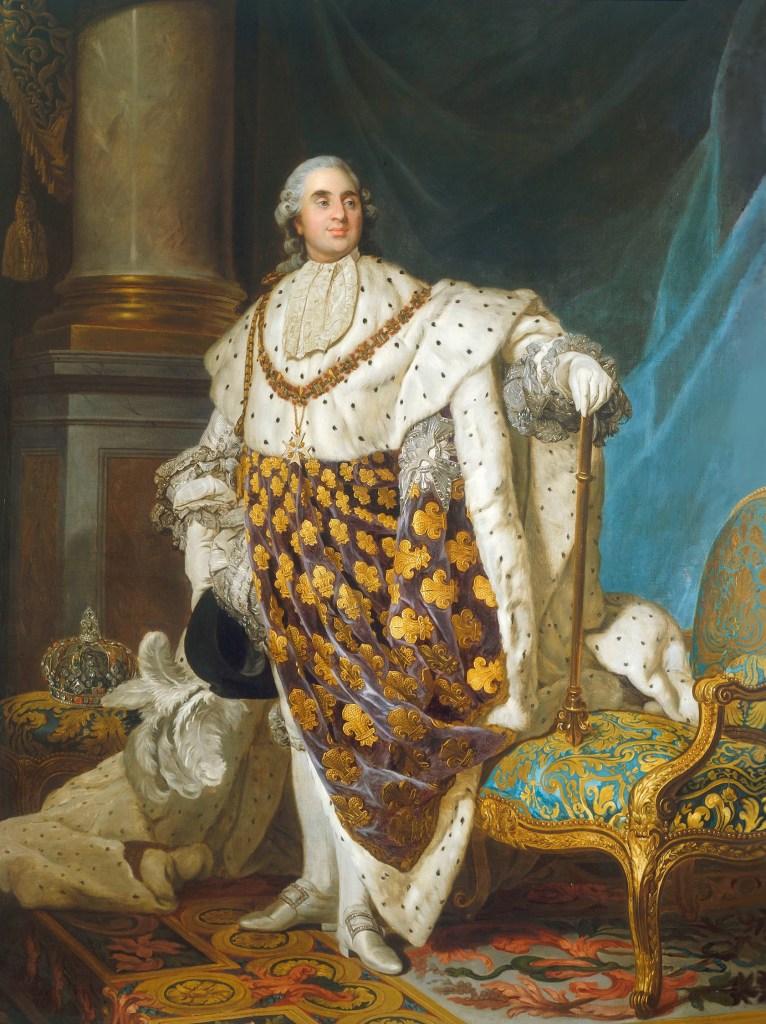
Picture: meet King Louis XVI in his coronation outfit. (He looked a little different on January 21, 1793 after losing his head…) Here he is on my Geneanet tree.
French nobility already existed with the Gauls, Romans and Franks. It evolved through twelve centuries. From the beginning of monarchy, nobles benefited from a particular status coming with privileges, duties and rights. You could be “born noble”, or having been “ennobled” by patent letters from the King if you did something really good. Nobility with privileges lasted until its abolition on August 4, 1789, during the French Revolution. It was briefly reestablished in 1814 under the “Restauration” but was only provided as an honorific distinction.
Today, French nobility still exists but has no legal recognition. Noble titles are still transmitted after verification. You can visit the website (in French) of the “Association d’Entraide de la Noblesse Française” for further information.
Nobility titles
- Roi / Reine = King / Queen
- Dauphin / Dauphine de France = Heir apparent to the throne of France. The word dauphin is French for “dolphin” and was the hereditary title of the ruler of the Dauphiné of Viennois, former province in southeastern France.
- Prince / Princesse = Prince / Princess
- Duc / Duchesse = Duke / Duchess
- Marquis / Marquise = Marquess / Marchioness
- Comte / Comtesse = Earl (Count) / Countess
- Vicomte / Vicomtesse – Viscount / Viscountess
- Baron / Baronne = Baron / Baroness
- Banneret
- Chevalier = Knight
- Écuyer = Squire
The cheaters… Nobility investigation
Because nobility brought privileges, some families would pretend they were noble when in fact they were not. In order to fight usurpation of nobility, several kings over the years would on a regular basis issue edicts requiring proofs of nobility (preuves de noblesse).
The most famous investigation was called la “Grande enquête sur la noblesse” (the Great investigation into nobility) under the reign of Louis XIV who signed a law in 1666 asking for families to provide a specific list of proofs of their nobility. This investigation was conducted by the “intendants des provinces” from 1666 and ended in 1727. (The “intendants des provinces” were like the current “préfets” of France). They were central figures of the royal administration. They asked all notaries and other royal officers to make a list of all the names followed or preceded by noble qualifications cited in the acts written over the last thirty or forty years. The lists were then broken down by diocese. Each individual mentioned on these lists had to produce the titles justifying their nobility. If they were not able to provide such proofs, they would be heavily fined and lose their nobility title.
In your nobility research in France, if you see the terms “preuves de noblesse” (proofs of nobility) or “maintenue dans sa noblesse” = ((family) kept in its nobility) followed by a date, it means that this particular family or individual had provided sufficient and adequate titles justifying their nobility, and were therefore authorized to keep their nobility title.
Heraldry
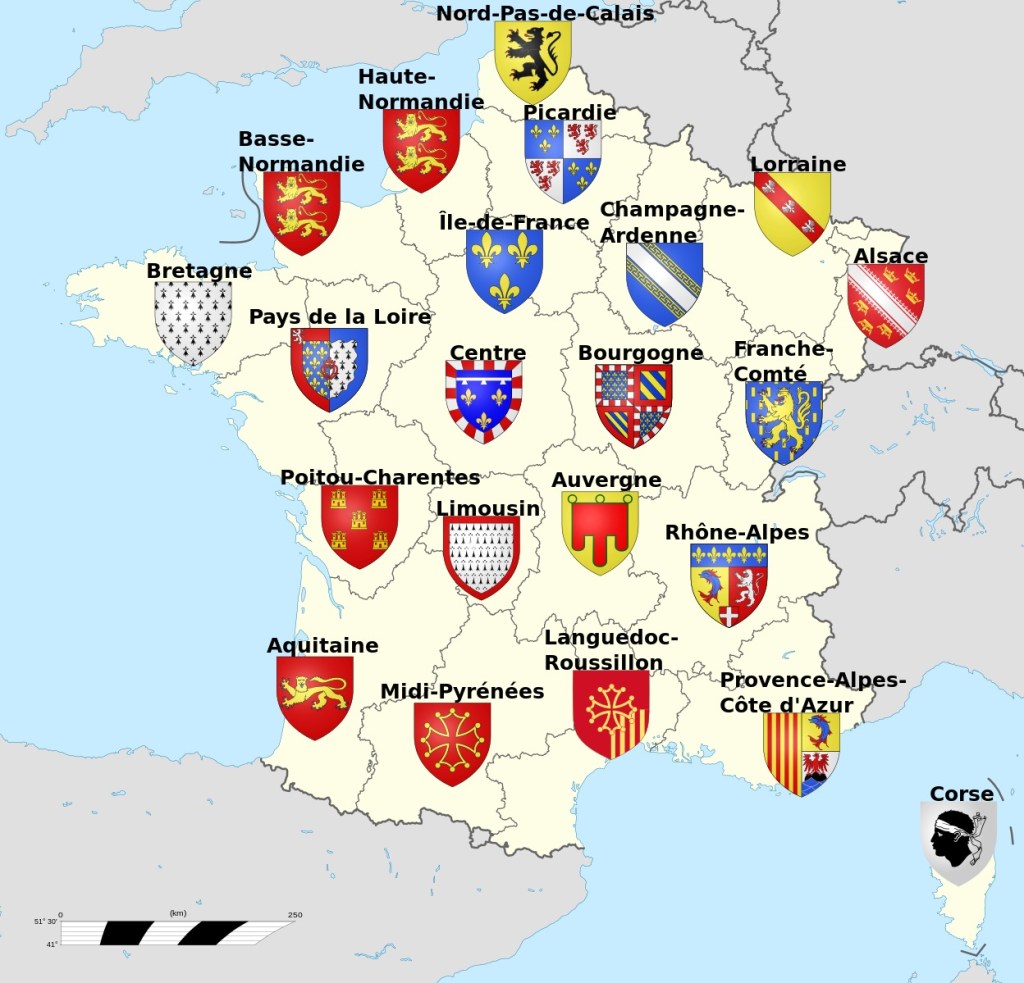
Coats of arms (armoiries) were distinctive signs during the different wars and tournaments. They were painted on “boucliers” (shields) and engraved in entryways of castles, fireplaces, etc.
They started to appear in Europe between the 11th and 12th centuries. At that time, the armament of knights underwent a great evolution, mainly in terms of head protection. They went from a “casque” (helmet) to a “heaume” (helm). Advantage: they were well protected. Inconvenient: they didn’t know who they were hitting, which was a little problem on the battle field.
Therefore, knights got into the habit of painting geometric patterns on their shields, and to be identified even better, added bright colors to be seen from far away. (So basically, coat of arms were the ancestors of today’s sport jerseys).
This science of coats of arms is called “héraldique” (heraldry).
Coats of arms are composed according to a very specific code. The colors are not applied at random, but based on their symbolism. Animals are used widely because they symbolize the moral and physical value of the knights. This is why you will see a lot of lions, bears, and dragons (let me know if you see earthworms, flies or cockroaches).
Very quickly, coat of arms expanded to professions, cities and even regions. For example: the coat of arms of Normandy, inherited from Henri Plantagenêt.
Nobility resources
I find it much easier to research my “old” noble ancestors than my more recent “un-noble” ones. While reading “recent” (a couple of centuries old) handwritten church or civil records never fails to touch my heart, the further back in time you go, the harder they are to read (decipher, really!).
However, once you reach nobility, there are so many documents available online, such as “Nobiliaires“, “Dictionnaires de la Noblesse“, “Histoire généalogique et chronologique de la Maison Royale de France“, as well as plenty of websites that provide information about nobility genealogy.
While you can find nobility information and genealogies on “Google Books” and the “Internet Archives” websites (archive.org), because you are researching French nobility, I would recommend searching on BnF Gallica (National Library of France) which has a lot more documents available.
BnF Gallica (in French) – BnF Gallica (in English) – Internet Archive – Google Books
For instance, I had conducted a search for the word “Nobiliaire” on April 26, 2023 (screen shots below).
- Internet Archives: 199 results.
- BnF Gallica: 18,725 results.
I conducted today, Wednesday, January 31, 2024, the same search for the word “Nobiliaire“.
- Internet Archives: 221 results
- BnF Gallica: 19,957 results
Of course, more and more resources are constantly being uploaded to all those sites, so much more resources will become available in time.
“BnF” stands for Bibliothèque Nationale de France (National Library of France). It is located in Paris, France, in several locations and buildings. Gallica is the BNF digital library, available for free on the internet. You will find any type of document: printed documents such as books, newspapers, magazines, in text or images, diagrams, manuscripts, maps, plans, and even sound documents.
You will see for instance “Nobiliaire d’Auvergne“, Nobiliaire Universel de France“, “Nobiliaire de Bretagne“, etc. A lot of them have multiple volumes.
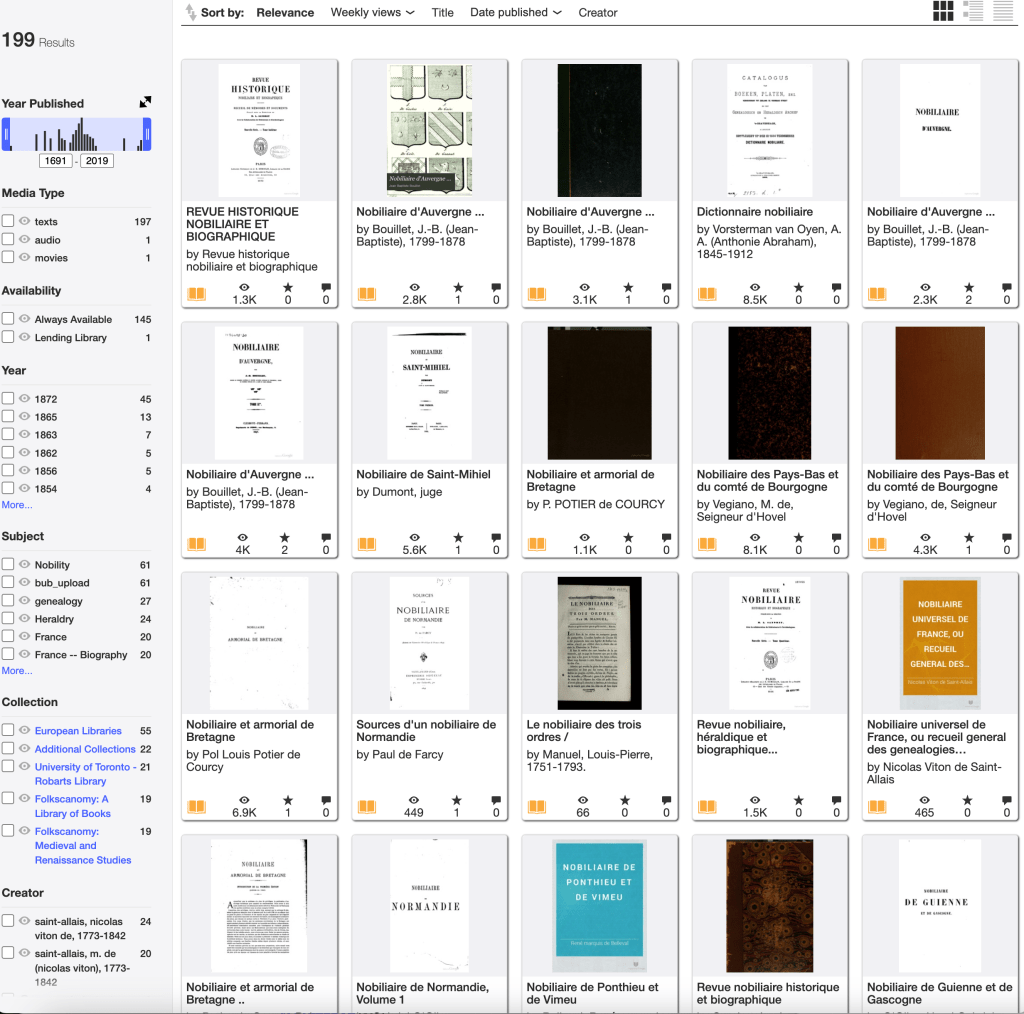

As you research nobility in France, you will see some the following online materials:
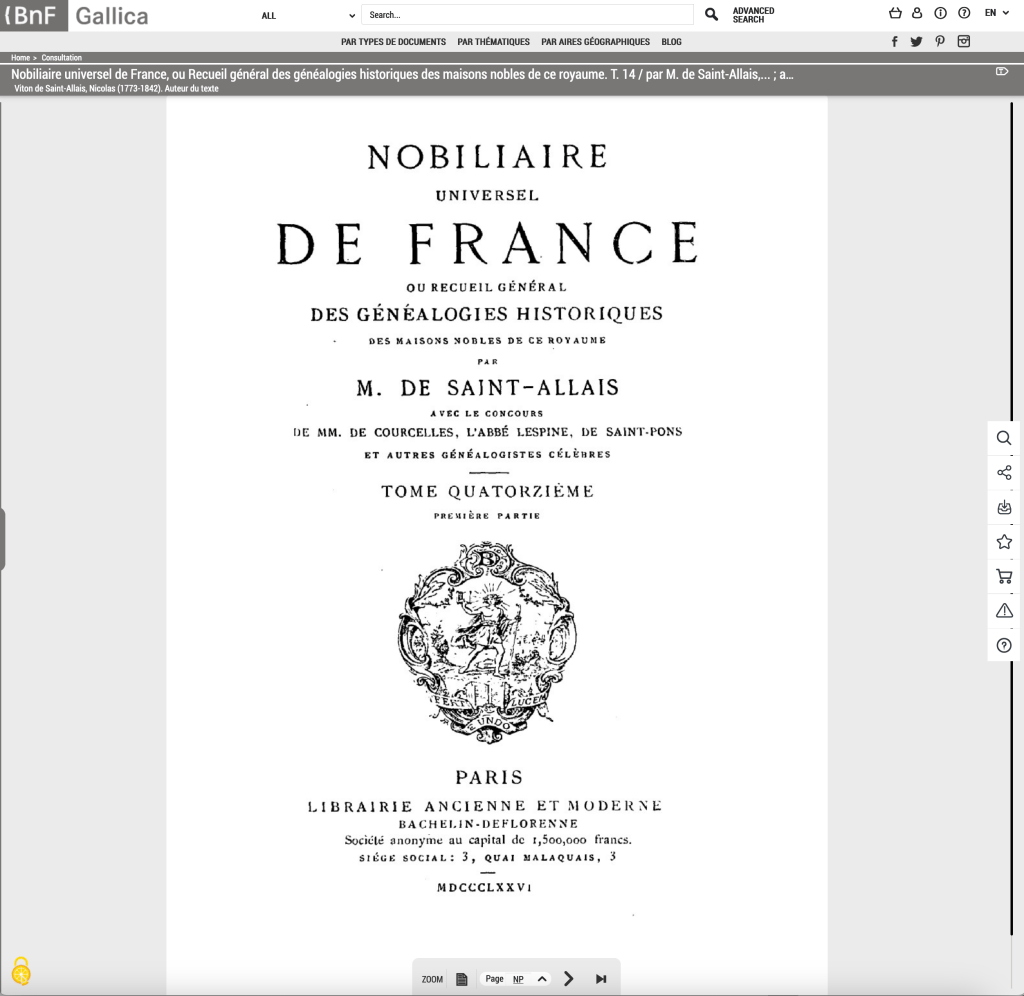
Nobiliaire: “which belongs to nobility”. These are books speaking of noble families and their genealogies. There are many, many books under the search word “Nobiliaire“: by region, by county, also some countries, and usually many different “Volumes” (or “Tomes“) under one title. “Nobiliaire d’Auvergne“, “Nobiliaire des Pays-Bas et du comté de Bourgogne“, “Nobiliaire Universel de France ou recueil général des généalogies historiques” (by Nicolas Viton de Saint-Allais) to name just a few. For instance, below is “Tome Quatorzième” (volume #14):
“Dictionnaire de la noblesse, contenant les généalogies, l’histoire & la chronologie des familles nobles de la France, …“: dictionary of nobility, containing genealogies, history, and chronology of noble families of France”, by François-Alexandre Aubert de la Chenaye Desbois (1699-1784), French writer and genealogist. While he wrote several books, he is mostly famous for his publications and dictionaries of the genealogies of French noble families. There are several editions and versions of the “Dictionnaire de la Noblesse“, most of them being available online.
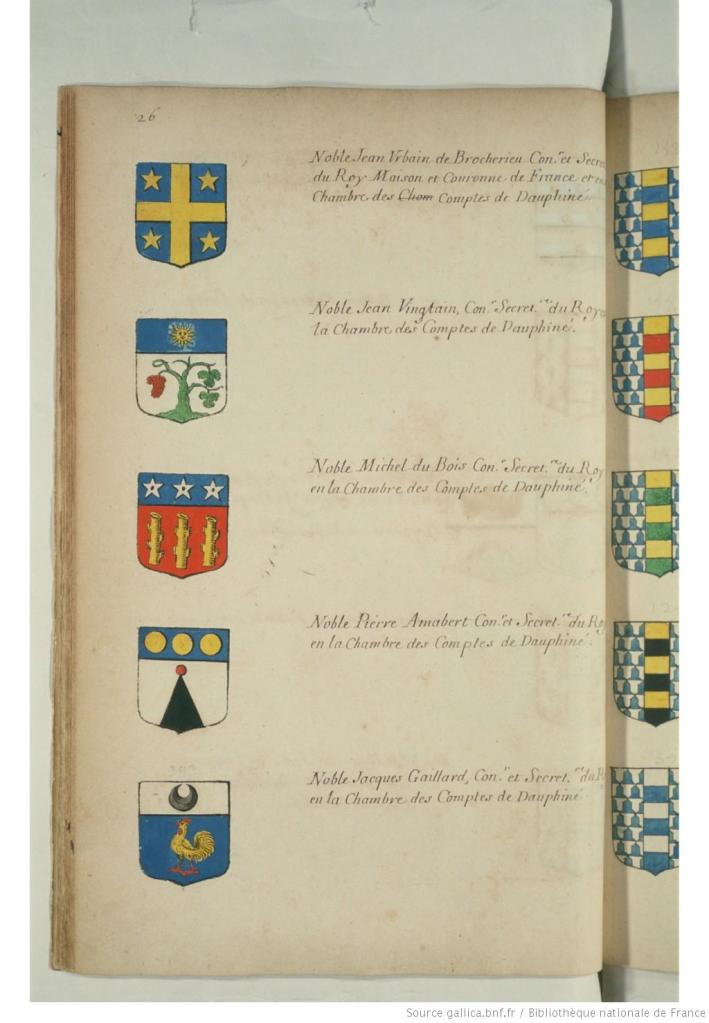
“Armorial Général de France” (sometimes called “Armorial d’Hozier”), by Louis-Pierre d’Hozier (1685-1767). The creation of these books was asked by King Louis XIV in 1696. There are 35 volumes listing the coat of arms of more than 120,000 people and families of the 25 old “provinces of France” at the end of the 17th century. This is what the Armorial d’Hozier looks like:
I hope the above information will help you research the nobility in your own family. So now, grab a cup of tea or coffee, and… get to work!
 My French Lineage