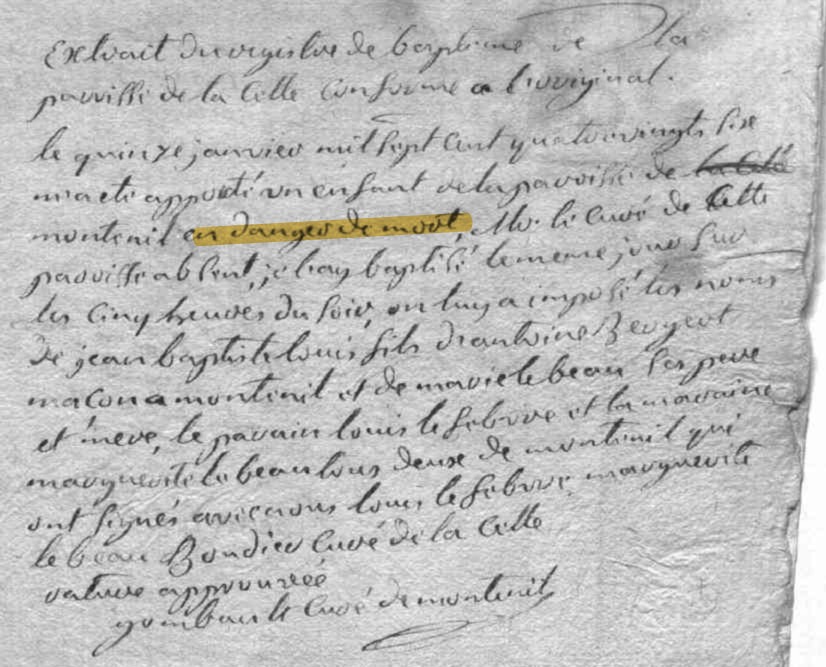
Some vital records immediately catch your attention. The baptism certificate of my ancestor Jean Baptiste Louis Berjot (1786-1861) was one of those. It contained a chilling note: “Enfant en danger de mort.” — “Child in mortal danger.”
On January 15, 1786, a baby was born in the small village of Montenils, in today’s Seine-et-Marne department, France — the same French department where I grew up two centuries later. He was between life and death. Because the priest of the village was absent, he was taken to a nearby village, La Celle, to be baptized.
The priest added a short note on his baptism record: “Enfant en danger de mort.” – “Child in mortal danger”.
That fragile newborn would grow up, marry, have children… and eventually become one of my ancestors.
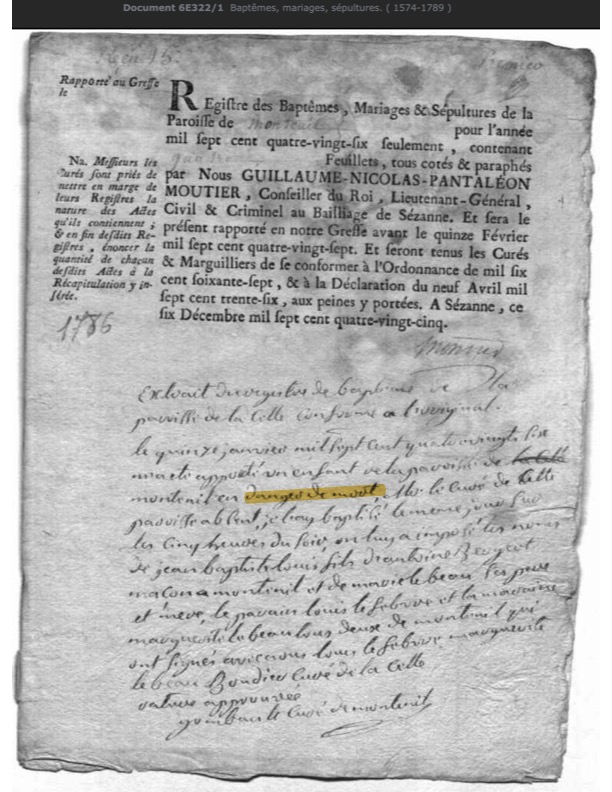
(*** Note: type “286” on the bottom right of the image as the Seine-et-Marne Archives always open to the first page)
💡 Did You Know?
In parish registers, the phrase “enfant en danger de mort” indicated that the newborn’s life was considered uncertain.
When a baby appeared too weak to survive, baptism was sometimes performed immediately after birth, or the child could be “ondoyé” at home by a midwife.
These small notes remind us how fragile life could be in the 18th century.
From a fragile newborn to a growing family
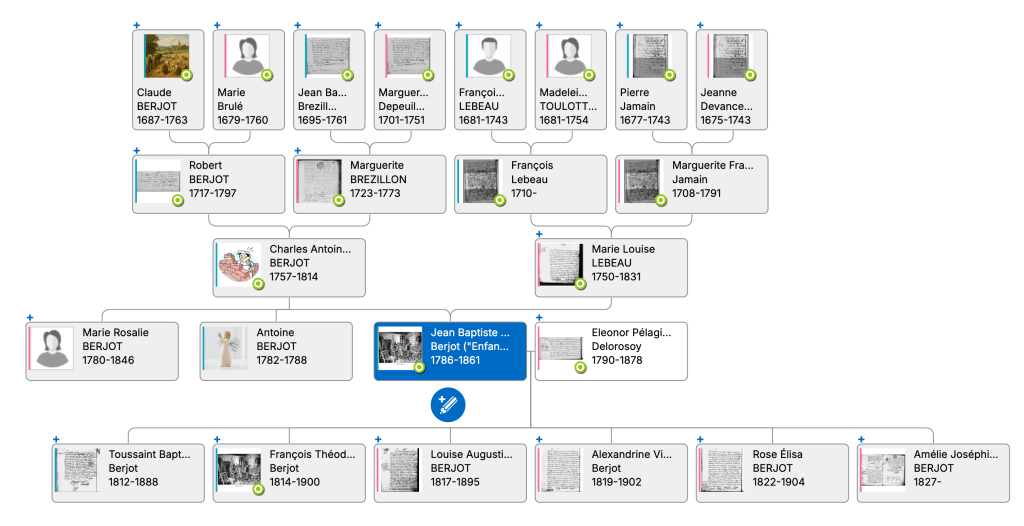
On February 12, 1811, Jean Baptiste Louis Berjot, by then charron in Montenils (wheelwright – builds or repairs wooden wheels), married Éléonor Pélagie Delorosoy in Le Gault-Soigny, Marne département, where she was born. We can imagine that they met when Jean Baptiste Louis went to work in her village, a good 2-hour walk from where he lived.
Together they built a family and had at least six children.
It is always striking to think that the child once described as “in mortal danger” went on to create an entire lineage.
The World They Lived In
The Year He Was Born
The year 1786, when Jean Baptiste Louis Berjot was born, was already filled with notable events across the world:
• February 23 – The expedition of Jean‑François de Galaup, comte de La Pérouse (dit “Lapérouse”) reaches Chile.
• May 1 – The opera The Marriage of Figaro by Wolfgang Amadeus Mozart premieres in Vienna.
• May 30 – The famous trial of the Affair of the Diamond Necklace (“L’Affaire du collier de la reine”) concludes in Paris.
• August 17 – Death of Frederick the Great, King of Prussia.
• December 4 – Administrative reforms in Mexico. King Charles III of Spain appoints twelve stewards to govern New Spain.
The Events That Shaped Their Lives
During the lifetime of Jean Baptiste Louis Berjot and Éléonor Pélagie Delorosoy, Europe experienced profound upheavals:
• French Revolution (1789–1799) (“Révolution française”)
• Napoleonic Wars (1803–1815) (“Guerres napoléoniennes”)
• Bourbon Restoration (la “Restauration” or “Restauration bourbonienne”): First Restoration (“Restauration bourbonienne”, 1814-1815) and Second Restoration (“Seconde Restauration”, 1815-1830)
• July Revolution of 1830 (“Révolution de Juillet” or “« Trois Glorieuses »”): second revolution after the one of 1789
• French Revolution of 1848 (“Révolution française de 1848”)
While their daily lives were likely centered on family, work, and their village, these major events formed the historical backdrop of their entire lives.
Sometimes genealogy reminds us that entire family lines depend on the survival of a single fragile life.
In January 1786, a priest feared that one newborn in Montenils would not survive the day.
More than two centuries later, his descendants are still here to tell his story.
 My French Lineage