One of my favorite things in genealogy is those “coincidences” I see time and time again. You begin researching one person… and suddenly, threads appear everywhere, linking them to lives you were studying just days before. Margaret “Molly” Brown is a perfect example of this fascinating web of connections.
In genealogy, I often have the feeling that someone is gently whispering: “Look closer — these lives are not as separate as they seem.” Every so often, a research day turns into a cascade of unexpected connections.
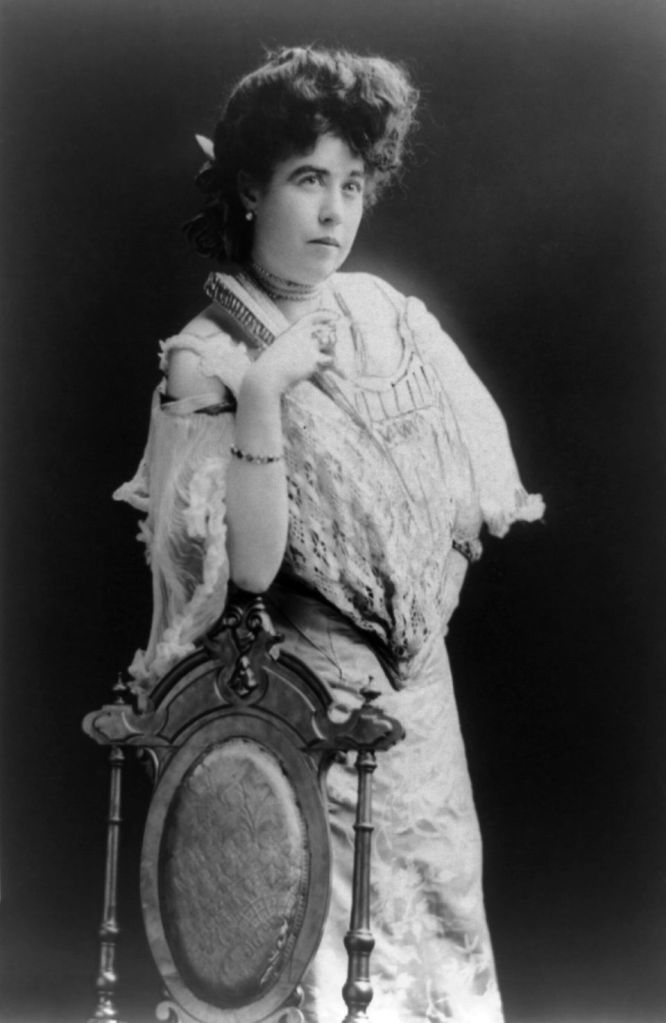
Margaret Tobin Brown (1867–1932), better known as “Unsinkable Molly Brown,” is a perfect example of what genealogy means to me. Her life illustrates something I encounter again and again in my research: we are all connected — through people, places, and events — often in the most unexpected ways.
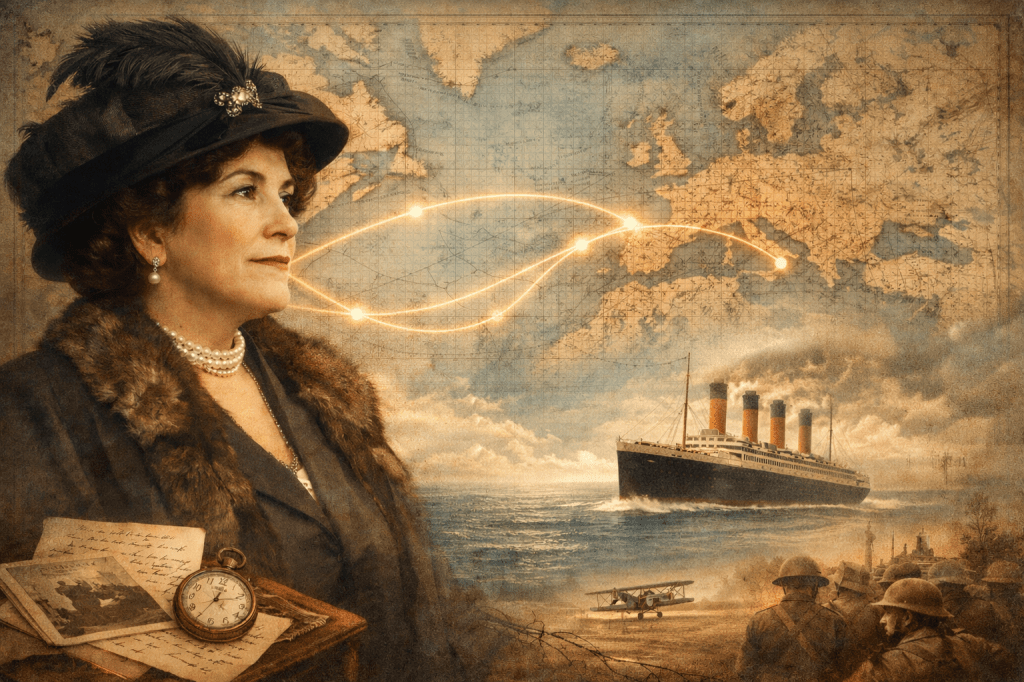
Most people know her simply as one of the survivors of the Titanic. But beyond that dramatic episode, she lived an extraordinarily rich life, one that touched many circles: social reform, international travel, philanthropy, and even wartime humanitarian work in France.
I first stumbled upon her last year while browsing the French Wikipedia “Colorado Portal.” A featured section titled “Lumière sur Margaret Tobin Brown” immediately caught my attention. The keywords read almost like a checklist of themes that frequently appear in my own research: service to others, worldwide history and events, France, World War I, humanitarian work, and her recognition by the French government.
I opened her French Wikipedia page — far more detailed than the English version, likely because of her extensive work in France. What I expected would be a quick 30-minute entry into my tree turned into an entire day spent following threads radiating from her life.
And that is exactly what I love about genealogy: one individual quickly becomes a crossroads. Over time, I have come to feel that these are not simple “coincidences,” but quiet moments of alignment — as if certain discoveries are patiently waiting to be found, and we are gently led to them when the time is right.
As I explored Margaret’s story, connections began appearing almost immediately:
• She contributed to the publication of the works of Mark Twain (uncle of one of her childhood friends) in braille and in French (Louis Braille, whose work I had “coincidentally” been researching only days earlier).
• She was close to Anne Morgan, daughter of financier J. P. Morgan.
• During World War I, she volunteered in France to help treat the wounded — which means that, in theory, she may have crossed paths with my own great-grandparents Berjot, who were both working as nurses on the front at the time.
• Even more striking: Dorothy Brown of Prescott, Arizona — whom I wrote about previously, see ‘Dorothy Brown’s Memoir: “Mission Accomplished”’ — returned to England on a ship carrying Titanic survivors. It is entirely possible their journeys intersected.
Moments like these feel like small genealogical “echoes”, or like a game of dominoes as they fall, gently touching each other, each bringing another discovery. You begin researching one life, and suddenly, doors open onto many others. What seemed like coincidence starts to feel more like a reminder: history is not made of isolated stories, but of overlapping lives constantly brushing against one another.
And that, to me, is the true magic of genealogy — discovering how unexpectedly close our worlds really are. These moments are what makes genealogy so endlessly captivating to me — those quiet, surprising reminders that our ancestors’ lives were never isolated stories, but part of a vast, intertwined human tapestry.
Genealogy
Here are the links to several pages on my Geneanet tree related to individuals or events mentioned in this post: (FYI: on Geneanet, the little “green circle” on an individual’s image indicates my direct lineage with the individuals).
Margaret Brown, “Unsinkable Molly Brown” (1867-1932)
Dorothy Brown (1903-1997)
Anne Morgan (1873-1952)
Mark Twain (1835-1910)
Foundation of Prescott, Arizona (1864)
Sinking of the Titanic (April 15, 1912)
Braille (writing system for blind or visually impaired people invented in 1825 by Louis Braille)
World War I (1914-1918)
My great-grandparents Berjot (Eugène Berjot and Fernande Monclin).
I also wrote a post about Fernande: see “Fernande Monclin (1893-1974), WWI Red Cross Volunteer Nurse“
 My French Lineage