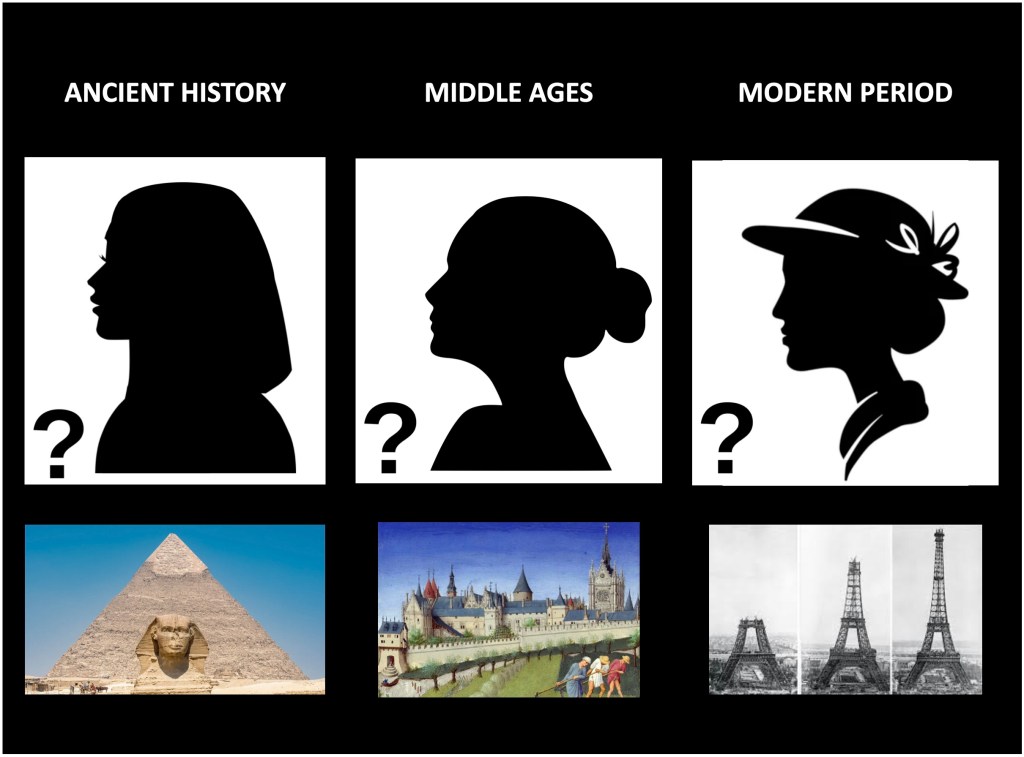
The further back in time we research, the more “unknown” women we find. Yet, these “unknown” women, our ancestors, have given birth to countless lines of royalties, anonymous and famous people, some of whom have shaped today’s world.
For the longest time, the transmission of lineage was done by men. Women’s identity was defined by their husband in charts, civil status documents, censuses, etc. Their names were seldom mentioned. They were designated by “wife of”, “widow of”, “mother of”, “daughter of”. Yet, they had an essential role in the family structure.
Who were they? What was their life like?
Their “name” in genealogy: Ne. – NN. – N.
The abbreviations “N.”, “Ne.”, “NN.” are commonly used in genealogy to indicate an unknown or partially unknown name. It comes from latin “Nomen nescio” meaning “I don’t know the name”. Nomen = name. Nescio = “I don’t know”.
On my Geneanet tree, I call my “unknown women” “Miss Mystère” (“Miss Mystery”). After all, they did exist. We just don’t know (yet) who they were. They are a mystery.
While it is very difficult to find these “unknown” women and trace their lives in Ancient times and the Middle Ages, we do have more options in modern times using the archives (see further below).
Meet Leutgarde Mystère
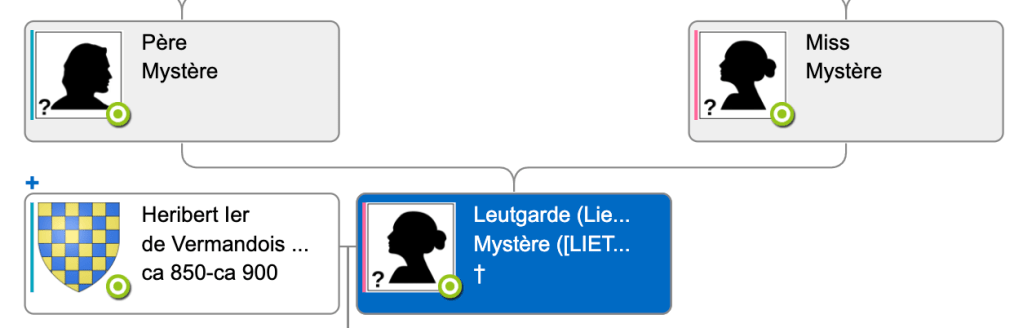
Miss Leutgarde Mystère is a perfect example of invisible women who left such an impact in History. She was the wife of Heribert Ier de Vermandois (ca 850-ca 900), great-great-grandson of Charlemagne and Hildegarde de Vintzgau. She is my ancestor (31 generations).
What do we know about Leutgarde? Nothing, other than her first name (well… that’s something!). We don’t know her parents, her date of birth, her date of death, or where she was from.
Yet… Leutgarde is the ancestor of (to name just a few!):
- Counts of Flanders, Guînes, Eu, West Friesland, Luxembourg, Boulogne, House of Normandy, House of Blois, Vendôme, Courtenay, Lorraine, House of Stuart, House of Clare (England), House of Bourbon (Kings of France), House of Savoy, House of Plantagenet, House of Habsburg, etc…….
- Kings of France, Bavaria, Aragon, Castille, Poland, Hungary, Riourikides dynasty, Duchy of Bohemia (Czech Republic), etc……….
- A few famous individuals: Hugh Capet (founder and first king from the House of Capet, the Capetian dynasty), William the Conqueror (first Norman king of England, built the Tower of London, Windsor Castle, Dover Castle, Hastings Castle (and more!), ordered the “Domesday Book”), Geoffroy V of Anjou (founder of the House of Plantagenet), Edward III of England (responsible for the Hundred Years’ War), Louis XVI of France (guillotined during the French revolution), Queen Elizabeth II of England, James VI and I Stuart, Empress Elisabeth of Austria (“Sissi”), Nicolas II (last Emperor of Russia), etc…….
- Much more recent individuals but no less famous: my husband (born in America), yours truly, moi (born in France), and probably you!
Not a bad posterity, for an “unknown” woman, isn’t it?
Note: The following information is the translation of part of an article of the “Fédération Française de Généalogie” (French Federation of Genealogy) (July 31, 2025). “Les femmes dans l’ombre des archives : comment les rendre visibles en généalogie” (Women in the shadows of the Archives: How to make them visible in genealogy).
Erased from titles, women have long been excluded from written history and therefore, from family archives. A reality that must be placed in the broader context of family history, where lineages, roles and transmissions have long been written by men. This absence is at the heart of a major challenge for genealogists: how to trace lives that have remained in the shadows, despite their fundamental role in family transmission?
Their invisibility is no accident: it is part of the logic of power, patrilineal transmission, and male-centered documentation. Yet, women have always been the silent pivots of the family unit: they were the educators, mediators, guardians of traditions.
Finding and tracing their life means reestablishing a human, social and historical truth. It is also a demanding quest because it requires avoiding the pitfalls of omission, concealment, or marginalization in official documents.
This article offers a methodical exploration of possible ways to restore women to their rightful place in family trees.
Where and how can we find women in the archives?
Department Archives/Vital Records
- Marriage records – provide their maiden names, their parents’ names, sometimes their occupation and where they are from
- Birth records of their children – help identify the mother, her age, where she is from
- Death and burial records – provide their spouse name (“wife of…” or “widow of…”) (and usually the names of the children witnesses to their death or burial)
Notary Archives
- Marriage contracts – provide information on dowries, separate property, arrangements between families.
- Wills, donations, inventories after death – reveal the economic or property presence of women.
- Deeds of sale or mortgages – some women appear as co-owners or guarantors.
Census Records
- Family households – record the roles of women in the family (wife, daughter, servant), their successive residences
- Marital status – look for changes in their status (single, married, widowed)
Judicial and Guardianship Records
- Guardianships, separations, offenses – reveal life situations often invisible elsewhere.
- Adoptions, complaints, pensions
Other Sources to Explore
- Parish registers
- Diaries
- Newspaper articles – marriage, obituary
- Grievance books and activist archives – useful for revolutionary periods and women’s movements
Genealogy
Here are the links to several pages on my Geneanet tree related to individuals or events mentioned in this post: (FYI: on Geneanet, the little “green circle” on an individual’s image indicates my direct lineage with the individuals).
Leutgarde Mystère (? – ?) and her husband Heribert Ier de Vermandois (ca 850-ca 900)
Hugues Capet (939-996) – Founder of the House of Capet, Capetian Dynasty
Guillaume le Conquérant (William the Conqueror) (1027-1087) – On his page, you will also see entered as his “children” some of his constructions, such as: Abbaye aux Dames (Abbey of Sainte-Trinité) and Abbaye aux Hommes (Abbey of Saint-Étienne), both in Caen, Normandy, France, Château d’Hastings (Hastings Castle), Château de Douvres (Dover Castle), Tour de Londres (Tower of London) and Château de Windsor (Windsor Castle), in England. Also linked to his page on the section on the right: Conquête normande de l’Angleterre (Norman Conquest), Bataille d’Hastings (Battle of Hastings), Domesday Book, Abbaye de Westminster (Westminster Abbey, where he was crowned).
Geoffroy V of Anjou (1113-1151) – (founder of the House of Plantagenet (Maison Plantagenêt))
Édouard III d’Angleterre (1312-1377) (Edward III of England, responsible for the Hundred Years’ War (Guerre de Cent Ans))
James VI and I Stuart (1566-1625) – He created the Union Flag
Louis XVI of France (1754-1793) – guillotined during the French revolution (Révolution française)
Elisabeth de Wittelsbach (“Sissi”) (1837-1898) (Empress Elisabeth of Austria)
Nicolas II Romanov (1868-1918) – (last Emperor of Russia)
Queen Elizabeth II of England (1926-2022)
 My French Lineage