** I dedicate this post to my cousin, Jacky Radet, who passed away on June 2, 2025. Jacky was “my partner in crime”, the only other genealogist of our family. I keep in my heart years of conversations sharing the same passion. He was such a valuable source of family heritage, sharing with me his chilhood memories of my mother (his first-cousin), my grandparents, my great-grandparents, and his mother Ginette. He also loved Paris and knew its History by heart. I miss our conversations…
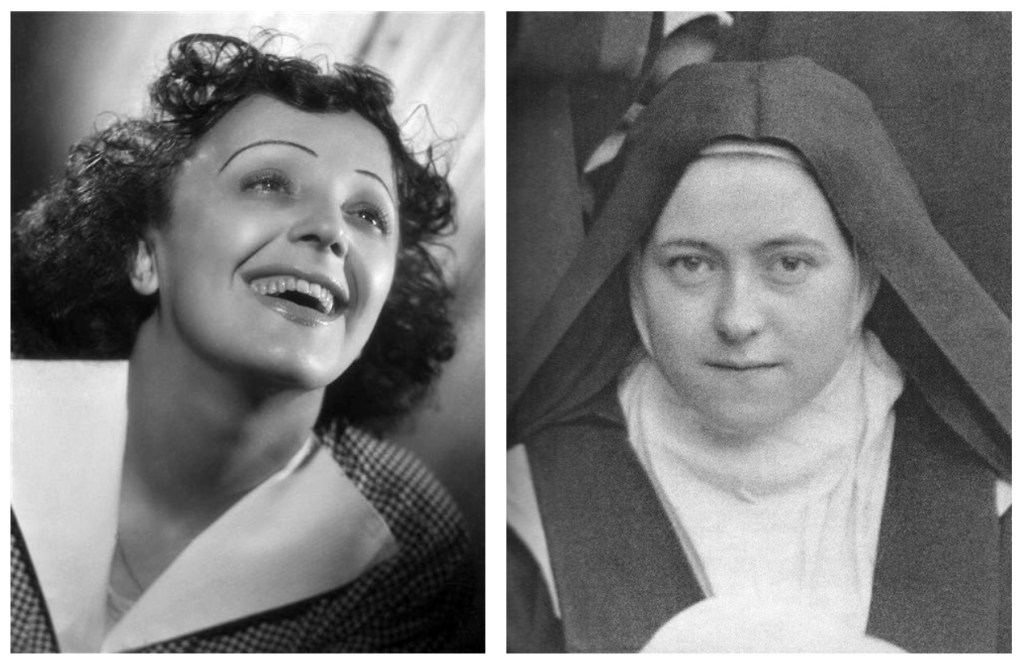
All her life, French singer Édith Piaf kept a devotion to Saint Thérèse of Lisieux, probably not knowing that they were related! I just discovered their cousin connection. Another time when I am blown away by my genealogy discoveries giving another “proof” (if needed) that we are all connected…
Following our intuition
As you know by now, I always follow my intuition, both in my life and in my genealogy research. Following my intuition has always – always – brought me to fantastic discoveries.
Yesterday morning was no exception. Here is how I discovered the cousin connection between Édith Piaf and Saint Thérèse of Lisieux, known as “The Little Flower” in the U.S.
The past few days, I had been working on the life of my grandmother’s half-sister, Ginette Radet (Jacky’s mother). I was creating a timeline of her life with the notes I had taken over the years from my conversations with Jacky. So yesterday morning, when the “Père-Lachaise Cemetery” popped up in my head, I didn’t pay too much attention to it because that’s where Ginette and Jacky are buried. (Père-Lachaise is the largest cemetery in Paris where a lot of famous people are buried).
Continuing working on Ginette’s life, “Père-Lachaise” pops up again in my head. Soon, the song “Milord” (by Édith Piaf) pops up in my head. (I continue working on Ginette’s life). Then, “La Foule“, another of Édith Piaf’s songs, pops up in my head! (It was getting pretty crowded, up there…) Considering that I hadn’t listened to any of Édith Piaf’s songs in a very long time, I decided that it was definitely time to pause and reflect on those clear and strong “messages” I had just received…
Suddenly, I remembered that Édith Piaf is also buried at Père-Lachaise! I checked my Geneanet tree and realized that she was not yet on my “Père-Lachaise” page, and that I hadn’t added her to my tree either! Sorry Ginette!! I’ll come back to you another day! (Not sure why I apologized to Ginette: she probably was the one sending me those messages!) 🙂
Within minutes, Édith Piaf was on my tree and “linked” to my “Père-Lachaise” page. Now the fun could begin!
With excited anticipation, I started Édith Piaf’s ascendance. At her fifth generation on her father’s side, I located a woman by the name of “Anne Bohard“. I remembered seeing that last name before. After verification, I saw that there was only one other person on my tree with that last name: “Marie Anne Bohard“, who happens to be an ancestor of… Saint Thérèse of Lisieux!! I checked where both Bohard ladies lived: same town, Athis-de-l’Orne (61). Those two just had to be related! After a little bit of digging (don’t you love that part??), I found their family connection… Édith Piaf and Saint Thérèse of Lisieux were 5th cousins, twice removed.
Finding their family connection is the kind of genealogical twist that gives you goosebumps. The fact that they were cousins didn’t surprise me at all (we are all related). What really touched me was to actually find their connection, and the fact that Édith Piaf had had all of her life a devotion to Saint Thérèse of Lisieux, not knowing that they were related. It reminded me of my lineage discovery with Sainte Odile.
It’s moments like these that make genealogy so profound and meaningful to me. One minute you’re tracing names and dates, and the next you stumble upon a thread that weaves two seemingly distant lives together in a way that completely reframes what you thought you knew.
A Tale of Two Lives: Édith Piaf & Thérèse of Lisieux
I thought that Édith Piaf and Thérèse of Lisieux were completely opposite women until I looked more closely at their respective lives. Indeed, they were two women leading very different lives and having different temperaments. Yet, both were unforgettable, deeply spiritual in their own ways, and both were marked by extraordinary devotion and suffering, at about the same time in their respective lives. Two radically different vocations — one public, one cloistered — each echoing with emotion and sacrifice.
🎤 Édith Piaf – The Voice of Emotion
Édith Piaf was born in 1915 in Paris. Her early life was marked by instability — her mother abandoned her as a baby, and her father left her in the care of his own mother, Louise Gassion, who ran a brothel. At age 3, Édith suddenly went blind due to keratitis. When she was 7, her grandmother took her on a pilgrimage to the tomb of Thérèse of Lisieux, who had not yet been canonized but was already venerated. Her sight returned shortly after this visit. This early experience of miraculous healing left a lasting spiritual mark: Édith would carry a small statue of Thérèse with her for the rest of her life, even during her international tours.
✨ Mirrored Moment:
At almost the same age — nine years old — Thérèse of Lisieux herself experienced a moment of healing after a vision of the smiling Virgin Mary. Both young girls, in vastly different circumstances and eras, found strength and recovery through faith.
As a teenager, Édith began singing in the streets of Paris to earn money. Her talent soon drew attention, and by age 19 she was discovered by nightclub owner Louis Leplée, who gave her the name La Môme Piaf (“The Little Sparrow”).
✨ Mirrored Moment:
At age 15, Piaf stood on the streets of Paris, singing to survive. At that same age, Thérèse entered a cloistered Carmelite convent in Lisieux. One chose the world’s stage, the other chose silence and prayer — yet both would become enduring symbols of French spirit and devotion.
Édith’s rise to fame was swift, but her life remained tumultuous. Her songs often reflected the pain and intensity of her life: love, addiction, grief (the death of her great love, boxer Marcel Cerdan), and pain were constant themes. Yet through it all, she sang with a rawness that resonated with audiences around the world. Her signature songs, such as La Vie en rose, Non, je ne regrette rien, and Hymne à l’amour, have become timeless symbols of French chanson.
✨ Mirrored Moment:
In her twenties, Piaf started to write her songs. At about that same age, Thérèse started to write Histoire d’une âme (Story of a Soul).
Though her health declined significantly in her final years, Édith Piaf continued performing until shortly before her death on October 10, 1963. She was only 47, but her legacy endures as a voice of deep emotion, resilience, and the soul of France.
🌸 Thérèse of Lisieux – The Little Flower
Thérèse Martin was born in 1873 in Alençon, into a deeply religious family. Her mother died when she was only four, a loss that marked her profoundly. Sensitive and introspective, Thérèse suffered a mysterious illness at age 9 but recovered after what she described as a vision of the smiling Virgin Mary. That healing moment was the start of her “little way” — a path of trust, simplicity, and great love in the smallest of acts. At just 15, she entered the Carmelite convent at Lisieux, dedicating her life to prayer, humility, and hidden sacrifice.
✨ Mirrored Moment:
Both Thérèse and Édith grew up in sorrowful homes without the presence of their mothers. Yet both turned to something greater than themselves for strength: one to God in the cloister, the other to song and the stage.
Thérèse died in 1897 at age 24 from tuberculosis, almost entirely unknown to the outside world. But after her death, her autobiography — Histoire d’une âme (Story of a Soul), written at the request of her superiors — spread across the globe, touching millions of believers with its message of childlike faith and absolute surrender to divine love. She was canonized in 1925 by Pope Pius XI, and in 1997 was declared a Doctor of the Church by Pope John Paul II (one of only a few women to receive that title). Today, Thérèse is one of the most beloved saints in the Catholic tradition, venerated worldwide for her message that “nothing is small in the eyes of God.”
✨ Mirrored Legacy:
Neither woman lived past middle age. Yet both Édith and Thérèse left behind an immense legacy that transcended their suffering. One sang, the other wrote. Both touched the world.
** On a side note: I always heard that both my great-grandmother, Madeleine Lescuyer, and my mother had been healed by Saint Thérèse of Lisieux. My great-grandmother wore a medal of Thérèse all her life after her healing. My mother almost died of septicemia when she was 7 months old. My great-grandmother and my grandmother always said she was healed because they prayed to Saint Thérèse.
Genealogy
Here are the links to several pages on my Geneanet tree related to individuals or events mentioned in this post: (FYI: on Geneanet, the little “green circle” on an individual’s image indicates my direct lineage with the individuals).
Ginette Radet (1918-2010) and Jacky Radet (1939-2025) (you won’t see much on Jacky’s page because my notes are considered “private” on Geneanet since he was born “within 100 years”. However, you’ll see the “events” linked to him).
Édith Piaf (1915-1963)
Saint Thérèse of Lisieux (1873-1897)
Louis Bohard and Marie (their common ancestors)
My page with some Popes who either played a big role in the History of France, or signed marriage dispensations, etc
 My French Lineage