Over the years, the words “mindfulness” and “consciousness” have been used more and more in our vocabulary. Mindful meditation, mindful/conscious breathing, mindful eating, mindful… reading this post! So how about mindful genealogy?
Mindfulness is learning to be fully present in whatever is happening now (sounds, thoughts, actions, feelings, surroundings). In today’s fast-pace life, we are more and more aware of the physical and mental health benefits of really being in the moment.
When you think about it, it’s funny to want to be “in the moment” while researching the life of individuals who lived 100, 500, 1,000+ years ago! Yet…
Mindful genealogy is letting ourselves really be with this particular individual we are researching. Not just focusing on finding a date and a location, but also being with them in our mind, in our heart… Taking a few deep breaths before researching… Asking (or not) for guidance in our research and being receptive to the ideas that come to us…
Reflecting…
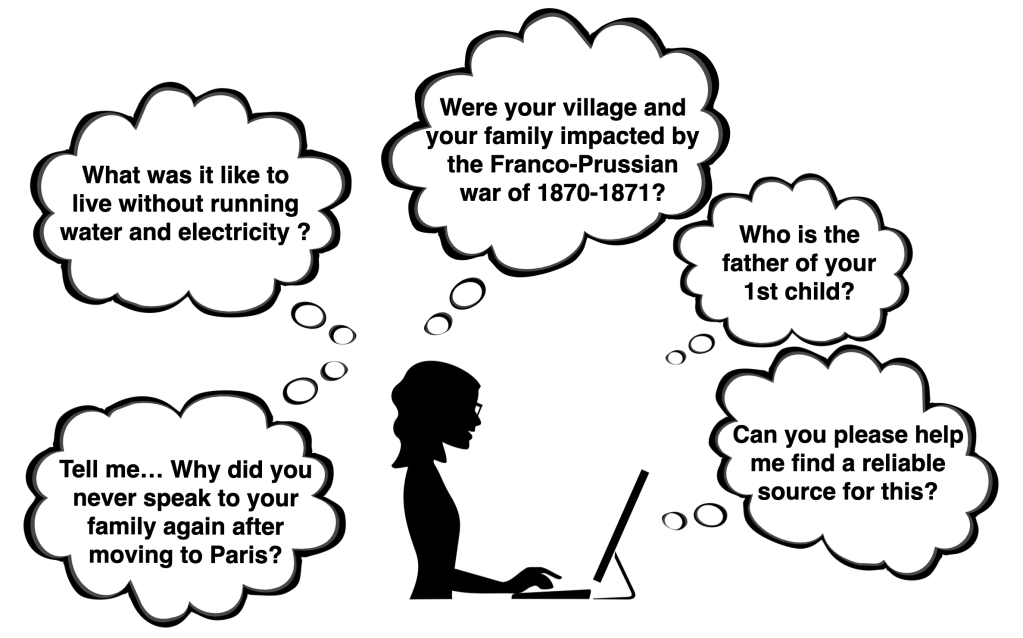
Who was this ancestor I am researching?
What was their life like?
What major event happened during their lifetime?
How come this individual was the only one of the family who moved away? Was it due to a marriage? A change of occupation? A health issue? A family conflict? A war? A family secret? An illegitimate upcoming birth to hide?
Can I imagine their life and feel their presence?
After all, we are the continuation of each and every one of our ancestors. Our cells, of course, but also their “vibes”, their energy. Their life experiences have shaped who we are.
What type of “baggage” did our ancestors carry when being named after their parents, grandparents, great-grandparents? (Imagine what Louis XVIII of France felt like…) What kinds of history or patterns (“good” or not) are we repeating, consciously or not, generation after generation? And what about all those “family secrets” that each family carries? I’ve seen so many “Oops” and “Really?? Noooooo…” in my research over the years!
I talk to the individuals I research. I do! I ask them all sorts of questions. The answers I get are hints, ideas, and clues to look into.
In her pioneer work on Psychogenealogy, French psychologist and psychotherapist Professor Anne Ancelin Schützenberger (1919-2018) wrote:
“As mere links in a chain of generations, we may have no choice in having the events and traumas experienced by our ancestors visited upon us in our own lifetime.
As future ancestors, our responsibility is to interrupt the transmission of unconscious repetitions, deal with unresolved legacies and heal the emotional wounds of the past, so that we may give life, meaning and purpose to future generations.”
One of her books is “The Ancestor Syndrome” (first published as “Aïe, mes aïeux!“)
Have you ever felt “lucky” to have found so quickly and easily the information you were looking for? Have you ever said: “Oh!! That’s so funny! I was working on a completely different branch 2 days ago not really knowing why, but I just linked that entire branch to my ancestor!!”.
What if we were guided in our research by our “invisible” ancestors?
When researching my French ancestors online (online records are available for free in France departmental archives *1), I can sometimes find in 2-3 clicks who I’m looking for in a 300 or 400 pages register… Was that just “luck”? “Coincidence?” Personally, I stopped believing in “coincidences” a long time ago. Both in my life and in genealogy.
Every time it flows in my research, I follow my intuition, even if I completely derive from my initial quest. I know it will soon bring an amazing discovery. It might not be today, but I know that within a few days, it will take me somewhere. On the contrary, when I get resistance (if I can’t find any source or information on the person I am researching), I close all my open tabs about this individual and stop my research about them… for the time being. Usually, they will “show up” again at some point, and this time, I will find information and sources about them.
We are all connected…
People, events, places.

- If you need help with this, check the “Researching in France” section. ↩︎
 My French Lineage