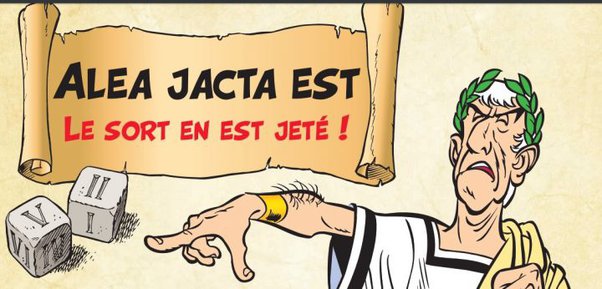
(This is Julius Caesar in a very famous and funny French comic books collection called “Astérix and Obélix”.)
I have so many great memories with my son Jérémy of the hours we spent playing backgammon together! Had we known this game was already played in the ancient Roman times, we would have dressed up to play, and spoken latin! Alea iacta est.
My grandmother Irène and my father also used to play backgammon after family meals, when “grownups” were having coffee, and us cousins would play around.
Just like for the arrival of the fork, though, I lost so many sleepless nights wondering “what’s the origin of backgammon”? You might be thinking: “Genealogy and backgammon?” Yes! Genealogy and its exciting discoveries!
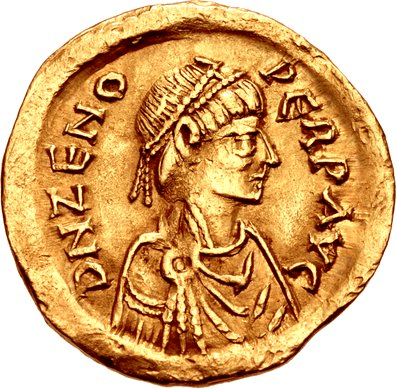
It’s while working on Ancient Rome and the complicated Roman Empire and Byzantine Empire times that my research took me to Zeno (425-491), an Eastern Roman (Byzantine) emperor. He was a player of a game called “tabula”, the ancestor to our modern backgammon! In 480, he wrote down his game that had been so unlucky, and half a century later, in 530, Agathias recorded the description of the rules of backgammon.
(Image: Wikipedia – Semissis issued during Zeno’s second reign marked:
d·n· zeno perp· aug·)
This game is still called τάβλη (tabula) today in Greece.
The ancestors of backgammon, however, existed even way before Zeno. Table games resembling today’s backgammon were played in ancient civilizations such as Egypt, Greece, Rome, Persia, to name a few.
Ancient Egypt: “Senet” was a board game consisting of 10 or more pawns on a 30-square playing board.
Roman Empire (27 BC-AD 395), the game was called “Ludus duodecim scriptorum”, or “XII scripta”.


“We don’t stop playing because we grow old, we grow old because we stop playing.”
George Bernard Shaw
Genealogy
Here are the links to several pages on my Geneanet tree related to individuals or events mentioned in this post: (FYI: on Geneanet, the little “green circle” on an individual’s picture indicates my direct lineage with the individuals).
Zeno (emperor) (ca 425-491) (“Zénon” in French)
Agathias (536 – ca 580) (Greek poet and principal historian of Roman emperor Justinian I)
Julius Caesar (100 BC – 44 BC) (“Jules César” in French)
Roman Empire (27 BC – 395) (“Empire romain” in French)
Byzantine Empire (330 – 1453) (“Empire byzantin” in French)
Amenhotep III (1403 BC – 1352 BC) (9th pharaoh of the 18th Egyptian Dynasty)
Nefertari (1302 BC – 1249 BC) (first of the Great Royal Wives of Ramesses the Great)
 My French Lineage