Eleanor of Aquitaine (Aliénor d’Aquitaine in French) is the Grandmother of Europe. So if you have discovered ancestors in France, she might be your grandmother too. (I’m at the 26th generation). I remember vividly the emotion I felt the day I joined my direct ancestors’ line to Saint Louis (Louis IX of France) and therefore to his great-grandmother: Aliénor d’Aquitaine. They are both such important figures of the History of France. Aliénor was one of the most important figures and women of the High Middle Ages. What an incredible woman she was…
Aliénor d’Aquitaine was the eldest daughter of Guillaume X d’Aquitaine (William X, Duke of Aquitaine), and Aénor de Châtellerault. Her grandfather was Guillaume IX «Le Troubadour», first known poet in occitan or langue d’oc (occitan language). She surrounded herself with poets and artists.
She was a very intelligent, beautiful, passionate, well educated, and very modern woman in a men’s world. She was the first Queen of France to accompany her husband to a Crusade (the 2nd Crusade to the Middle East, bringing with her a few hundreds of ladies in waiting, which had never been seen before, making the Church pretty upset).
A room in the Palace of Versailles is made as a tribute to her.
Aliénor, Queen twice
Queen of France (from 1137 to 1152)
At the death of her brother Guillaume, she inherited the Duché d’Aquitaine. She was only 14 years old. (At the age of 14, I inherited bad grades in French History class, being bored out of my mind! If only they taught History in schools using genealogy… With the “visual” part of it, showing a tree… That would make it so much more real and engaging!)
At the age of 15, in 1137, Aliénor married Louis VII le Jeune, future King of France. She became Queen of France later that year. They had two daughters together: Marie de France (1145-1198), who married Henri Ier de Champagne (1127-1181), and Alix de France (ca 1151-1198), who married Thibaud V de Blois (1130-1191).
Discovery of the extreme refinement of Oriental cuisine during the 2nd Crusade (1147)
During the 2nd Crusade, Aliénor discovered Constantinople where they stayed for a few weeks before heading to Jerusalem. It was a real enchantement. Constantinople was “the city of the cities”, the great city of the 12th Century, the New York of today. Aliénor was suddenly thrown into a universe of perfumes and scents she had never smelled, bed sheets made of a fabric that she didn’t know, foods and spices of completely unknown flavors, such as cinnamon, ginger, nutmeg, and cumin.
In the Holy Land, Aliénor discovered a passion for the extreme refinement of oriental cuisine. Among the other spices she discovered was sugar, which was then considered a spice. Sugar was an extremely precious, rare, and expensive item at that time. One gram of sugar had the value of one gram of gold. Among the vegetables Aliénor discovered in Orient were shallots and eggplants, which had not yet been introduced in the Kingdom of France in her time. She also discovered spinach, the consumption of which really increased in France after Aliénor’s return.
Aliénor imposed all these fascinating and new flavors to her table in the Kingdom of France on her return.
Aliénor and Louis VII separated later (mutual decision, on the ground that they were 4th and 5th generations cousins), and their marriage was annulled in 1152.
Queen of England (from 1154 to 1189)
Less than two months after the annulment of her marriage to Louis VII le Jeune, at the age of 30, in 1152, Aliénor d’Aquitaine married Henry Plantagenêt, future Henry II of England. She became Queen of England in 1154. They had eight children together, three of them future Kings: Henry the Young King (Henri le Jeune), Richard I of England or Richard the Lionheart (Richard Cœur de Lion), and John, King of England or John Lackland (Jean sans Terre).
Her blood runs in the veins of all major European kings and queens because Aliénor is the link between the dynasty of the “lys” of France (Fleur-de-lis) and the dynasty of the “lion” of England.

Later in her life, Aliénor spent several years in prison in various locations, having been arrested by her own husband Henry II for participating in the revolt directed by her sons against their father Henry II. She was only released at the death of Henry II, in 1189.
All her life, Aliénor always thought of the future of her paternal inheritance and the inheritance of her husband. Her last son, John Lackland (Jean sans Terre), who became King of England in 1199, did not manage to keep all the lands of the Plantagenêt empire. A year after his accession to the throne, Jean lost the city of Évreux and the County of Berry to King of France Philippe II Auguste (who, by the way, was his 3rd cousin). At the end of the battle, the two kings signed a peace treaty. Usually, for these alliances to hold, they had to be ratified by a marriage. Understanding that John would break up the Kingdom and gradually destroy everything she had built, Aliénor, at the age of 80, set to the Kingdom of Castille, Spain, crossing the Pyrénées, traveling almost 1,500 km, to find her granddaughter Blanche de Castille in order to marry her to Louis VIII le Lion of France, son of Philippe II Auguste. (Blanche de Castille and Louis VIII are the future parents of Saint Louis, Louis IX of France. St. Louis, Missouri, is named after him).
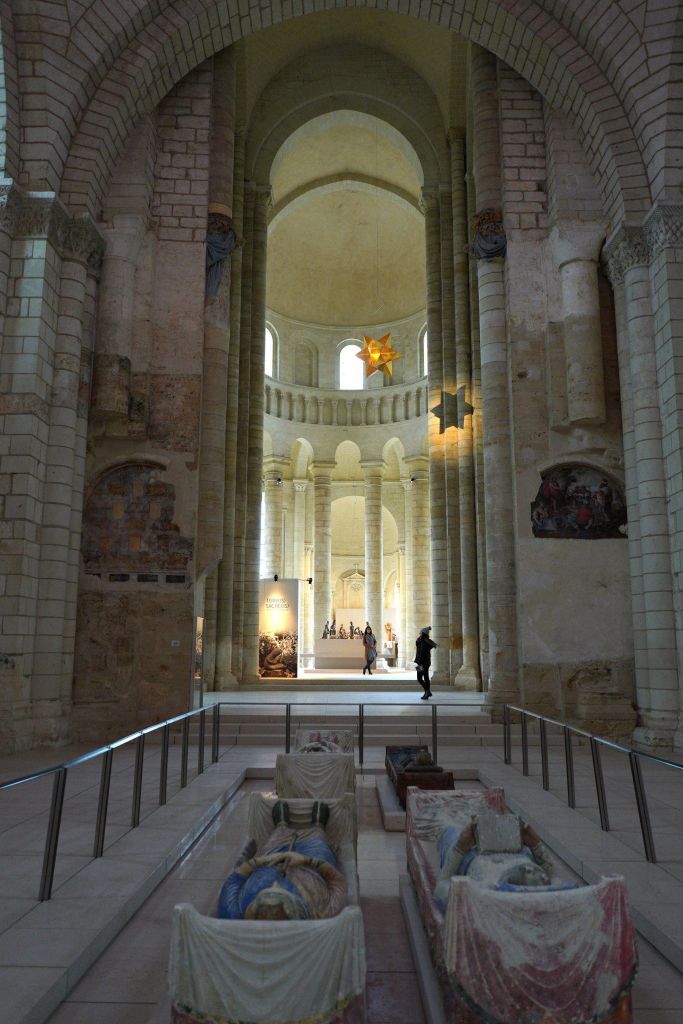
Aliénor d’Aquitaine at the Fontevraud Abbey
Aliénor d’Aquitaine retired to the Abbaye de Fontevraud (Fontevraud Abbey) and was buried there, along with her husband Henry II, her son Richard I (Richard the Lionheart) and Isabelle d’Angoulême (who was the wife of Jean sans Terre). Today, the four “gisants” (tomb effigies) are those of Aliénor, Henry II, Richard I and Joan of England.
Aliénor had wanted to make the Abbaye de Fontevraud the “nécropole” of French Royalty. Unfortunately, during the French Revolution of 1789, all tombs were vandalized, and the bones of Eleanor and everyone were exhumed and scattered. Today, only the tombs effigies remain at the Abbaye de Fontevraud.


“Le vase d’Aliénor” – Eleanor’s Crystal Vase
The “Vase d’Aliénor”, rock crystal from the East, very rare in the Middle Ages, is the only object that belonged to Aliénor d’Aquitaine that we have today.

Sources used for this post : “Secrets d’Histoire : Aliénor d’Aquitaine, une rebelle au Moyen Âge” (Stéphane Bern, YouTube, in French); Le Louvre Museum; Abbaye de Fontevraud, “Pays de la Loire” website.
Genealogy
Both David and I have direct lineage with Aliénor d’Aquitaine and both her husbands, Louis VII le Jeune and Henry II of England. We also both have direct lineage with the other two wives of Louis VII le Jeune, Constance de Castille and Adèle de Champagne.
Henry II of England had other children with several mistresses, so who knows… maybe I will discover a direct lineage there too at some point!
Here is Aliénor d’Aquitaine (Eleanor of Aquitaine) on my Geneanet tree.
(FYI: on Geneanet, the little “green circle” indicates my direct lineage with the individuals).
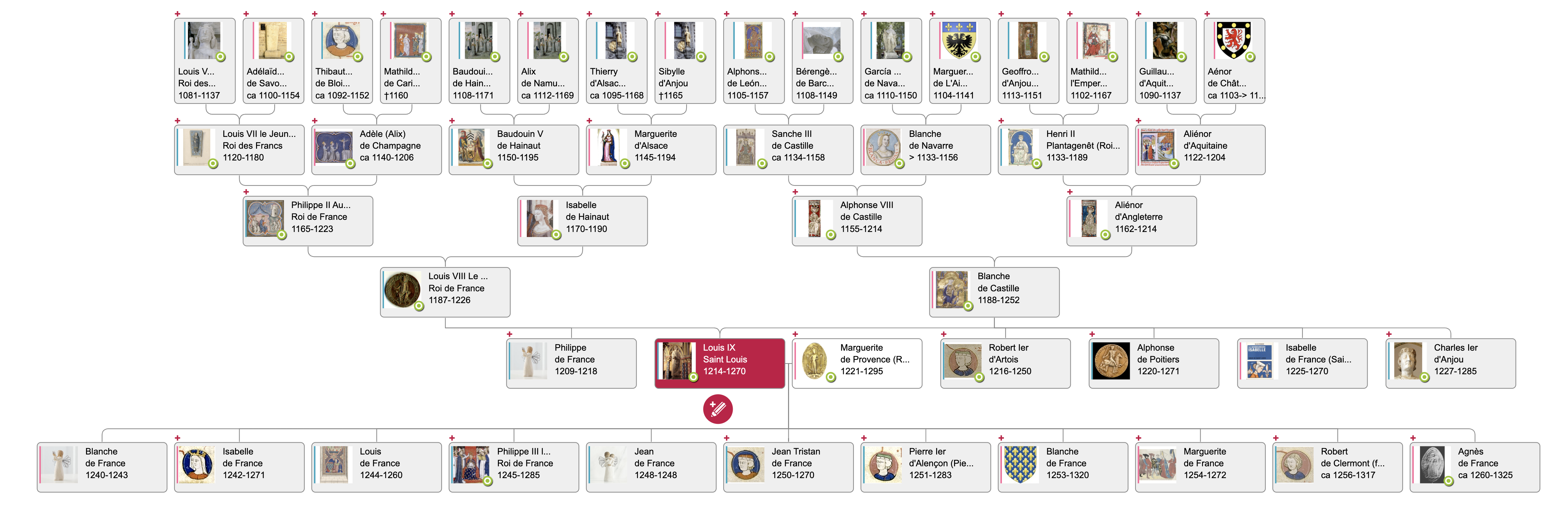
 My French Lineage