
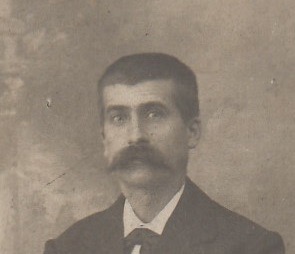
This is Eusèbe Lepoint (1875-1952), my paternal great-grandfather. He spent the entire 4 years of World War I as a Prisoner of War in the detention camp of Minden, Nordrhein-Westfalen, Germany.
On August 1, 1914, the German Empire declared war on the Russian Empire. That same day, the order for mobilization was given in France. Eusèbe and all men of the 1896 to 1910 classes were called to their regiments. Eusèbe reported for duty on August 2. He did not return home until February 7, 1919.
Eusèbe Lepoint was captured during the siege of Maubeuge on September 7, 1914, and was sent to the detention camp of Minden, Nordrhein-Westfalen, Germany, where he stayed for four long years, until December 3, 1918. Minden is considered to be one of the worst detention camps in Germany.
I discovered that he had been a Prisoner of War on his “registre matricule” (if you need help locating your ancestor’s military information, please refer to the “Military Archives” section). Nobody knew in my family that he had been a Prisoner of War. This was a sad discovery. But at least, he came back, unlike so many others…
I was not done with the sad discoveries, though. As I dug deeper in the archives of the Red Cross for Minden in search of records about my great-grandfather, I discovered that his brother Arthur Joseph (1870-1956) and his nephew Arthur Séraphin Lepoint (1894-1973) were also captured with him during the Siege of Maubeuge on September 7, 1914. My great-grandfather and his brother Arthur Joseph both spent 4 years in Minden, while Arthur Séraphin, Arthur Joseph’s son, was sent to Senne, another prisoner camp in Germany, where he too spent 4 years in captivity.
I wonder how one can resume a “normal life” after living such a horrible experience in such difficult conditions… But Eusèbe Lepoint found a way. My father says that his grandfather was a very quiet but kind man, and that he has great memories of him.
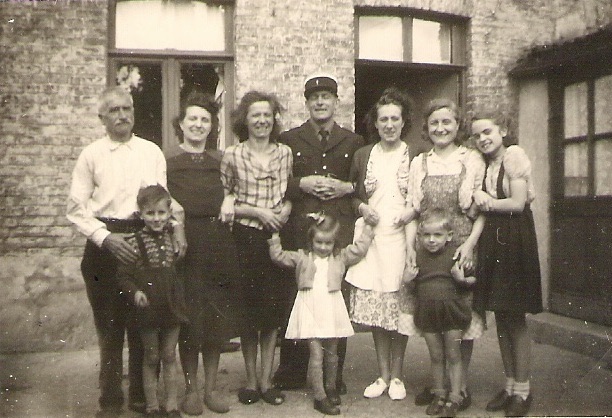
And what about those amazing women who “held the fort”, taking care of their scared and worried children, not only alone, without the support of a husband, but also living in a country at war, with limited amount of food, under the bombs, worrying about whether they would ever be reunited with their husbands? My great-grandmother Félicité Reynders was one of those women.
The Minden Museum created this 4’35” video which shows the camp in 3D. I wonder if my great-grandfather and his brother appear on the actual photos of the prisoners and the camp added to this video…
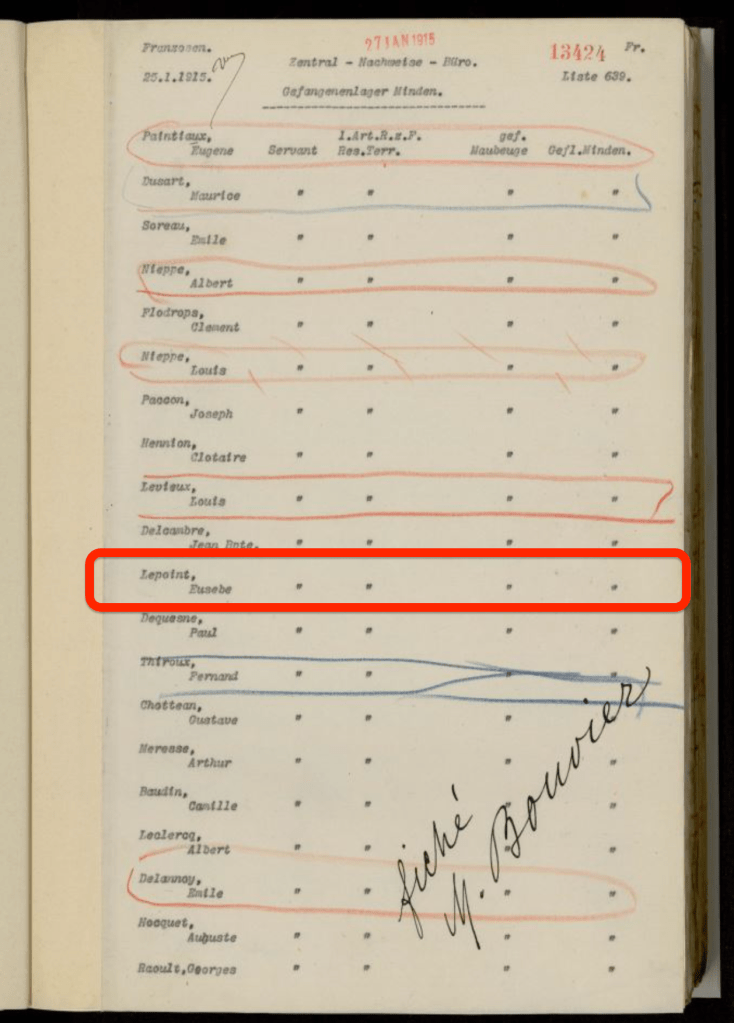
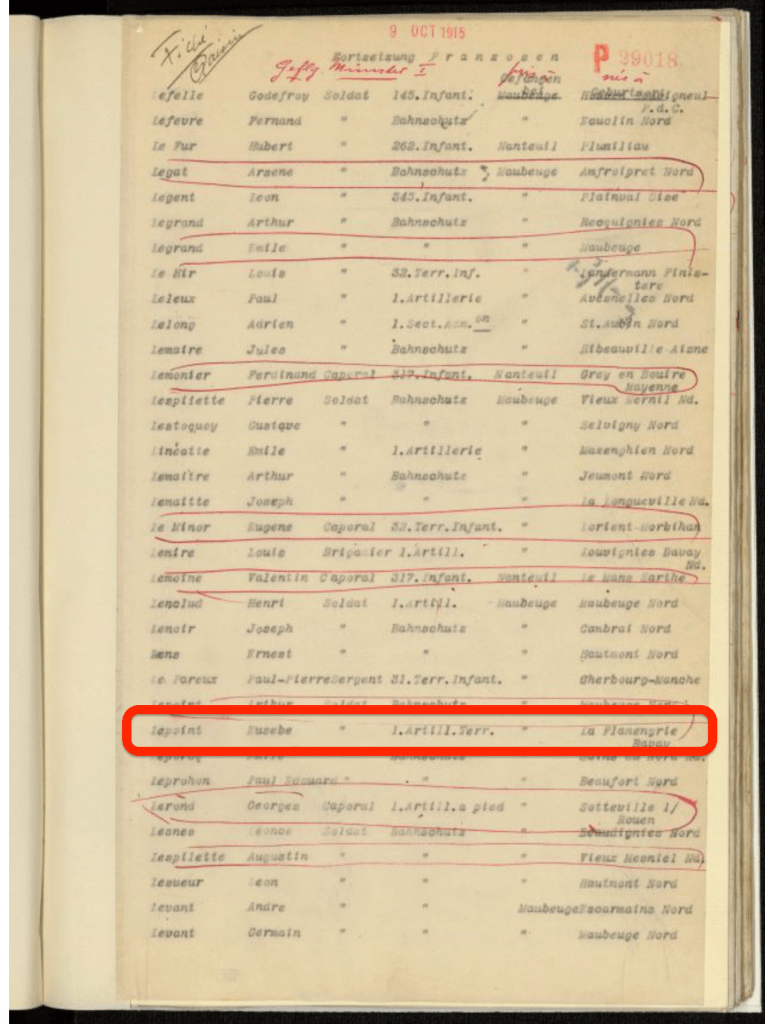
Below are the records I found of my great-grandfather’s detention at Minden (click on each image to view the actual record). They are available on the website of the ICRC (International Committee of the Red Cross).


Genealogy
Here are the links to several pages on my Geneanet tree related to individuals or events mentioned in this post: (FYI: on Geneanet, the little “green circle” on an individual’s image indicates my direct lineage with the individuals).
My great-grandparents Eusèbe Lepoint and Félicité Reynders.
World War I (Première Guerre mondiale)
Siege of Maubeuge (Siège de Maubeuge) (August 28 to Sept. 8, 1914)
Red Cross – (Croix-Rouge)
 My French Lineage