Major historical events that shaped French genealogy and records
What historical events in France and in the world were happening during our ancestors’ lives? Which major discovery made their lives easier? Did they participate in world events? Did they move to a different village, country or continent because of a war, an epidemic, or religious persecution?
Here are just a few of the Historical events that happened during our ancestors’ lives to help us understand better the individuals we are researching.
** Note: each block with an arrow is expandable and provides a summary of the event.
Jump to a century
15th • 16th • 17th • 18th • 19th • 20th • 21st
Browse events by topic
🔵 Records • 🔴 Wars • 🟢 Migration • 🟡 Society • 🟣 Religion
🔵 Genealogy records & Administration (parish registers, civil registration, censuses)
🔴 Wars & Conflicts (wars, invasions, revolutions)
🟢 Migration & Population (emigration waves, settlement movements)
🟡 Society & Innovation (printing press, railways, industrialization, major social changes)
🟣 Religion
🌿 Indicates a Major genealogy turning point
Jump to 12 Key Events That Shaped French Genealogy
15th Century (1401-1500) (xve siècle)
🟡 1422
Charles VII, King of France
(Roi de France)
October 21, 1422 – Beginning of the reign of Charles VII of France. Born in 1403, he is the last surviving son of Charles VI and Isabeau of Bavaria.
His reign saw the end of the Hundred Years’ War.
His reign is inseparable from the epic tale of Joan of Arc who, after lifting the siege of Orléans, led him to be crowned in Reims on July 17, 1429. He died in 1461.
🔴 1429
Joan of Arc meets Charles VII
February 25, 1429 – First meeting between Joan of Arc and Charles VII (Première rencontre entre Jeanne d’Arc et Charles VII)
A young French peasant girl, Joan of Arc, claimed divine guidance and played a pivotal role in the latter stages of the Hundred Years’ War. She successfully led French forces to victory at Orléans, a turning point in the conflict, and helped secure the coronation of Charles VII. Her actions significantly boosted French morale.
Later captured by the Burgundians, sold to the English, and tried for heresy by an English-backed ecclesiastical court, she was tragically burned at the stake in 1431. Despite her short military career, her legacy as a national heroine and Saint has endured.
🟡 1451
Gutenberg invents the printing press
(Gutenberg invente l’imprimerie)
Johannes Gutenberg’s development of the movable-type printing press revolutionized the spread of information. This invention made books far more accessible and affordable, leading to increased literacy, the faster dissemination of new ideas (including those of the Renaissance and later the Reformation), and a profound impact on education and communication.
🔴 1453
Fall of Constantinople
(Chute de Constantinople)
May 29, 1453 – Fall of Constantinople
The capital of the Byzantine Empire, Constantinople, fell to the Ottoman Turks led by Sultan Mehmed II. This event marked the end of the Byzantine Empire, a direct continuation of the Roman Empire, and solidified the Ottoman Empire’s dominance in Southeastern Europe and parts of Asia and Africa. It also significantly disrupted traditional trade routes between Europe and Asia, spurring further exploration.
🔴 1453
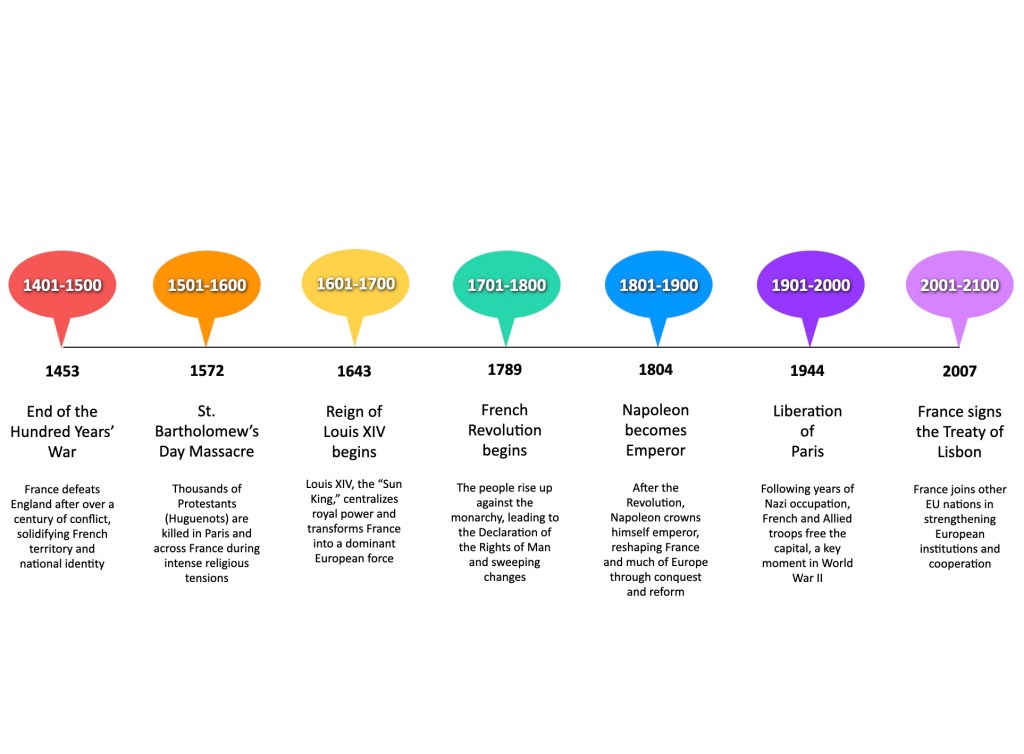
End of the Hundred Years’ War
(Fin de la Guerre de Cent Ans)
October 9, 1453 – End of the Hundred Years’ War
Long-running conflict between England and France triggered on May 24, 1337, by a claim to the French throne made by Edward III of England.
This war began in the 14th century and actually lasted 116 years, 4 months and 15 days. It finally concluded with a decisive French victory.
This greatly impacted the political landscape of both nations and contributed to the rise of more centralized monarchies.
🟢 1492
Christopher Columbus reaches America
(Christophe Colomb arrive en Amérique)
October 11, 1492 – Christopher Columbus reaches America
Departing in August from Palos de la Frontera, Spain, with three ships, sailing under the Spanish crown, Christopher Columbus reached the Atlantic islands of the Bahamas in October. Believing he had sailed all the way to India, he called the inhabitants “Indians”.
This marked the beginning of the Age of Exploration, leading to profound global consequences, and ultimately European colonization of the continents.
🔴 1494
Italian Wars begin (1494-1559)
(Début des Guerres d’Italie)
While extending slightly before the 16th century, these wars saw successive French monarchs (Charles VIII, Louis XII, Francis I, Henry II) invade various Italian city-states, primarily vying for control of Naples and Milan, against a shifting array of alliances involving Spain, the Holy Roman Empire, and various Italian powers.
While ultimately failing to secure lasting territorial gains in Italy, these wars exposed France to the Italian Renaissance, leading to a significant cultural infusion and artistic flourishing within France, particularly under Francis I.
16th century (1501-1600) (xvie siècle)
🔵 1539 🌿
Ordinance (French language + parish records)
August 1539 – French becomes the official administrative language – Mandatory recording of baptisms and burials (parish records)
(le français devient la langue administrative officielle – début officiel de l’état civil en France)
King Francis I of France signed the Villers-Cotterêts Ordinance (Ordonnance de Villers-Cotterêts). This document:
1) made French the exclusive official language of administration and law, replacing Latin.
2) required priests to registrer births and keep a register of baptisms and burials. This is the beginning of civil status in france.
Your ancestors:
A child baptized after this date may appear in parish registers that still survive today.🟡 1543
Copernicus
May 1543 – Nicolaus Copernicus publishes De revolutionibus orbium coelestium (Copernic publie “Des révolutions des sphères célestes”).
Copernicus formulated the heliocentric model (model of the universe that placed the Sun at its center, rather than Earth). He died shortly after publication.
🔴 1562 🌿
French Wars of Religion begin
(Début des Guerres de Religion en France)
March 1, 1562 – Series of civil wars between French Catholics and Protestants (called Huguenots) from 1562 to 1598. Between two and four million people died from violence, famine or disease directly caused by the conflict, and it severely damaged the power of the French monarchy.
One of its most notorious episodes was the St. Bartholomew’s Day massacre in 1572. The fighting ended with a compromise in 1598, when Henry of Navarre, who had converted to Catholicism in 1593, was proclaimed King Henry IV of France and issued the Edict of Nantes, which granted substantial rights and freedoms to the Huguenots. However, Catholics continued to disapprove of Protestants and of Henry, and his assassination in 1610 triggered a fresh round of Huguenot rebellions in the 1620s.
🟣 1572
St. Bartholomew’s Day Massacre
(Massacre de la Saint-Barthélémy)
August 24, 1572 – Thousands of Protestants (Huguenots) are killed by Catholics in Paris and across France during intense religious tensions.
🔵 1579 🌿
Marriage records
1579 – Mandatory recording of marriages by priests (parish records) (enregistrement obligatoire des mariages par les curés)
King Henri III of France signed the Blois Ordinance (Ordonnance de Blois). Among other things, this document requires priests to also record marriages.
🟡 1582
Gregorian calendar begins
October 1582 – (Début du calendrier grégorien)
The Gregorian calendar is the calendar used in most parts of the world. It went into effect in October 1582 following the papal bull Inter gravissimas issued by Pope Gregory XIII, which introduced it as a modification of, and replacement for, the Julian calendar.
The principal change was to space leap years slightly differently.
🟣 1598 🌿
Edict of Nantes
(Édit de Nantes)
April 30, 1598
Issued by King Henry IV of France, the Edict of Nantes granted substantial rights to Huguenots (Protestants) in predominantly Catholic France.
This act brought an end to the French Wars of Religion, providing a period of religious tolerance and stability, though it would later be revoked.
17th century (1601-1700) (xviie siècle)
🟢 1608 🌿
Foundation of Québec
(fondation de la ville de Québec par Samuel de Champlain)
July 3, 1608 – Foundation of Québec by Samuel de Champlain
Start of major French migration to New France, creating genealogical links between France and North America.
🟡 1609
Galileo
August 21, 1609 – Galileo demonstrates his telescope
(Galilée perfectionne la lunette astronomique)
In Venice, Galileo presents to officials his improved telescope. This opened a new era in astronomy and scientific discovery.
🔴 1610 🍫
Louis XIII “the Just” (r. 1610–1643)
(Règne de Louis XIII « le Juste »)
May 14, 1610: Reign of Louis XIII begins. Son of Henry IV and Marie de’ Medici. He is 8 years old when his father is assassinated in 1610, so his mother, Marie de’ Medici, served as regent until 1614.
1617–1642: Power dominated by Cardinal Richelieu, chief minister.
- Involves France in the Thirty Years’ War (from 1635) to oppose Habsburg power.
- Richelieu centralizes royal authority, weakens nobles, and suppresses Protestant fortresses.
🍫 *** Very important: Louis XIII introduces the chocolate in France!! You’ve got to love that King!
🔴 1618
Thirty Years’ War begins
May 23, 1618 – Thirty Years’ War begins
(Début de la Guerre de Trente Ans)
This brutal European conflict begins in the Holy Roman Empire over religion and power. It’s a series of armed conflicts which tore Europe apart from May 23, 1618 to October 24, 1648.
There were multiple causes but its trigger was the revolt of Protestant Czech subjects of the House of Habsburg, the repression which followed, and the desire of the Habsburgs to increase their hegemony and that of the Catholic religion in the Holy Roman Empire.
🟢 1620 🌿
Pilgrims / Mayflower
November 21, 1620 – Pilgrims’ Movement to America (Arrival of the Mayflower in Cape Cod)
(Pèlerins vers l’Amérique – Arrivée du Mayflower à Cape Cod, en Amérique du Nord)
The pilgrims came to America in search of religious freedom. At the time, England required its citizens to belong to the Church of England. People wanted to practice their religious beliefs freely, and so many fled to the Netherlands, where laws were more flexible. After several years there, fearing the loss of their native language and cultural heritage, they decided to set out for the New World and build a new life. With the help of the Virginia Company’s financing, the pilgrims boarded the Mayflower in 1620 and sailed to the Americas.
Not all the passengers on the Mayflower were seeking a separation from the Church of England. Some were merely sympathetic to the cause and seeking a new life. Others were skilled workers, such as craftsmen or soldiers, who served vital roles in the success of both the voyage and the new settlement.
🟡 1643
Louis XIV, the “Sun King” (r. 1643-1715)
(Règne de Louis XIV, “le Grand”, le “Roi-Soleil”: 1643-1715)
May 14, 1643 – Beginning of the reign of Louis XIV, Louis The Great, the “Sun King” (r. 1643-1715)
Son of Louis XIII and Anne of Austria (daughter of King Philip III of Spain).
His reign of 72 years was one of the longest in European history and the longest in French history.
Became king at age 4, on May 14, 1643, upon the death of his father, Louis XIII. Due to his young age, his mother, Anne of Austria, ruled as regent with the help of Cardinal Mazarin, until Louis assumed full power in 1661, at the age of 22.
Supported artists, architects, writers, and musicians, making France a cultural leader in Europe.
Constructed the Hôtel des Invalides in Paris and transformed the hunting lodge of his father into today’s Palace of Versailles.
🔴 1648
Thirty Years’ War ends
(Fin de la guerre de Trente Ans)
October 24, 1648 – End of the Thirty Years’ War
It caused 4 to 7 million deaths (military and civilians) on all sides throughout Europe, leading to numerous migrations, the impoverishment of the population and the nobility, and widespread destruction. The Peace of Westphalia ceded Alsace to France.
🟣 1685 🌿
Revocation of the Edict of Nantes
October 18, 1685 – Revocation of the Edict of Nantes
(Révocation de l’Édit de Nantes)
Louis XIV revoked the Edict of Nantes (1598) with the Edict of Fontainebleau, outlawing Protestantism in France. Protestant churches were destroyed; Huguenot schools were closed; pastors were expelled. Huguenots were forced to convert to Catholicism or face severe punishment — imprisonment, galley slavery, confiscation of property.
Although emigration was illegal, over 200,000 Huguenots (about 1% of the kingdom) fled France in secret, often leaving behind wealth, land, and family. They resettled primarily in Protestant-friendly countries, where they were welcomed for their skills, education, and craftsmanship. Countries they went to: Dutch Republic (Netherlands), England, Switzerland, German states, South Africa, North America, Piedmont/Savoy, Sweden.
18th century (1701-1800) (xviiie siècle)
🔴 1701
War of the Spanish Succession (start)
(Début de la Guerre de Succession d’Espagne)
July 7, 1701
A major European conflict for the succession to the Spanish throne.
🟡 1709
Great frost
(Début du “Grand hiver”)
January 6, 1709 – Start of the “Great Frost”
An intense cold snap from January 6 to 22, then at the beginning and the end of February, leading to famine and high mortality. France was particularly hard hit by the winter, with the subsequent famine estimated to have caused 600,000 deaths by the end of 1710. It was the coldest European winter in over 500 years. In England, the thaw caused widespread flooding.
🔴 1714
War of the Spanish Succession (end)
(Fin de la Guerre de Succession d’Espagne)
September 7, 1714 – End of the War of the Spanish Succession
Second Treaty of Utrecht – End of the War of the Spanish Succession. Spain ceded the Spanish Netherlands, the Kingdom of Naples, the Duchy of Milan, and Sardinia to the Habsburg Monarchy of Austria; the kingdom of Sicily to the duchy of Savoy; Gibraltar and Minorca to Great Britain; and recognized Portuguese sovereignty over the Amazon River in South America. France recognized British sovereignty over Rupert’s Land, Newfoundland and Acadia.
🔴 1740
War of the Austrian Succession (start)
(Début de la Guerre de Succession d’Autriche)
December 16, 1740 – Start of the War of the Austrian Succession
A European conflict born from the contestation, by states which had subscribed to it, of the Pragmatic Sanction of 1713 by which the Emperor Charles VI of the Holy Roman Empire bequeathed to his daughter Maria Theresa of Austria the hereditary States of the House of Habsburg.
It opposed two coalitions: Prussia, Bavaria and France on one side; Austria, Great Britain, the United Provinces, and Russia on the other.
🔴 1748
War of the Austrian Succession (end): Treaty of Aix-la-Chapelle
(Traité d’Aix-la-Chapelle – met fin à la guerre de Succession d’Autriche)
October 18, 1748 – Treaty of Aix-la-Chapelle
End of the War of the Austrian Succession
🔴 1756
Seven Years’ War (start) (French and Indian War)
(Début de la guerre de Sept Ans)
May 17, 1756 – Start of the Seven Years’ War
A major conflict in the history of Europe, the first which could be described as a “world war” because it involved the great European powers grouped into two alliance systems, and taking place in theaters of operations located on several continents, particularly in Europe, North America (where it was called the French and Indian War) and India.
🔴 1763
Seven Years’ War (end): Treaty of Paris
(Traité de Paris de 1763)
February 10, 1763 – Treaty of Paris (of 1763)
Signed in Paris, it ended the Seven Years’ War which pitted France and her allies against England, Spain and Portugal. The British Empire took a dominant position in North America with the annexation of New France while the transfer of Louisiana to Spain confirmed the expulsion of France from the continent. The new situation laid the foundations of the American and then French revolutions.
🟡 1765
American Revolution (start)
(Début de la Révolution américaine)
March 22, 1765 – Beginning of the American Revolution
Colonial rebellion and war of independence in which the Thirteen Colonies broke from British rule to form the United States of America. The revolution culminated in the American Revolutionary War.
🔴 1775
American Revolutionary War (start)
(Début de la Guerre d’indépendance des États-Unis)
April 19, 1775 – Beginning of the American Revolutionary War
The American Revolutionary War (April 19, 1775 – September 3, 1783), also known as the Revolutionary War or American War of Independence, was the armed conflict that comprised the final eight years of the broader American Revolution, in which American Patriot forces organized as the Continental Army and commanded by George Washington defeated the British Army.
🟡 1776
Birth of the United States of America
(Naissance des États-Unis)
July 4, 1776 – Birth of the United States
The United States was born on July 4, 1776, with the adoption of the Declaration of Independence by the Continental Congress. This declaration formally severed the political connections between the thirteen American colonies and Great Britain.
🔴 1778
France enters the American Revolutionary War
(Traité d’alliance: la France rejoint la Guerre d’indépendance des États-Unis)
February 6, 1778 – Treaty of Alliance: France entered the American Revolutionary War
Prior to this formal alliance, France had been covertly providing the Americans with military supplies and financial assistance. The key factor that led to France’s formal entry into the war was the decisive American victory at the Battles of Saratoga in the fall of 1777. This victory convinced the French that the Americans were capable of resisting the British and made a formal alliance worthwhile.
The Treaty of Alliance, signed in Paris in February 1778, formalized the alliance, and French troops and naval forces soon began arriving in America to support the Continental Army. France’s support was crucial, providing the Continental Army with supplies, weapons, troops, and naval support. Their involvement shifted the balance of power, forcing Great Britain to fight a global war.
🔴 1783
American Revolution War (end): Treaty of Paris
(Traité de Paris de 1783)
September 3, 1783
Signed in Paris by representatives of King George III of Great Britain and representatives of the United States.
It officially ended the American Revolutionary War (also known as the Revolutionary War, or American War of Independence) and recognized the Thirteen Colonies, which had been part of colonial British America, to be free, sovereign and independent states.
🔴 1783
Treaty of Versailles (of 1783)
(Traité de Versailles de 1783)
September 3, 1783
This treaty is composed of three treaties of peace and friendship signed by Great Britain in the Palace of Versailles the same day as the Treaty of Paris.
The Treaty of Versailles was signed by representatives of King George III of Great Britain, King Louis XVI of France and King Charles III of Spain.
- Treaty with France: ends the Franco-English War
- Treaty with Spain: ends the Anglo-Spanish War
- Treaty with the United Provinces: ends the Fourth Anglo-Dutch War (it will only be signed in 1784).
🔴 1789 🌿
French Revolution (start)
(Début de la Révolution française)
May 5, 1789 – Beginning of the French Revolution
The French Revolution started on May 5, 1789, and ended on November 9, 1799.
It was a period of political and societal change in France and its colonies, as well as in Europe. It began with the Estates General of May 5, 1789 —representing the clergy, nobility and commons—and ended with the Coup of 18 Brumaire of Napoleon Bonaparte on 9 November 1799.
The French Revolution put an end to the “Ancien Régime” (“Old Regime”, which was the absolute monarchy) replaced with the constitutional monarchy (1789-1792), then by the First Republic.
Your ancestors:
A farmer in Brittany or Burgundy might suddenly see church authority disappear and new civil authorities take control of records.(Here is my post about my ancestor who died during the French Revolution. His name was Charles Louis Joseph de L’Escuyer d’Hagnicourt).
🔴 1789
Storming of the Bastille
(Prise de la Bastille)
July 14, 1789
The Storming of the Bastille occurred in Paris, France, on July 14, 1789. At the time, the Bastille represented royal authority in the center of Paris.
This day is considered the first major intervention of the Parisian people in the course of the Revolution and in French political life. Its fall was the flashpoint of the French Revolution.
🟡 1789
Declaration of the Rights of Man
(Déclaration des droits de l’homme et du citoyen)
August 26, 1789 – Declaration of the Rights of Man and of the Citizen
Fundamental human and civil rights document from the French Revolution which presents a set of individual and common natural rights, as well as the conditions for their implementation.
🟣 1790
Civil constitution of the clergy
(Constitution civile du clergé)
July 12, 1790 – Civil constitution of the clergy
This decree adopted at the beginning of the French Revolution ended Catholicism as France’s official religion and reorganized the French clergy under secular control and subject to elections.
It was condemned by Pope Pius VI and created a schism between the constitutional clergy (jurors, who swore allegiance to the state) and refractory clergy (non-jurors, who refused the oath). It was repealed by the Concordat of 1801.
🟡 1791
Louis XVI becomes “King of the French”
(Louis XVI, Roi des Français (monarchie constitutionelle))
September 13, 1791 – Louis XVI, King of the French (constitutional monarchy)
Having taken an oath to the Constitution, the monarch lost his title of “King of France” and became “King of the French”.
🔴 1792
Coalition Wars (start)
(Début des guerres de Coalition)
April 20, 1792 – Start of the Coalition Wars
Seven wars fought by different military alliances (mainly Great Britain, the Austrian Empire, the Russian Empire and the Kingdom of Prussia) against France, encompassing the French Revolutionary Wars (1792–1802) and the Napoleonic Wars (1803-1815), with the Peace of Amiens between (1802-1803).
🔵 1792 🌿
Civil registration / First Republic
(Convention Nationale – Première République – Tenue des registres retirée de l’Église)
September 21, 1792 – National Convention (First Republic) – Beginning of the “civil registration”)
On September 21, 1792, the recording of baptisms, marriages and deaths previously done by priests were taken away from the Church and given to city officials. They became “civil registration”.
Successor to the Legislative Assembly, the Convention founded the First Republic; 77 Presidents will lead it until 1848.
Your ancestors:
From this year forward, births, marriages, and deaths are recorded at the town hall rather than the church.🔴 1793
Louis XVI executed
(Louis XVI est guillotiné)
January 21, 1793 – Louis XVI is guillotined
Imprisoned since August 10, 1792, the King was guillotined at 10:22AM, in the Place de la Révolution in Paris (the former Place Louis XV, which became Place de la Concorde in 1795).
🟡 1793
Republican calendar (start)
(Début du Calendrier républicain, 15 vendémiaire an II)
October 6, 1793 – Start of the French Republican calendar
Created and implemented during the French Revolution and used by the French government for about 12 years from late 1793 to 1805, and for 18 days by the Paris Commune in 1871.
(For your research of your ancestors who lived during that time, you will find the date conversions on my Glossary page here).
🟡 1799
Consulate (Napoleon)
(Consulat – Coup d’État du 18 brumaire an VIII)
November 9, 1799
Replacing the overthrown Directorate, there were three Consuls: Napoleon Bonaparte as First Consul, Cambacérès as Second Consul, and Lebrun as Third Consul.
19th century (1801-1900) (xixe siècle)
🔴 1804 🌿
Napoleonic Code under Napoleon Bonaparte
(Code civil, ou « Code Napoléon »)
March 21, 1804 – Napoleonic Code becomes effective
French civil code promulgated by Napoleon Bonaparte and established during the French Consulate in 1804. Standardized civil law and record keeping across France and territories under French influence.
It is still in force in France, although heavily and frequently amended since its inception.
🔴 1804
Napoleon, Emperor of the French
(Napoléon Ier, Empereur des Français)
May 18, 1804 – Napoleon becomes Emperor of the French
Born in 1769, Napoleon reigned after dissolving the Consulate and proclaiming the Empire, crowning himself.
Author of the Napoleonic Wars which swept Europe with the “Grande Armée”, he died in exile in 1821.
🟡 1814
Louis XVIII, King of France
(Louis XVIII, Roi de France)
April 6, 1814 – Louis XVIII, King of France
Born in 1755, brother of Louis XVI, he reigned after the fall of Napoleon. He died in 1824.
🔴 1815
Napoleon returns
(Retour de Napoléon Ier – Période des Cent-Jours)
March 1st, 1815
Having escaped exile on the Island of Elba, Napoleon regained power and reconstituted his army as he headed north in the period called the “Hundred Days”.
🟡 1815
Bourbon restoration: Napoleonic Wars end
July 8, 1815 – Louis XVIII is restored
(Retour de Louis XVIII: Restauration bourbonienne et fin des Guerres Napoléoniennes)
Louis XVIII regained power (the Bourbon Restoration) following Napoleon’s defeat at the Battle of Waterloo, ending the Napoleonic wars.
🟡 1824
Charles X, King of France
(Charles X, Roi de France)
September 16, 1824: death of Louis XVIII; succeeded by his brother Charles X
Born in 1757, he reigned following the death of his brother, Louis XVIII. He died in 1836.
🟡 1827 🌿
First railway line (France and Continental Europe)
(Première ligne de chemin de fer de France et d’Europe continentale)
June 30, 1827
Located in France, powered by teams of horses, it linked the mines and industries of Saint-Étienne to the port of Andrézieux in the Loire.
Rapid development in France. Travel becomes easier, increasing internal migration and movement to cities.
Rapid developments in the United Kingdom brought Robert Stephenson and Co. steam-powered locomotives to new railroads throughout Europe.
🟡 1828
First gaslights for night illumination
(Premiers becs de gaz dans les rues)
December 31, 1828
Installed on Rue de la Paix in Paris, gaslights replaced the oil-based public lighting used until then.
🔴 1830
July Revolution – Revolt of the “Three Glorious”
(Révolution de Juillet: les “Trois Glorieuses”)
July 27, 1830 – Revolt of the “Three Glorious”
A Parisian revolt, it lasted 3 days, from July 27 to July 29. It led to the fall of the government.
Consequence:
- abdication of Charles X
- ascension of Louis Philippe to the French throne
- establishment of the constitutional July Monarchy.
🟡 1830
Louis Philippe I, King of the French
(Louis-Philippe Ier, Roi des Français)
August 9, 1830 –
Born in 1773, he reigned after seizing power following the Revolution of 1830 (the July Monarchy). He died in 1850.
🟡 1831
Revolt of the Canutes
(Révolte des canuts)
November 21, 1831 –
Begun in Lyon due to the invention of the Jacquard loom for textile factories, 40,000 Canuts (workers) revolted until December 3.
A second wave of revolt took place from April 9 to 15, 1834. There were a total of 490 deaths.
🔵 1832 🌿
Cholera epidemic
(Épidémie de choléra)
March 26, 1832 –
First case recorded in Paris. The epidemic lasted until September 1832, with 100,000 deaths recorded in France, including 18,500 in Paris and 19,000 in Marseille.
🟡 1839
Beginnings of photography
(Débuts de la photographie)
August 19, 1839 – Beginnings of photography
François Arago, French astronomer and physicist, presents the “Daguerreotype”, the first photographic process created by Nicéphore Niépce and Louis Jacques Mandé Daguerre. Thanks to the daguerreotype, images were obtained on silver-plated copper plates after “only” half an hour of exposure. Photography then took off thanks to the publication of details of the daguerreotype process in order to “freely endow it to the whole world”.
The invention of photography isn’t credited to a single person, but rather to several inventors who contributed to its development over time.
However, the name most often remembered as “the inventor of photography” is French inventor Nicéphore Niépce. In 1826 or 1827, he produced the first known permanent photograph, titled Point de vue du Gras (View from the Window at Le Gras), thanks to a process he called heliography, using bitumen of Judea on a pewter plate.
🔴 1839
February Revolution
(Révolution de Février)
February 22, 1848 –
This Paris uprising from February 22 to 25 forced Louis-Philippe to abdicate. It left 350 dead and 500 injured.
🔴 1848
June Days uprising
(Journées de Juin)
June 22, 1848 –
Revolt of Parisian workers from June 22 to 26 to protest against the closure of the National Workshops.
There were 3,000 to 5,000 dead among the insurgents, 1,000 to 1,800 dead among the National Guard, 1,500 executed, 11,000 imprisoned, and 4,000 deported to French Algeria.
🟡 1848
Louis-Napoléon Bonaparte President (Second Republic)
(Louis-Napoléon Bonaparte, Président de la République française (Deuxième République))
December 20, 1848 –
Born in 1808, died in 1873. Following the overthrow of Louis-Philippe, he was elected by universal male suffrage.
He is known as “Louis-Napoléon Bonaparte when President of the Second Republic, and “Napoleon III” when emperor of the French.
🟡 1852
Napoleon III, Emperor of the French
(Napoléon III, Empereur des Français)
December 2, 1852 –
Born in 1808, died in 1873. He transformed himself from elected President to Emperor in a self-coup d’état.
He is known as “Louis-Napoléon Bonaparte when President of the Second Republic, and “Napoleon III” when emperor of the French.
🟡 1858
General security law
(Loi de sûreté générale du Second Empire)
February 19, 1858 – General security law
Known as the “Suspects’ Law”, any attempt at opposition was punishable by prison and authorized the arrest and deportation without trial of an individual convicted of political offenses since 1848, among other measures.
It was repealed in 1870 and gave rise to the “Reparation Law” to compensate the victims of this first law, in 1881.
🟡 1860
Nice & Savoy annexation (Treaty of Turin)
(Annexion (rattachement) de Nice et de la Savoie à la France) (Traité de Turin)
March 24, 1860 – Nice and Savoy integrated to France
The States of Savoy, or Sardinian States, ceased to exist and were integrated into France following the Treaty of Turin, negociated between Napoleon III and the Kingdom of Piedmont-Sardinia.
This treaty formalized a preliminary agreement reached at the Pombières meeting. Subsequent plebiscites in these two regions confirmed the desire of their inhabitants to join France.
🔵 1871 🌿
Destruction of Archives of Paris
(Destruction des archives de Paris)
May 1871 – Destruction of the Archives of Paris
In May 1871, during the Commune de Paris (March 18, 1871-May 28, 1871), “communards” set multiple buildings on fire, including the Palais des Tuileries, the Palais-Royal, the Palais de Justice, and the Hôtel de ville.
Unfortunately, the Palais de Justice, and the Hôtel de ville were the buildings keeping copies of all civil records. As a result, many civil registration records were destroyed. Out of the 8 million of records lost, only 1/3 were reconstituted.
Your ancestors:
If your ancestors lived in Paris during that time, you will find the link to the reconstituted archives on my page “Destruction of the Archives of Paris“).🟢 1885
Statue of Liberty (gift from France) arrives in New York
(Arrivée de la Statue de la Liberté (cadeau de la France) à New York)
June 17, 1885 – The Statue of Liberty (gift from France), arrived in New York
France gifted the Statue of Liberty to the United States to commemorate the enduring friendship between the two nations, particularly their alliance during the American Revolution, and to celebrate the centennial of the U.S. Declaration of Independence.
The Statue of Liberty arrived in New York Harbor on June 17, 1885. It was transported from France in 350 individual pieces, packed in 214 crates, aboard the French frigate Isère. The pedestal was not yet complete, so the statue remained disassembled on what was then Bedloe’s Island (now Liberty Island) until the pedestal was finished.
The Statue of Liberty is a symbol of transatlantic movement.
Engineer: Gustave Eiffel (who built the Eiffel Tower in Paris)
🟡 1887
Construction of the Eiffel Tower
1887-1889 – Construction of the Eiffel Tower
(Construction de la Tour Eiffel, la “Dame de Fer”)
Constructed by Gustave Eiffel as the centrepiece of the 1889 World’s Fair, and to crown the centennial anniversary of the French Revolution.
🟡 1896
First modern Olympic Games (Games of the Ist Olympiad)
(Premiers Jeux Olympiques) – (“Jeux de la première olympiade“)
April 6 to April 15, 1896
Imagined by Frenchman Pierre de Coubertin, 14 nations participated in Athens until April 15. There were 241 athletes competing in 9 different sports.
(My father, Daniel Revenu, was a 4-time Olympian in Fencing (foil). I dedicated my post “1924: France 100 years ago” to him).
20th century (1901-2000) (xxe siècle)
🔴 1914 🌿
WWI begins (France)
(Début de la Première Guerre mondiale en France)
August 3, 1914 – Beginning of WWI in France
While the assassination of Archduke Franz Ferdinand on June 28, 1914 is often cited as the spark that set off World War I, and Austria-Hungary declared war on Serbia on July 28, 1914, the war didn’t immediately involve all major powers.
For France, World War I officially began on August 3, 1914, when Germany declared war on France. This was a direct consequence of the alliance system in Europe, as France was allied with Russia, and Germany had already declared war on Russia on August 1st. France had begun to mobilize its troops on August 2.
(Here is my post about my Great-grandfather, “Marcel Radet, WWI Veteran“)
Your ancestors:
If you have French ancestors who participated in WWI, you will see the mention “Campagne contre l’Allemagne” (Campaign against Germany) on their “fiche militaire”. Here is my page “Military Archives (Registres matricules)” to help you locate your ancestor’s military information).🟡 1918
Great Influenza (Spanish Flu) epidemic
(Épidémie de Grippe Espagnole)
March 4, 1918 –
It began in France and the United States and lasted until July 1921, infecting hundreds of millions worldwide and causing between 20 and 100 million deaths.
🔴 1918
WWI ends – Armistice of 11 November 1918
(Armistice du 11 novembre 1918)
November 11, 1918
The Great War (later called World War I) left 1,398,000 dead on the French side and 18.6 million worldwide.
Alsace-Lorraine was returned to France.
Following the Treaty of Versailles the following year, the Hapsburg and Ottoman Empires were dissolved.
The century of American superpower began. Harsh reparations imposed on Germany eventually led to the Second World War.
🟢 1919
First international commercial flight
February 8, 1919
Following a commercial flying boat service established in Florida in 1914, the world’s first international commercial flight took place between the Aérodrome de Toussus-le-Noble (Yvelines, west of Paris) and London.
It carried 12 passengers who paid 15 francs each. It took more than 2 1/2 hours at a speed of about 70mph.
Two days later, flights between Paris and Brussels began.
🟡 1929
Wall Street’s crash “Black Tuesday”: Great Depression
(Krach de 1929 “Jeudi noir” de Wall Street)
October 29, 1929
The stock market crash in New York led to the Great Depression which affected millions of families worldwide for years.
🔴 1939 🌿
WWII begins (France)
(Début de la Deuxième Guerre mondiale en France)
September 3, 1939
World War II officially began for France on September 3, 1939, when France and the United Kingdom declared war on Germany. This declaration came two days after Germany’s invasion of Poland on September 1, 1939.
While the declaration of war marked the beginning of France’s involvement, the period immediately following was known as the “Phoney War” or “drôle de guerre,” with little direct fighting on the Western Front until the German invasion of France in May 1940.
(I wrote two posts about “My Family During World War II“)
🔴 1944
D-Day: Normandy Landings
(Débarquement de Normandie)
June 6, 1944
Approximately 156,000 Allied troops landed on the beaches of Normandy on D-Day, June 6, 1944. This massive invasion force included troops from the United States, the United Kingdom, Canada, and other Allied nations.
The landing marked the beginning of the end of World War II in Europe.
D-day commemorations happen every year in Normandy, France, with many officials from different countries.
🔴 1944
Liberation of Paris
(Libération de Paris)
August 19-25, 1944
French and Allied troops free the capital, a key moment in World War II. Paris had been occupied by Nazi Germany since the signing of the Armistice of 22 June 1940, after which the Wehrmacht occupied northern and western France.
🔴 1945
Victory in Europe Day: WWII ends
(8 mai 1945: Capitulation allemande en Europe)
May 8, 1945
World War II ended in Europe with the surrender of Germany on May 8, 1945, leaving widespread destruction in Normandy and in German cities.
World War II ended “for the world” on September 2, 1945 with the formal surrender of Japan which officially ended the war in Asia.
World War II is the deadliest conflict in history, causing the death of 70 to 85 million people, more than half of whom were civilians. Millions died in genocides, including the Holocaust, and by massacres, starvation, and disease. After the Allied victory, Germany, Austria, Japan, and Korea were occupied, and German and Japanese leaders were tried for war crimes.
🟡 1957
EEC (European Economic Community)
(Naissance de la Communauté Économique Européenne (CEE))
March 25, 1957 – Birth of the European Economic Community (EEC)
Six countries were involved: West Germany, Belgium, France, Italy, Luxembourg and the Netherlands. Other countries joined the union later.
The EEC then became the European Community on November 1, 1993.
🟡 1973
First oil shock
(Premier choc pétrolier)
October 17, 1973 –
Global oil price crisis which resulted in a sharp devaluation of the dollar and triggered a generalized economic crisis.
🟡 1986
Chernobyl nuclear disaster
(Catastrophe nucléaire de Tchernobyl)
April 26, 1986 –
A major nuclear accident, it contaminated an area of 4,800 km² which became unlivable and required the evacuation of 200,000 people. The accident caused up to 4,000 deaths and the radioactive cloud covered part of Europe.
🟡 1989
Fall of the Berlin Wall (end of the Cold War)
(Chute du mur de Berlin ; fin de la Guerre froide)
November 9, 1989 –
This event symbolically marks the end of the Cold War, leading to the reunification of Germany the following year and triggering the transition to democracy in the former Eastern Bloc countries (several gained independence and joined the EU and NATO).
🟡 1993
Maastricht Treaty / European Union (EU)
(Traité de Maastricht / Union européenne – UE)
November 1, 1993 –
Supranational political and economic union of 27 member states that are located primarily in Europe.
Signed on February 7, 1992, it became effective on November 1st, 1993.
21st century (2001-2100) (xxie siècle)
🔴 2001
September 11 attacks
September 11, 2001 – 9/11 –
(Attentats du 11 septembre 2001)
Perpetrated by suicidal radical Islamists led by Osama Bin Laden who caused the death of 2,977 people in New York, in Pennsylvania, and in Washington DC. The events of this day triggered US military responses in Afghanistan and Iraq and led to increased security and electronic surveillance in the United States.
🟡 2002
Euro (start)
(Entrée de l’euro)
January 1, 2002 – Introduction of the Euro
France was one of the founding members of the Eurozone, adopting the new currency. The name euro was officially adopted on 16 December 1995 in Madrid.
The euro was introduced to world financial markets as an accounting currency on 1 January 1999, replacing the former European Currency Unit (ECU).
Physical euro coins and banknotes entered into circulation on 1 January 2002, making it the day-to-day operating currency of its original members, and by March 2002 it had completely replaced the former currencies.
🟡 2007
First iPhone
(Premier iPhone)
January 9, 2007 – First-generation iPhone announcement
The first-generation iPhone was announced by then–Apple CEO and co-founder Steve Jobs on January 9, 2007, at Macworld 2007, and launched later that year.
🟡 2011
Japan earthquake and tsunami
(Séisme de magnitude 9.1 au Japon)
March 11, 2011 – Magnitude 9.1 earthquake in Japan
This earthquake was followed by a tsunami and a major nuclear accident at the Fukushima Daiichi nuclear power plant, with global resonance. Over 15,000 people lost their lives.
🟡 2016
Paris Climate Agreement
(Accord de Paris sur le climat)
April 22, 2016 – Paris Agreement on Climate Change
196 parties adopted a landmark international treaty aimed at limiting global warming to well below 2 degrees Celsius, preferably to 1.5 degrees Celsius, compared to pre-industrial levels.
🟡 2016
Brexit
(Référendum sur l’appartenance du Royaume-Uni à l’Union européenne)
June 23, 2016 – Brexit Referendum
The United Kingdom voted to leave the European Union, a decision that led to years of complex negotiations and significant political and economic upheaval.
🟣 2019
Notre-Dame Cathedral Fire
(Incendie de la Cathédrale Notre-Dame de Paris)
April 15, 2019 –
A major fire engulfed the iconic Notre-Dame Cathedral in Paris, causing extensive damage, including the collapse of its spire and much of the roof. The incident prompted a massive outpouring of national and international support for its reconstruction.
The Cathedral re-opened on December 7, 2024.
The construction of Notre-Dame Cathedral started in 1163.
🟡 2020
COVID-19 pandemic
(Pandémie de Covid-19)
March 11, 2020 –
The World Health Organization (WHO) declared the outbreak a public health emergency of international concern (PHEIC) on 30 January 2020, and assessed the outbreak as having become a pandemic on 11 March.
🟡 2026
.
March 13, 2026 – My birthday in our new town and new house!
This obviously has no place in this timeline. It was just for fun and to see if I lost you in this long timeline! Even though we work with the deceased, we, genealogists, are very funny people…
Mon anniversaire dans notre nouvelle ville et notre nouvelle maison !! Bon… Ça n’a rien à faire dans cette chronologie. C’était juste pour rire et pour voir si j’ai perdu mon audience. On a le droit de rire, en généalogie !
12 Key Events That Shaped French Genealogy
Why These 12 Events Are So Powerful
They explain the most common genealogy puzzles:
• Why parish registers start in the 1500s
• Why some records are missing
• Why Protestants suddenly disappear from records
• Why civil records begin in 1792
• Why migration increases in the 1800s
• Why certain generations are missing during wars or epidemics
| Date of Event | Why it matters in genealogy |
| 🔵 1539 — Ordinance of Villers-Cotterêts | Issued by Francis I of France. Why it matters in genealogy: Parish priests must record baptisms and write records in French instead of Latin. This marks the beginning of systematic parish record keeping in France. |
| 🟣 1562–1598 — French Wars of Religion | Why it matters in genealogy: Churches and archives were sometimes destroyed, creating gaps in parish registers. |
| 🟣 1598 — Edict of Nantes issued by Henry IV of France | Why it matters in genealogy: Protestants (Huguenots) gained religious rights and began keeping separate Protestant registers in some regions. |
| 🟢 1608 — Foundation of Québec by Samuel de Champlain | Why it matters in genealogy: Start of major French migration to New France, creating genealogical links between France and North America. |
| 🟣🟢 1685 — Revocation of the Edict of Nantes | Why it matters in genealogy: Protestant worship banned. Hundreds of thousands of Huguenots fled France, creating major migration waves to England, the Netherlands, Germany, and America. |
| 🔴 1789 — French Revolution | Why it matters in genealogy: Massive political upheaval. Church property seized and many records relocated or reorganized. |
| 🔵 1792 — Civil Registration Introduced | Birth, marriage, and death records now kept by municipal governments instead of churches. Why it matters in genealogy: This is the starting point for modern civil records (état civil) used in most French genealogical research. |
| 🔵 1804 — Napoleonic Code under Napoleon Bonaparte | Why it matters in genealogy: Standardized civil law and record keeping across France and territories under French influence. |
| 🟡 1837–1850 — Development of Railways in France | Why it matters in genealogy: Travel becomes easier, increasing internal migration and movement to cities. |
| 🔵 1870s — Duplicate Civil Registers Strengthened | Municipalities must send copies of civil registers to departmental archives. Why it matters in genealogy: This is why many records survive even if town registers were destroyed. |
| 🔴 1914–1918 — World War I | Why it matters in genealogy: Huge demographic impact: millions of deaths and missing men in French family trees. |
| 🔴 1939–1945 — World War II | Why it matters in genealogy: Occupation, displacement, and some destruction of archives. Also explains wartime records and refugee movements. |
Sources to prepare this timeline page: Merci à Geneanet, FamilySearch, Wikipedia.
 My French Lineage